

You are using an out of date browser. It may not display this or other websites correctly.
You should upgrade or use an alternative browser.
You should upgrade or use an alternative browser.
Scott Speakers
- Thread starter humber
- Start date


Yup. Philips tweeters FTW! It really does depend on the speaker model. They made some good ones and some bad ones. Those look great!One of my Scott S196 speakers. Sound great with my Marantz 1060, speakers not yet re-capped.

Uncle Fester
Super Member
I picked up a pair of Scotts, one is an s-11c, the other is an s-11, although they were sold as a pair.
They could probably use a recapping.
They date from 1967 to 1969, and don't sound half bad.
They could probably use a recapping.
They date from 1967 to 1969, and don't sound half bad.
I was given another pair of Scott speakers, S-15s, that had been stored in a garage for a long time. They were dusty but cleaned up nicely. Like the earlier smaller Scotts, they are a solid box, with great sound from a three-way speaker. The grill cloth was still in good shape and I've been able to find a pair of badges to put on them. Haven't opened them up, as they sound good in my small attic studio, but they sure are pretty to look at.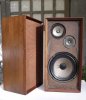
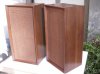

The grill slips under the molding and is held in place by foam strips along the edges that push it outward. You should be able to slip a putty knife or something like it under an edge and push it over and up. At least that's how the grills on my S-15s are put in.Well I just found some yesterday for 20.00 here is a pic. Hooked them up this morning to my SX-838 Pioneer and they sound pleasant enough.They look great. Have not yet figured out how to pull off the grill cloths, as they seem tucked under the edges of the molding and not flush with it. Whatever the grill cloth is made of I am not sure but they look like new.
I'll give them a spin for a while.
Uploaded with ImageShack.us
Uploaded with ImageShack.us


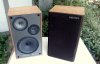
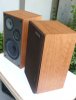
My third set of Scott speaker, free leftovers at an estate sale. No one wanted them as the cases were a bit battered. All the drivers worked and they sounded good with a couple of newer receivers. Stripped the veneer, repaired the cases, and veneered them with real cherry veneer. Pretty, and sound good enough to keep. Will need a sub with them, but they sound great with classic jazz records.
Before:
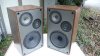
And after:
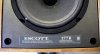
Before:
And after:

NH-MAN
Addicted Member
My third set of Scott speaker, free leftovers at an estate sale. No one wanted them as the cases were a bit battered. All the drivers worked and they sounded good with a couple of newer receivers. Stripped the veneer, repaired the cases, and veneered them with real cherry veneer. Pretty, and sound good enough to keep. Will need a sub with them, but they sound great with classic jazz records.
Before:
View attachment 1865690
And after:
View attachment 1865691View attachment 1865692View attachment 1865693
Wow, that is some nice veneer.

Go Giants
Super Member
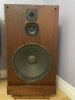
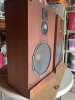
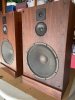
I bought a pair of S-17's a while back.From the early 70's . Beautiful walnut cabinets. Reminded me of AR4ax's . I was pleasantly surprised at the way they sounded.
I had a pair of these too. Cabinets were beat up, but all drivers worked. Even the tweeter control worked. They were dated 1972 and had the tweed grills.
They sounded really nice and I agree reminded me of AR4X's.
I would not hesitate to by vintage Scott if the price is right. They were as good, if not not better, than some of the more well known companies of the day.




CanadianJoke
New Member
Somebody said I should drop these here, so here's my brand "new" (to me) pair of Scott pro 70 speakers

I'll repost here what I posed in a separate thread:
Link to full album: https://imgur.com/a/pdhHZjX
There is scant information about these online, so I decided to make a post to inform as well as to see if anyone else knows about Scott speakers
These are from around 1972, Big heavy acoustic suspension design speakers. They weigh 50lbs each, with a real wood case. Features a 12" woofer, 4.5" midrange, and two 1" dome tweeters. There are adjustment switches behind a flip down wooden door to reduce the levels of the tweeter and the midrange by -3 or -6db, independently. The grille is cloth over wood.
As far as sound, I really really like these. They have that classic acoustic suspension smooth bass, and lots and lots of midrange. I like to keep the tweeter on -6db because the dual tweeters makes the treble a little harsh, but I think -6db makes it just right. Very nice to put on some R&B or Jazz, it can do rock and bass-heavy EDM music well too.
Overall, very happy with these for $200 CAD for the pair.
I'll repost here what I posed in a separate thread:
Link to full album: https://imgur.com/a/pdhHZjX
There is scant information about these online, so I decided to make a post to inform as well as to see if anyone else knows about Scott speakers
These are from around 1972, Big heavy acoustic suspension design speakers. They weigh 50lbs each, with a real wood case. Features a 12" woofer, 4.5" midrange, and two 1" dome tweeters. There are adjustment switches behind a flip down wooden door to reduce the levels of the tweeter and the midrange by -3 or -6db, independently. The grille is cloth over wood.
As far as sound, I really really like these. They have that classic acoustic suspension smooth bass, and lots and lots of midrange. I like to keep the tweeter on -6db because the dual tweeters makes the treble a little harsh, but I think -6db makes it just right. Very nice to put on some R&B or Jazz, it can do rock and bass-heavy EDM music well too.
Overall, very happy with these for $200 CAD for the pair.

Hobie1dog
subaholic
There are some Scott S 15 speakers that were just listed on craigslist for $225 todayI was given another pair of Scott speakers, S-15s, that had been stored in a garage for a long time. They were dusty but cleaned up nicely. Like the earlier smaller Scotts, they are a solid box, with great sound from a three-way speaker. The grill cloth was still in good shape and I've been able to find a pair of badges to put on them. Haven't opened them up, as they sound good in my small attic studio, but they sure are pretty to look at.View attachment 1746816View attachment 1746818View attachment 1746819

mitchalee
Active Member
I am listening to a pair of Scott S-15 now. These are excellent compact speakers. Some of the best. I would say close in sound quality to AR / Teledyne 's smaller acoustic suspension speakers. The fact that they may well be inexpensive house brand mysteries HH Scott had some other company make for them or other such historical curiosities, are just that: curiosities. They do not effect the excellent sound one whit.
The bass is accurate and deep enough for most music. The voices and very well reproduced. The instrumental timbre is sometimes a bit veiled sounding, but not much more than any other speaker under $750. Percussion is convincing with plenty of definition. And as I understand it, these were under $150. No bad!
Now, in all honesty, their strongest recomendation is that they are superbly non-fatiguing. Not often exciting. Not the last word in "you are there" illusions. But they have a sweet, open sound that is never strident, harsh, steely, or beaming. They image well, especially with voices.
Finally, they are quite narrow. Not towers, but thin enough to be placed on the sides on an actual bookshelf. And they are not deep. So their form factor allows easy placement. So in challenging installations, one has a good chance to approximate ideal placement which will make them sound incomperably better than harder to position speakers.
The bass is accurate and deep enough for most music. The voices and very well reproduced. The instrumental timbre is sometimes a bit veiled sounding, but not much more than any other speaker under $750. Percussion is convincing with plenty of definition. And as I understand it, these were under $150. No bad!
Now, in all honesty, their strongest recomendation is that they are superbly non-fatiguing. Not often exciting. Not the last word in "you are there" illusions. But they have a sweet, open sound that is never strident, harsh, steely, or beaming. They image well, especially with voices.
Finally, they are quite narrow. Not towers, but thin enough to be placed on the sides on an actual bookshelf. And they are not deep. So their form factor allows easy placement. So in challenging installations, one has a good chance to approximate ideal placement which will make them sound incomperably better than harder to position speakers.
Dannyboy311
Member
Pair of these near me in mint condition for $100, worth it?Scott Audiophile Bostonian FourView attachment 2137025View attachment 2137026View attachment 2137027View attachment 2137028
Specs on back rate them to 750watts at 4 ohms!!
200 nominal....

You could do a lot worse for the price, I suspect. You'll have deep bass (which seems to be somewhat overlooked nowadays - everyone seems to think that subwoofers are the magical and perfect solution) and some sense of imaging and simultaneously, airiness with the front drives in a row and the upward facing drivers adding ambiance.
It might be worth checking the caps to make sure they haven't drifted too far in value, but listen to the speakers first. If they sound great, why bother even checking? You can always do it down the line if you want.
It might be worth checking the caps to make sure they haven't drifted too far in value, but listen to the speakers first. If they sound great, why bother even checking? You can always do it down the line if you want.

Fomoco1649
Well-Known Member
Agreed… HH Scott was another smart American Audio engineer from Massachusetts & certain models & years were very good , mainly 70s….not sure who owned or who was running the company in the 1985 but I bought a mint pair of their Little 14 inch Audiophile Bostonian one speakers in original boxes plastic bags & owners manual, solid build quality rubber surrounds 6.5 inch woofers & they sound very good for their size, beautiful little keepers , another reminder of the quality back in the 70s & 80s….From my research, it appears H H Scott was swallowed up by a bigger organization that is obviously using the name and Scott's heritage value to now market junk. My bet is the plasma set was made in some nowhere factory in China by a bunch of 18 year old girls working for nothing.
Now back to "my" speakers. If they are ordinary, why did Scott construct such high quality speaker boxes? As I said previously, these babies are HEAVY and beautifully made. They, the cabinets , remind me of AR 2ax speakers in construction methods and size.
Has anyone info on sites I could visit or who made the actual speakers?
Hermon Hosmer Scott was one of the big names in the early days of HiFi and into the stereo era. Scott made a name for itself with their electronics, especially their tuners (Scott's first invention was a dynamic sound processor which deticked 78s so they could be played on air), and their tube stuff is still has very respectable performance (and the vernier tuning dials are cool as all get out). While perhaps not in the Marantz and Mcintosh realm (at least not in collectibility), it's close, and certainly in the same league as Fisher and Sherwood.
Scott also made a very interesting turntable, the 710, which used a cone shaped pulley, idlers, and a drum connected to a worm gear to create a variable speed turntable with a regular motor.
Scott's speakers were a side line for what was mostly an electronics company, but they benefited from that association since Scott was the first speaker maker that I know of who intentionally designed speakers with relatively uniform impedance, which made them easy to drive - I assume that Scott recognized that amps that aren't transformer coupled (like tube amps were) could have problems with low impedance dips. Such dips, which, in worst cases, can get close to a dead short, weren't unknown in speakers designed without awareness or concern for interaction with amps.
Keep in mind that these Scott speakers were coming out at a time when the market was practically owned by the big speaker companies - AR (which at one point had something like a third of the market), KLH, Advent, and for those who didn't care for the east coast sound, JBL and Altec. These companies had greater economies of scale, bigger advertising budgets, and were more likely to be chosen by people buying other name brand electronics. So as good as many of the Scott speakers are, they don't have the name recognition that equals collectibility nowadays.
HH Scott eventually couldn't compete with Japanese electronics, and was sold. Some of the subsequent owners have produced very good equipment, but some have not. Which muddies the waters.
By the way, be aware that HH Scott and EH Scott are two entirely different companies. EH Scott, who were out of the Chicago area, I think, was one of the top makers of radios in the 30s up to 50s, which usually came in large, luxurious consoles. They still have a devoted following, but shipping such consoles is ruinous - dangerous and expensive.
HH Scott was in Maynard, Mass.
One last thought: Scott employed Daniel Von Recklinghausen, a very talented engineer, who is the source of the immortal wisdom: 'If it sounds bad and measures good, it's bad. If it sounds good and measures bad, you've measured the wrong thing.'
Scott also made a very interesting turntable, the 710, which used a cone shaped pulley, idlers, and a drum connected to a worm gear to create a variable speed turntable with a regular motor.
Scott's speakers were a side line for what was mostly an electronics company, but they benefited from that association since Scott was the first speaker maker that I know of who intentionally designed speakers with relatively uniform impedance, which made them easy to drive - I assume that Scott recognized that amps that aren't transformer coupled (like tube amps were) could have problems with low impedance dips. Such dips, which, in worst cases, can get close to a dead short, weren't unknown in speakers designed without awareness or concern for interaction with amps.
Keep in mind that these Scott speakers were coming out at a time when the market was practically owned by the big speaker companies - AR (which at one point had something like a third of the market), KLH, Advent, and for those who didn't care for the east coast sound, JBL and Altec. These companies had greater economies of scale, bigger advertising budgets, and were more likely to be chosen by people buying other name brand electronics. So as good as many of the Scott speakers are, they don't have the name recognition that equals collectibility nowadays.
HH Scott eventually couldn't compete with Japanese electronics, and was sold. Some of the subsequent owners have produced very good equipment, but some have not. Which muddies the waters.
By the way, be aware that HH Scott and EH Scott are two entirely different companies. EH Scott, who were out of the Chicago area, I think, was one of the top makers of radios in the 30s up to 50s, which usually came in large, luxurious consoles. They still have a devoted following, but shipping such consoles is ruinous - dangerous and expensive.
HH Scott was in Maynard, Mass.
One last thought: Scott employed Daniel Von Recklinghausen, a very talented engineer, who is the source of the immortal wisdom: 'If it sounds bad and measures good, it's bad. If it sounds good and measures bad, you've measured the wrong thing.'