• The move to the new server is done. There are some software and database maintenance updates in process. This has us passing the hat around to help out. We appreciate any donations. Seriously, even a dollar helps. The payment page may be found here - https://www.audiokarma.org/support.html

Servicing a SONY DAT machine (Pictorial)

No need to replace the foam.

It ate your test tape because the cleaning fluid was not fully evaporated, making the headsdrum "sticky".

Go for the transport swabbing, take pictures and ask if you are lost.
I've done another swab, and it's all but fixed the distortion and dropouts. It didn't eat the second test tape as it recorded alright, just that the playback still yields distortion and dropouts, so I've concluded that the caps need replacing on the RF headamp, unless there was something I've missed.

EDIT: read further back in this thread, and I've seen that someone had a similar problem in the pro version of my deck, and managed to fix it by pulling the left guide fully home as it didn't fully travel around the drum as it should've done. Might have to check that out before I consider replacing the capacitors.
 
Last edited:
The key point is about the silver hook sliding on one of the 2 ring gears that "drive" the guides (parts #351 and #357 on drawing 5.8 in the service manual).

Usually it is stuck with old grease and can not slide freely. Levers #353 and #358 must also be cleaned to slide freely.

To clean seriously you have to remove the 2 ring gears which involves some work on the mecha (look at post #392 and #395, as the ZA-5ES has the same mecha).
 
Brought my old 60ES down from the loft at the weekend - it's been up there for around eight years, but is in pristine condition! Got it in 1996 and had light use for a few years, but definitely no more than 100 hours. It was fine when I packed it away eight years ago. I have a TCD-D3 (massive use and NEVER skips a beat, stunning reliability!) and two TCD-D100 units (which work, but have their niggles) so I didn't need the 60ES for a while. However, I would like to start using it again as part of my hifo separates system to save me always patching in one of my portables.

Anyway, back to the 60ES. When I first loaded up a tape it played, but no sound. I then ran an HP-DDS cleaning tape for 10 seconds and tapes played fine from then and all sounded wonderful. After about an hour of playing, I was going to try another tape but I could not eject the tape that was in there. I left it for a couple of days and tried again today and surpisigly tape ejected first time. I then played a few others, but eventually the same thing happened.

I opened case and managed to get tape out by winding the rubber belt by hand, but the eject button does not open tray - might well work again in two days, but hardly a long-term option ;-) I notice that when I switch on (no tape in now of course) there is fast spinning of something then all goes quiet. I still have lid off so I can see the transport and it looks to me like the tape loading machanism moves slightly but the two bits that move down in a curve from left and right (not sure of the techie term!) seem to start to move but get stuck. I'm guessing this might be a familiar story and I can see from other posts that perhaps I can solve it myself - perhaps it's lubricant that's gone hard, but I wonder why leaving it a few days appears to fix things at least temporarily? One other thing is that I noticed is that the little foam wheel that rests on the head was about to fall apart so I've removed it - it completely disintegrated when I rubbed it between my fingers! Didn't leave any residue on the head as far as I can see though. Btw, I notice from reading this thread that I maybe should not use DDS cleaning tapes - what should I use instead?

I'd love to get this unit working again as it sounds excellent and I have around 200 audio DAT tapes in my library. I'd really appreciate your thoughts.


Thanks in advance

Ian - UK

 
What you can (almost) easily do:
- remove the foam and all of its dust
- remove the mecha from the cabinet
- take pictures
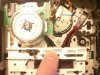
- try to turn with you thumb the black gear surfacing on the front right of the mecha, from left to right. It should extend the 2 bits (=guides) that load the tape arounf the drum. If you can not turn it either it is stuck with hardened grease or something is jammed.
 
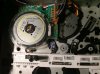
Had another look inside, and with my more-competent dad, he's discovered corrosion on the drum, and ruled out bad RF caps and stuck mecha.
IMG_3831.JPG
It's part number Y68VO. If all else fails, I'll either have to get it sent off for repairs or cannibalise another DTC-77ES or PCM-2700.

UPDATE: managed to fix it! Turned out it was just the drum that needed more TLC. Managed to get the worst off and it's sounding like a DAT should.
 
Last edited:
Great ! Congratulations !

Did you check the sliding condition of the silver hook on one of the ring gears ?
 
Last edited:
I've identified the cause of my troubles! One of the little white washers has come off (see attached pic). Consequently, the gear wheel had slipped off the rack which meant that one of the tape loading guides was stuck in the loaded position. Once I re-attached the gear to the rack everything worked fine when shuttling the white plastic tape-loading rack back and forward by hand.

Reading elsewhere on this thread, this appears to be a very common problem. I can see loads of these little white plastic washers elsewhere in the machanism and I know that others have found the broken part and swapped it with a working one from a component that is pretty much fixed and doesn't have the rotation of the part I've lost. Howevever, I've shaken the transport (very gently!) and can find no trace of the part. Anyone any idea if the part can still be ordered from Sony? If it is orderable, does anyone have any idea the part number and a contact number/address where it can be ordered?

Once I'd separated the layers I was pleased to see that everything else looks clean and tidy.

missing washer.jpg
 
You can buy replicas on Ebay but it costs ! (search for " sony dat bushing")

You can use some pieces of plastic with glue.
 
Thanks. You weren't kidding about cost, they are £7 each! They are from Switzerland though so must be good ;-) I'll probably order a couple so I have a spare for future.

Delivery might take a while though and I was thinking of moving a good washer from another area so I can use my deck. There are loads to choose from, is there one that I could take and leave off for a short time until my spare part arrives? The one I have lost is securing an upside-down item so is obviously essential, but perhaps there is one on a component that is the right way around where things would still be OK for a short time without fiddling with plastic and glue.
 
I found a bush that appears not to be critical (although I will order one and replace it) and moved it to the missing part (see pic1). I now I have a new problem - actually, I think it might be an old problem and perhaps the reason the bush came off in the first place. Once I had put the transport back together, I tested the movement of the guides by hand using the black wheel at the bottom right. Both guides move smoothly up to the top, but when I start to wind them back down, the right-hand guide almost immediately sticks (see pic2). If I pull gently on the roller then it does move all the way down again. Something is obviously catching. Note that this is the guide that had lost it's bush so I suspect this catching might well have been the cause of the bush coming off in the first place.

Not quite sure why, but if I hold the transport upside down then the guide does not catch at all. Not sure if that helps anyone shed light on why it might be catching, but this appears to prove that the problem does not lie in sticky gears. In fact, to prove this, I've just separated the layers again so the gears are disengaged - I can now slide the white plastic part (see pic3) back and forward using my finger and it sticks in normal orientation, but does not stick at all when I hold things upside down.

Just watched a YouTube guide by Splodge (
) where he talks about the allignment of the plastic guide rail when it meets the short metal guide rail near the top. I feel that the catching happens right at the end of the guide arm movement - there would be some travel back down before it hits the metal/plastic boundary so I'm not so sure its the positioning/alignment of the metal rail that is causing the problem.

Anyone have any ideas?

pic1.jpgpic2.jpg pic3.jpg
 
The guides slide on black plastic rails embedded on the chassis. Sometimes the rails break or sometime the rails move and so are misaligned with the metal "shoes" that hold the guides at the end of their travel. As you can not move the metal shoes you can try to file a bit the black plastic rails.
 
Thank you, I'll try that. So far I've had it easy, I've only had to remove the six screws that hold the two 'layers' together. Is it more of a strip down to get at the plastic rails you mention in your message?

I can't thank you enough for responding so quickly, it is very much appreciated! I'm so keen to get my 60ES running again - I suppose it will be all the more rewarding if I need to carry out various bits of surgery to achieve my goal ;-)
 
You don't need to remove anything else. The black rails are clearly visible on your third picture. It the surface on which each guide slide.

Use a file to make the path a little wider where the guide is blocked.
 

Attachments

  • rails.jpg
    rails.jpg
    126.3 KB · Views: 57
Sorry to ask more questions! The metal & plastic rails appear to be exactly in line. Pic1 shows the guide that's jamming when I move guides by hand by sliding the rack. It is on a hair trigger as a little pull of the white roller 'unsticks' it - also turning the assembly upside down there is no catch at all - but it's enough to stop the right-hand-side guide returning to the bottom :-(

I have two questions:

1 - Can the white roller head be removed without causing trouble? See pic1, I have circled the part in yellow - there appears to be only a single small screw holding it on (blue arrow), although there is also a tiny plastic notched pin (pic2 blue circle) on the other side holding it in place.

2 - Unfortunately, it's the right hand guide so I can't see underneath due to the component circled in yellow in pic2! Not sure what this is - can it be removed safely?

Carrying out both of the above should let me see more clearly why tapes won't unload due to right-hand guide sticking, but I don't want to cause more problems by removing something I shouldn't! I'm so close to getting this working it's driving me mad! Note that when I put the transport back in, it loads and plays a tape just fine (crystal clear, no distortion - as you would expect from a machine with no more than a few hundred hours plaing time), it's just that when the tape is finished I can't unload to play another.

Thanks again for your help.

pic1.jpg pic2.jpg
 
Maybe the rails are deformed not in wide but in height. Or maybe something is jamming on the roller assembly itself.

You can remove the roller assembly (not the roller itself !) by removing the "blue" screw. I don't think it will affect the tracking but keep in mind that it is screwed in plastic so don't apply too much strength when replacing it and it is not easy to reassemble.

I would remove the roller assembly differently: remove the metal shoe at the end of the path (2 screws), disconnect the roller assembly from its lever from under (what you colored in blue in you second picture, you will need to remove the white geared part first), extract the roller assembly though the shoe hole. Check the roller assembly.

The component in yellow is the capstan motor. You can remove the capstan assembly by removing 3 small screws from above (the other side of the picture).
 
On Saturday I removed the capstan so I could see everything clearly - everything was intact for both guides With the capstan removed and everything checked, still the right-hand tape guide would stick when in the fully loaded position! I then disconnected/removed the following components for the right guide-assembly:

- metal fork tape guide at the top of the guide channel (two black screws)
- little metal shoe/roller assembly (has a super fiddly/delicate plastic attachment to metal arm!)
- arm with thin metal plate that moves the guide and roller

All were connected properly and nothing was broken - I paid close attention to the tiny white plastic bushes that secure various components to the plastic axles. The whole guide mechanism does seem really flimsy and I'm not surprised there are reliability issues on ageing desks, but nothing appeared broken. I reassembled everything and lo and behold, no more sticking! I didn't really fix anything so I'm not so sure this will last, but let's see how it goes.

I'm now on the lookout for a Sony PCM-R500 - apparently it has very good build quality, a 4 direct-drive motor transport and has excellent A/D and D/A converters! EBay, here I come ;-)

One last thing, I've been playing loads of tapes since fixing the load/unload issue on Saturday and I have to say the 60ES sounds very sweet through my Sennheiser HD414 'Anniversay Edition' headphones. I should also point out that some of these tapes were recorded on the 60ES, but I've tested many others that were recorded on my TCD-D3 and TCD-100 portables and all play perfectly with no drop-outs or digital noise anywhere. One of the tapes (Roger Waters 'Amused to Death') was the very first digital copy I made of a CD to DAT on my D3 in 1991 and it played on the 60ES perfectly too! Btw, the vast majority of my tapes are HP DDS1 60m & 90m from late 90's and I have had almost zero problems with them at all over time - the Waters tape is now 25 years old so perhaps DAT tapes have better longevity than we have a right to expect from a ferric-coated plastic reel of wafer-thin tape pulled past a rotating head!

Thanks everyone for your help, it was much appreciated.


Regards
Ian
 
From my experience Sony DAT decks sound really really good, especially the 55ES and the 1000ES.

The R500 is a totally different deck. Its mecha is an evolution of the 1000ES. The rotary encoder is replaced by "regular" switches.

The 4 DD mecha, in both versions (1st edition 1000ES and evolution 77ES/ZA-5ES/2000ES/R500/R700...), is very smooth and reliable, quite easy to work on and without any exotic parts that needs to be replaced (beside the rotary encoder gear but you can now find newly built replacement).

The 4 DD mecha "evolution" is not prone to suffer from old grease except on one specific location: the silver hook that is supposed to slide on one of the ring gears that moves the guides. 100% of the decks I have serviced were suffering of that problem. The main symptom is a not fully engaged left guide (S1) thus generating some drop-outs in sound.
 
Many thanks once again. I'm afraid it might be some time now before I attempt these repairs as I am abroad but will definitely take your advices once again and will report back with my progresses :). Much appreciated and very grateful.

Hi everyone,after some weeks I managed to get back to my DAT servicing.I have a few observations & questions please:
1: DTC-750...SUCCESS! YES/NO.
YES: Transport is working fine again after hours of trial and error. It was down to cleaning the brake lining around the spool carriers and also (more important), adjusting the toothed belt that drives the tape reels. Question: Why is it that this belt has to be so loose otherwise nothing works?
NO: Am struggling to get rid of distortion that I am picking up especially when levels are high. Sounds kind of fuzzy at times? Not sure how to explain but any help from you guys what I can test for to find a fault somewhere perhaps with a scope might sort out this issue please. I have checked the guides alignment and believe I have adjusted them to the best I could with a scope, I have also recapped the RF amp as 4 out of 6 caps had high ESR. What;s causing the distortion during playback? Is it the head that's possibly going faulty? I have tried the mechanism with a different main board (PCM-2300) that I have as spare and ruled out a fault on the board.

2: PCM-2700: I have a working PCM 2700 (thanks to this forum) which I managed to fix after rescuing it from ending up at the dump! Am I right in noticing that it's a superior sounding deck compared to the DTC-750? The transport is so much more reined and quiet when winding a tape however the PCM-2700 refuses to accept any DATA tapes. It won't even wind them.Why is this happening?

Finally I have a challenging and hopefully not a stupid question but will go for it:
Can i modify the PCM-2700 to give me the capability of making Timer Recordings? Basically how can I make use of the Remote switching to function as a Timer (Rec/Play) function? In other words how can I convert a pcm2700 to have the timer function of a 77es?
If I manage to modify it in such a way I can happily take the DTC-750 out of service as the PCM-2700 is a superior machine.No need of having 2 machines rigged up, especially if I manage to set up the PCM to accept DSS tapes.

Thanks everyone
 
Last edited:
Back
Top Bottom