• The move to the new server is done. There are some software and database maintenance updates in process. This has us passing the hat around to help out. We appreciate any donations. Seriously, even a dollar helps. The payment page may be found here - https://www.audiokarma.org/support.html

Shibata on an M91ED? Why not!

ND says (via eBay) that he'll refund the EVG/Sanyo 614-DQ. I've shipped it off. Then I asked him if mine was typical of his stock, wondering if he got a bad batch or maybe even counterfeits. He hasn't answered; he might not have the time or the wherewithal to check.
 
Very good news on your EVG 614-"DQ". Stylus retailers are indeed sometimes unintentionally sabotaged by distributors who don't know all the little ins and outs of the thousands of styli they handle, and I've seen it happen. Then too, the Pfanstiehl index is sometimes too coarse to differentiate between all the variants. I expect the former is the case here.

As for CD-4 being cut at a lower level, my limited library of Quadradiscs (which I play in stereo) tells me this is true. I can imagine several reasons why this might be: velocity limitations of the cutterheads available at the time; avoiding IGD/tracing problems by keeping the smallest modulated radius as large as possible; avoiding damage by conventional styli by never coming close to their tracking limits.

Because of this, I find Quadradisc releases very satisfying in stereo (as long as they're kept meticulously clean), which is why I buy them.

Doug G. is our resident Quadradiscist and if he sees this, he will disperse the cloud of ignorance I've just laid down.

UPDATE/BUMP: Calling Doug G...
.
 
Last edited:
[snaps fingers] That's right-- I've got a separate question for Mr. Daddy that's waiting for his return. I tried explaining it to his assistant but I think I only succeeded in frightening her. That's okay, I had to at least try.
 
Last edited:
A June 1977 JAES paper by Shure's Allen Groh ("The Dynamic Vibration Absorber Principle Applied to a High-Quality Phonograph Pickup")[dead link] details the compromises necessary/possible when designing a Shure-type cartridge intended for both CD-4 and normal stereo and may help explain why the M24H's low-frequency tracking ability is as low as it is. This paper is cited as support of the assertions in the 1978 Shure Technical Seminar (see link in post #68).
 
Last edited:
Thanks for the link. I see what you mean. They need damping in the suspension to control HF resonance, but that same damping looks like stiffness below 1kHz.

I wonder if the N24H uses the discrete-mass dynamic damper, or the distributed version. I seem to recall that the former was also used in the V15-III, and the latter in the V15-IV.
 
I think they also mention it, if not directly answer your question, in their 1978 Technical Seminar (abridged version in the May and June 1978 issues of Audio).
 
Last edited:
They imply that the discrete construction was an experiment which led to the distributed one, which was then used in the V15 III and IV and the M24H. (Probably the V15 V too but that came out after the paper.)
 
I think the elaborate damping scheme, like some of the other elaborate engineering solutions Shure chose for the Type IV, were rendered unnecessary by further thinking and some fancy metallurgy in the Type V. Don't quote me on that; I still have to find the source of what I think I read awhile back. But it does make sense, at least to me. In fact, trying to get away from the complexity and fiendish production challenges of the IV probably led them to say "Dammit, let's ditch this aluminum cantilever entirely!"
... Meanwhile, those still wanting an affordable if not hilariously cheap line-contact stylus for their M91Es and EDs should look for the Astatic NMR Series, allegedly JICO-made version of the Shure N97LT. Astatic called it the SH154-qd.
 
Last edited:
I don't know. The beryllium foil cantilever moved the primary resonance clear out of the audio range, but it would still need damping, right? Which if applied in the main suspension would hurt LF trackability as much as ever.

I bought a JICO N97LT some years ago. It's a decent-looking bonded HE tip on telescoped aluminum cantilever. At least I trust it's an HE - I don't see any cuts, so it's ground, not just tumbled. More than $46 though, even then.

Avoid Pfanstiehl 4773-DHL. They forgot how to align the tip, the cantilever is massive and over-long, and the bonding post is the biggest I've ever seen. I wrote it off; I won't even use it on beaters.
 
Thanks for pointing out that the JICO N97LT has a hyperelliptical diamond (though at a higher price). At the moment, it's $80 shipped from JICO. I don't see telescoped cantilever construction, though.
.
 
Last edited:
I can't see it in their picture either. They could have cheapened it since I bought mine, but I think the picture looked the same back then as now. Mine is definitely telescoped. It also uses a Shure-style tension wire, and, if I recall correctly, a square magnet. I'd say I got what I paid for. Makes me wonder what's behind the higher price on their N95HE. I've never gotten a straight answer to that kind of question.
 
Very interesting about the telescoped build. If you still have that stylus, plus a camera with good macro capability, take a photo of it sometime, and I'll put up a photo of the Astatic. If you don't still have it, we'll just have to use our imaginaaaaations, as Spongebob would say.
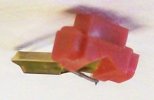
 
Very good news on the EVG 614-"DQ". Stylus retailers are indeed sometimes unintentionally sabotaged by distributors who don't know all the little ins and outs of the thousands of styli they handle, and I've seen it happen. Then too, the Pfanstiehl index is sometimes too coarse to differentiate between all the variants. I expect the former is the case here.

As for CD-4 being cut at a lower level, my limited library of Quadradiscs (which I play in stereo) tells me this is true. I can imagine several reasons why this might be: velocity limitations of the cutterheads available at the time; avoiding IGD/tracing problems by keeping the smallest modulated radius as large as possible; avoiding damage by conventional styli by never coming close to their tracking limits.

Because of this, I find Quadradisc releases very satisfying in stereo (as long as they're kept meticulously clean), which is why I buy them.

Doug G. is our resident Quadradiscist and if he sees this, he will disperse the cloud of ignorance I've just laid down.

UPDATE/BUMP: Calling Doug G...
.

Sorry, you guys, I was following this thread but somehow spaced it out and thought it was a different one and then...

Anyway, what you say about quadradiscs is generally true. Also, they wanted to keep the modulated radius as large as possible for the sake of the ultra sonic engravings (15-45kHz) as they are, of course, more difficult to trace-the reason for the very subject styli. Bass frequencies are also attenuated on most CD-4 records as it was thought that the larger excursions of the stylus would upset the tracking of the ultrasonic frequencies too and it was necessary anyway to scrunch up the grooves.

I have always thought most of the reasoning here was needless worry, however, because there are a few CD-4 discs which have normal distribution of groove size and spacing across the sides and they work just as well as the "skinny recorded groove area" ones.

The cutterhead limitations (they actually overheated them from the ultra sonic frequencies attempting CD-4 cutting, originally) were dealt with by cutting the masters at 1/3 or 1/2 speed. So then, they were only working out to normal audio-type frquencies.

This continues to be a very interesting thread and I'll try to keep up.

:D

Doug
 
Thanks for the CD-4 info, Doug, especially the bass rolloff part. Oh, and the Astatic "N97LT", another stylus to try in your M91E or ED:
Astatic-Jico replica of N97LT, down to the telescoping cantilever.jpg
 
Last edited:
Very interesting about the telescoped build. If you still have that stylus, plus a camera with good macro capability, take a photo of it sometime, and I'll put up a photo of the Astatic. If you don't still have it, we'll just have to use our imaginaaaaations, as Spongebob would say.

Sorry for the slow reply, Postini quarantines AK notifications no matter what I tell it. I don't get to turn it off, it's a work account.

I've been meaning to take some photos. I'll put them here, but do you have a favorite "stylus closeup" thread I should dupe them to?

Dave
 
NeedleDaddy 614-DQ is not Shibata but he won't admit it

A while ago I bought a 614-DQ from NeedleDaddy, so I could play with a Shibata stylus. When I put it under the microscope it was immediately clear that it was not a Shibata after all, but a perfectly ordinary two-cut elliptical per 1966 Grado patent 3,292,936. I asked for, and got, a refund. I asked, "Is this an isolated bad part, or was the whole batch mislabeled?" I was told the owner was out of town.

Today I repeated my query. The reply was immediate and polite, but disappointing.

"We'll have to agree to disagree."

So, he refunded the purchase but will not acknowledge that there's a problem. I expect we will continue to see ads for the soi-disant "Shibata" 614-DQ.

It's a pity. Beware.

Dave
 
Thanks for the update!
At least it's a really good elliptical.
AKer hakaplan mentioned back in a 2007 thread that the JICO N110HE stylus had a small-diameter telescoped cantilever. So I've been selling JICO short-- they did, at least at one time, go the extra mile. I wonder if they're still making it that way. The JICO website photos aren't always accurate-- they show aluminum cantis to illustrate their SAS styli, after all.
 
Last edited:
I can't let y'all have all the fun. I just ordered a Shibata from Merlin and will try it on my RXT4, and maybe a Shure P mount if I get one :thmbsp:

I love the way people here think, both inside the box and outside the box :yes:
 
Back
Top Bottom
