• The move to the new server is done. There are some software and database maintenance updates in process. This has us passing the hat around to help out. We appreciate any donations. Seriously, even a dollar helps. The payment page may be found here - https://www.audiokarma.org/support.html

Sibilance and counterweight/tonearm decoupling

flavio81

Turntable technician
This post is dedicated to @cafe latte and @Pio1980 who constantly try to improve their system by tweaking.

Yesterday i dusted off my PL-41 turntable with SME 3009 II non-improved tonearm.

Well, i fitted the Grado Red1 (actually a Grado Signature XTZ with a Grado Red1 stylus), and i was getting some sibilance on records that normally played fine...
Thinking that the stylus was perhaps a bit worn, i swapped with a Grado Gold3 stylus, completely brand new, yet i had the same problem.

Thus I swapped for an "easier" cartridge: I got hold of a my AT VM510CB mounted on an Audio-Technica LH11H headshell, a premium, very nice headshell.

Well, the problem was still there. For example I tried "Hall and Oates: Rock and Soul Volume I", and most tracks had sibilance. Other records had the problem so I immediately thought something was wrong, wrong. This time i coudln't fault the stylus, there are no more than 50 hours on that sytlus. Tried more VTF, tried realigning overhang. The problem was still there.
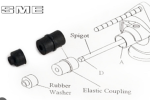
I recalled Alex Korf's great tonearm vibration analysis and how decoupling the counterweight can be of benefit. And the SME 3009 II originally has two rubber "elastic couplings" to decouple the counterweight assembly:
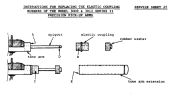

1719246508763.png

However on my tonearm it was replaced with the aftermarked teflon coupling (see example picture, below):

1719246578186.png

This teflon coupling is much stiffer than the original rubber coupling.

I am using the vtf adjuster outrigger, so the combined counterweight is in its heaviest configuration. Thus I thought that the energy from the stylus was exciting the tonearm resonances and causing mistracking.

The first thing I did was to try creating a makeshift spacer using a ca. 1mm thick foam sheet between the cartridge and tonearm, and then screwing the cartridge very gingerly into the headshell, so it is supported by the foam sheet itself, "floating" thanks to its compliance.

In doing this i was making a makeshift cartridge isolator, similar to "The Cartridge Man's Isolator" (sample pic below)
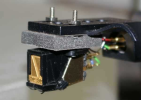
1719246849577.png


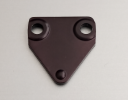
Or to Joseph Grado's tonearm decoupler:
1719247340866.png

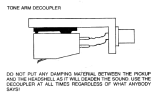
The idea is to prevent the high energy of the sibilants to excite the tonearm resonances. Joseph Grado, who did know about tonearms (he wrote a nice article on tonearm design), put this in the instruction manual for the Signature series:
1719248912499.png
Well, back to the experiment with my makeshift decoupler:

Now the first, 2nd and 3rd tracks of the Hall&Oates record were tracked almost cleanly. Then I tried other records that were challenging (specifically, i tried records with choirs / background singers at the inner grooves -- and settled on "Vai Passar", Chico buarque, last track, at the inner grooves. Listen to it.). The problem was still there, but significantly diminished. Now it was only present at the inner grooves on challenging tracks, and now it wasn't exactly heard as sibilance, but rather what sounded like high harmonic distortion on vocals. A form of mistracking, i guess. This problem was also present before using the foam sheet on the headshell. The sound would be acceptable to some people, but to me it was evident that it was a problem.

Note that the VM510CB cartridge has a conical stylus so we're stretching the frontiers of conical tracking here...

So, first message to my friends: this thing (cartridge isolation) works. I am a witness.

NEXT STEP

Now, I theorized that SME engineers know much more about counterweight isolation than me, and fortunately i had the original, new, rubber "elastic coupling" ready for installation. I mean, these little grommets:
1719247535281.png

Thus, i removed the teflon coupling and installed the elastic couplers following the SME service manual. Now my SME was restored to factory spec.

I set the cartridge at 2.0g VTF as per the specs and...

Massive improvement!! Now even the inner grooves appeared to sound good. Even tightening the cartridge on the headshell (thus coupling it more to the headshell) the performance was good. "Private Eyes" (track), near the inner grooves, is rendered as good as I've heard with any other conical on my other turntables. The "Vai passar" track had much less of the harmonic distortion. It sounded clean at the female chorus near the end of the record (90mm radius --distance from the spindle) and good (okay) at the final chorus at the last grooves (70mm radius). Considering that this is not a brand-new record, and I have used it with various cartridges and tracking forces, this is sounding as expected for a conical stylus and i've no doubt that if I fit a microLine again, it would track cleanly.

And on the rest of the record, completely clean tracking. The VM510CB conical is a fantastic value for the money, and I say this as somebody who also had the VM540ML to compare with.

So, bottom line -- don't mess with the counterweight decoupling on these tonearms, i guess!!
 
Register to hide this ad
PS: Swapped the AT-VM510CB for an ADC XML II Improved with brand new original stylus, never used. VTF=1.25gm. Now on a different headshell, no "isolator" foam cushion between the cartridge and headhsell.

That is, i'm changing the bonded conical for a state-of-the-art (still in 2024... how little things change) diamond-on-sapphire ellpitical needle.

"Vai passar" now tracks cleaner at the end of the song, still with a very slight grainess I would attribute to groove damage and would dissappear with a microline.

Hall and oates' "Private Eyes" now tracks 99% cleanly, still a very very small hint of graininess, that again, i'd attribute to groove damage.
 
hm, makes me wonder if there is anything to be had by sticking a rubber grommet or O ring or something between the SAE-1000 and the headshell on my MicroTrak arm. easy enough to try, its not like there is any alignment to fiddle with there.
 
Y'know it's funny: hard mounting the CW is one of the most common and effective upgrades for Rega arms. Those little rubber O-rings are doing the arm no good. But, the SME is completely different from a Rega, so needs different fixes to control resonances .
 
hm, makes me wonder if there is anything to be had by sticking a rubber grommet or O ring or something between the SAE-1000 and the headshell on my MicroTrak arm. easy enough to try, its not like there is any alignment to fiddle with there.
Empiric testing. Sometimes, it's the best path to success! :thumbsup:
 
Y'know it's funny: hard mounting the CW is one of the most common and effective upgrades for Rega arms. Those little rubber O-rings are doing the arm no good. But, the SME is completely different from a Rega, so needs different fixes to control resonances .

As the owner of a RB303, this is relevant to my interests.

But it depends on what you're listening for. For example i saw some days ago a youtube comparison of a Rega P3 versus a SL-1200MK5 (or was it MK7)? With audio clips.

The youtuber was raving about how much clearer high frequency detail one got with the Technics. While for me it was clear that the Technics tonearm had a some colorations and ringing at the high frequencies...

I've seen that the michell counterweight and another aftermarket counterweight for the Rega tonearm are solid coupled. But they make me scratch my head a little bit. Are we really getting closer to the original recorded sound?

For example when I compare a good conical cartridge like the AT-VM510CB to a good MC like the OC9XML, the former produces an exciting, punchy sound. Totally likeable. However the latter is really telling it like it is. This on my system. And even comparison videos on Youtube, which compare a better VM540ML with a OC9XEN (not quite a XML), show exactly this: exciting punchy sound vs natural sound. It is alright to have preferences, of course.

Alex Korf's vibration testing of a RB300 tonearm shows the vibrations at mid and low frequencies were very, very well controlled on the stock arm. These are the ones that are normally affected (in a positive or negative way) by counterweight decoupling.

And that the only problem on the RB300 was with headshell vibrations (at high frequencies, circa 10KHz).

1719385266731.png

If you follow alex Korf's blog you'll see the vibrations for the RB300, from about 1000Hz down, are exemplary, just perfect. And this is the old RB300, not the improved RB303 or yet improved RB330 or the higher end models.

For headshell vibrations, following Korf's general recommendations, a ceramic headshell spacer would be perfect. Or, and this is my conjecture, a makeshift foam/etc spacer could perhaps also work.

Considering that Korf's credible analysis show that counterweight decoupling (or coupling) works for the low part of the resonance spectrum, i can't see how what it is vanishingly slow could improve. I am placing my bet that it would not improve, and whatever sonic benefit is heard might not be what was in the master tape.

I recall the online reviews of the SME 3009/III -which I also own- and often the words are "dull", "lifeless", "boring". Yet when Stereophile reviewed it in the late 70s, this was the result:

"the arm is almost completely free from resonances (... ) Our experience with the SME 3009 III over a period of several months has shown that most cartridges produce a more tape-like sound in this arm than they do form any other arm (...) The SME is still our first choice and, as of now, our reference arm for all phono cartridge tests"

Thus, i'm not very convinced that removing the rubber decouplers on the Rega counterweight would bring the sound closer to the original recording. But perhaps one day i'll try.
 
Regarding putting something soft/dampening between the cartridge and tonearm I am sceptical.
Everything that introduces any kind of possible movement between the stylus, except for the movement from the music in the record grove, and the platter is a no-no for me. If I understand correctly a damping plate in the cartridge mount will do this to some degree.

Damping the counterweight I can understand may have its benefits since it does not compromise rigidity between stylus and platter.

Maybe damping the counterweight helps solving problems caused by a bad/loose tonearm bearing where vibrations causes issues?

Rigidity ftw!
 
Regarding putting something soft/dampening between the cartridge and tonearm I am sceptical.
Everything that introduces any kind of possible movement between the stylus, except for the movement from the music in the record grove, and the platter is a no-no for me. If I understand correctly a damping plate in the cartridge mount will do this to some degree.

Damping the counterweight I can understand may have its benefits since it does not compromise rigidity between stylus and platter.

Maybe damping the counterweight helps solving problems caused by a bad/loose tonearm bearing where vibrations causes issues?

Rigidity ftw!

I would tend to agree. the resonances originating at the cartridge should be allowed to exit through the arm and damped or controlled at the chassis. Most of the ultra high end tables are now doing everything they can to damp these resonances. Same would be true in the opposite direction through the record and into the platter.
 
Dual tried a similar counterweight decoupling back in the 70’s with their “2x anti-resonator” design:

IMG_6378.jpeg

Complicated looking cutaway picture for what is essentially a weight suspended on the end of a leaf spring inside the main counterweight body itself.

Supposedly effective but quite delicate and reportedly many were replaced under warranty for the spring fatiguing/breaking (probably some owner mishandling as well).

If you believe Dual’s ad hype of the time, it was “tuned” to a specific tone arm and deck for each model. They had several different looking weights, probably as much about individual table styling choices as it was tone arm differences. I certainly can’t confirm or refute their claims, I’m not that type of engineer and even if I was I wouldn’t have the resources at hand they would have back then.

I have a “2x anti-resonator” from a 701 on my 1229Q and I’m pretty sure I noticed a difference when I installed it. If I did though, it was fairly small. Potentially the placebo effect as I wasn’t making measurements but rather just subjectively listening.

My 1249 also has a suspended counterweight, but its a much simpler design. I haven’t had it apart, but the 1249 feels like the “floating” part of the weight is rubber mounted as opposed to the more complicated method on the “2x”.

But “sprung” counterweight are a thing apparently. Or at least Dual messed with it for a while. How it’s implemented (ie: spring, rubber, etc) is the question though.

I would think if someone had a custom tone arm, it would be worth messing about with a couple “anti-resonant” methods at the counterweight. Would be a fun/interesting little “trial and error” experiment.

Assuming things like alignment, vta, vtf, good recordings, etc is already sorted out.
 
Last edited:
I tried a few approaches and different materials for counterweights on my DIY arm.

The sorbothane counterweight is pretty drastically different from anything else I tried. It seems to substantially reduce anything that makes it past the stylus/cartridge and into the arm from reflecting (back to the stylus). I'd characterize the sound as very neutral and perhaps even digital like, less like vinyl. It even excelled at minimizing pops and ticks but didn't seem to bother real dynamics in the recording.

But some that listened prefer the directly coupled steel counterweight, I think for the same reason some people prefer vinyl to digital.

tonearm_longer_wand[1].jpg
 
As the owner of a RB303, this is relevant to my interests.

But it depends on what you're listening for. For example i saw some days ago a youtube comparison of a Rega P3 versus a SL-1200MK5 (or was it MK7)? With audio clips.

The youtuber was raving about how much clearer high frequency detail one got with the Technics. While for me it was clear that the Technics tonearm had a some colorations and ringing at the high frequencies...
Do you remember the YouTube title or address of this video? I'd would be interested to see (and hear) it.

Thanks!
 
I have used AT-OC9MLii and AT33PTGii (both microline) and never hear any disturbing sibilance with my SME V. Here with Wallys Fulcrum for Azimuth adjustment
oc9ml2 wally.jpeg
and not with my Denon 51F with Technics 270Cii with Tonar hyperelliptical, and not with Shure V15 IV with Jico SAS/b.
Maybe I cannot hear sibilance?
 
I have used AT-OC9MLii and AT33PTGii (both microline) and never hear any disturbing sibilance with my SME V. Here with Wallys Fulcrum for Azimuth adjustment
View attachment 3236189
and not with my Denon 51F with Technics 270Cii with Tonar hyperelliptical, and not with Shure V15 IV with Jico SAS/b.
Maybe I cannot hear sibilance?
Some sibilance may be in the original recording, and bad tracking can worsen this sound. Many times, the mics were recorded as too "hot."

Some people hear nasty sibilance with Michael Jackson's "Billie Jean" on the original EPIC pressing. "S" sounds like "dance," "she caused a scene," "she just a girl," "the child's not my son."

This is a heavily modulated track, so-called "Hot." I think most of the sibilance is in the original master.

No other song on this excellent album displays sibilance.

I noticed that heavily modulated tracks display this characteristic pattern, which follows the bass and drum lines.

The cartridge dances in rhythm with these grooves. This clip, uploaded in HD, shows the track patterns and cartridge response.

Billie Jean.
Off "Thriller." EPIC QE-38112. Pitman pressing. 1982.
Runout: PBL 38112-2AH P.
 
Last edited:
Highly modulated bass may excite the fundamental resonance. A tonearm with higher mass in the horizontal axis (e.g. the Moerch DP-8) may fix that dance.
 
There is one aspect on aged and deformed decouplers that often is missing in discussions like these.

Once the back end of the arm starts sagging due to aged decoupling rubbers, it has lost its damping. What happens is normally one of two things: The first is that the rubber disintegrates, leaving the metal parts of the arm tube and the counter weight back end more or less in direct contact with each other, possibly also dangling loose. The other variation is the rubber instead drying out to something much harder. Both of these result in loss of the isolation the arm was originally designed for. So, a sagging back end on a tone arm is not only a cosmetic problem, but always a sure sign of lost damping of arm resonances.

My impression is that modern arm designs tend to have less of isolation/damping in the arm than what was common in the 70s to 80s. The idea nowadays being that the vibrations in the arm shouldn't be damped, but instead be transmitted out of the arm, into the deck. I think the old Lenco arms are a good example of the old isolation/damping design going astray, messing up dynamics and timing.

When dealing with vintage arms one could experiment with different degrees of isolation, to see what happens with resonances and dynamics, but in general I think it is best to stay close to the original design. SMEs weren't designed to carry the vibrations out of the arm, but to damp them in the isolation rubbers - excessive undamped vibrations in the arm tube do probably cause the knife edge bearings to chatter. In this situation, even a Grado cart isolator could be an improvement, despite going against everything sacred in modern tonearm design.

By the way, I'm currently busy experimenting with new replacement rubbers for the mk I SME arms. Tricky bastards, those. A rubber isolator with a brass tube insert, with the tube providing stability and the rubber doing the isolation, all kept in place with a long screw from the back (no glue, as in the mkII). I can certainly see why folks have been tempted to gloss over those particularities by just turning replacements in nylon instead.

If my experiments work out as I hope I'll possibly make a couple of variations of them, with the rubber part in silicone or polyurethane rubbers in different Shore hardnesses. I think e.g. carts with high or low compliance, or long or short arm tubes could benefit from this. But i don't expect to be able to advice on where to use what...

The mk II dampers shouldn't be any problem to make in a couple of similar variations too while I'm at it.

Does somebody here know how the 3-part back end of the "improved" ones could be taken apart without breaking anything? Those do often sag badly, and they seem to be more or less riveted together.
 
Last edited:
I've seen that the michell counterweight and another aftermarket counterweight for the Rega tonearm are solid coupled. But they make me scratch my head a little bit. Are we really getting closer to the original recorded sound?
Not just Michell, but just about every other aftermarket provider extant. At most it's metal on metal; at least it's a hard plastic like nylon, teflon or acetal.... similar to the mod made to your SME. None that I'm aware of retain the soft compliance of the original....they can't all be wrong.

What i listen for is details in the background instruments where the harmonies and rhythm play against the melody. I like punch, too, but not in violins or saxophones where the sound can become strident. It might affect some recordings in this manner but the recording in question is often recorded digitally or is not the best to begin with, and I'm not willing to give up background clarity on all records to render a few more listenable.

As to why the modification works with Rega arms I'm not sure, but I have a feeling it has to do with what Korf describes a headshell resonances. These not only result in frequency domain peaks but smear the time domain resolution that reveals tiny dynamics....and big ones like punch.

Btw, if you want to explore a mod to remedy the shell resonance check out the thread below that decribes it in detail: It is fairly cheap, accessible and fully reversible, and will give you an idea of what the CW mod can bring to the sound.

https://www.canuckaudiomart.com/forum/viewtopic.php?f=32&t=42239
 
As the owner of a RB303, this is relevant to my interests.

But it depends on what you're listening for. For example i saw some days ago a youtube comparison of a Rega P3 versus a SL-1200MK5 (or was it MK7)? With audio clips.

The youtuber was raving about how much clearer high frequency detail one got with the Technics. While for me it was clear that the Technics tonearm had a some colorations and ringing at the high frequencies...

I've seen that the michell counterweight and another aftermarket counterweight for the Rega tonearm are solid coupled. But they make me scratch my head a little bit. Are we really getting closer to the original recorded sound?

For example when I compare a good conical cartridge like the AT-VM510CB to a good MC like the OC9XML, the former produces an exciting, punchy sound. Totally likeable. However the latter is really telling it like it is. This on my system. And even comparison videos on Youtube, which compare a better VM540ML with a OC9XEN (not quite a XML), show exactly this: exciting punchy sound vs natural sound. It is alright to have preferences, of course.

Alex Korf's vibration testing of a RB300 tonearm shows the vibrations at mid and low frequencies were very, very well controlled on the stock arm. These are the ones that are normally affected (in a positive or negative way) by counterweight decoupling.

And that the only problem on the RB300 was with headshell vibrations (at high frequencies, circa 10KHz).

View attachment 3235929

If you follow alex Korf's blog you'll see the vibrations for the RB300, from about 1000Hz down, are exemplary, just perfect. And this is the old RB300, not the improved RB303 or yet improved RB330 or the higher end models.

For headshell vibrations, following Korf's general recommendations, a ceramic headshell spacer would be perfect. Or, and this is my conjecture, a makeshift foam/etc spacer could perhaps also work.

Considering that Korf's credible analysis show that counterweight decoupling (or coupling) works for the low part of the resonance spectrum, i can't see how what it is vanishingly slow could improve. I am placing my bet that it would not improve, and whatever sonic benefit is heard might not be what was in the master tape.

I recall the online reviews of the SME 3009/III -which I also own- and often the words are "dull", "lifeless", "boring". Yet when Stereophile reviewed it in the late 70s, this was the result:

"the arm is almost completely free from resonances (... ) Our experience with the SME 3009 III over a period of several months has shown that most cartridges produce a more tape-like sound in this arm than they do form any other arm (...) The SME is still our first choice and, as of now, our reference arm for all phono cartridge tests"

Thus, i'm not very convinced that removing the rubber decouplers on the Rega counterweight would bring the sound closer to the original recording. But perhaps one day i'll try.
Humans are funny creatures, years ago I removed the damping (for an experiment) from my speakers, sat back and listened, my first impression was it sounded better, more depth ect without the damping, but a longet listen I realised it was also muddy and not as clean. What was going on here is I was hearing standing waves doubling things up ir the slightly delayed last bit of music bouncing back which for a short listen seemed better but you soon tire of all the extra distortion.
My point here is related to what you saiid about the SME, it also related to Technics turntables, people who have been listening to a turntable with a box plinth may find at first listen at least the Technics lacking, but what it lacks is the bit you dont want like my speaker experiment.
Re ringing in Technics arms, the besr mod you can do to one is rewire it and add an internal rubber tube (Kab sells them for 5 bucks). If you drop a Technics arm tube onto a table it vibrates and bounces like a tuning fork. If you add the tube it stops dead with a thunk. It is impossible to over damp an arm, we dont want any energy from the arm getting back to the cartridge. My 2c on headshell damping which I have not tried yet is either mill out a pocket in the headshell (my prefered approach) and fill it with damping gel (inside it becomes constrained damping). The other way is to drill many holes and fill them with a damping compond (probably less effective). Either way will give a decently damped headshell without compromising the solid cart mounting.
Chris
 
Maybe not on the same level as the tonearms here, but I use a Project 8.6" arm on my hybrid direct drive turntable. When I rebuilt the arm (straight aluminium arm tube) I pushed some sections of very soft neoprene tubing up inside the wand. New oiled bearings and pure silver litz wiring straight from cartridge pins to output sockets is also used. This is a lightweight arm - about 8.5 grammes effective mass - with an Ortofon OM20 or Super OM30 cartridges fitted. Low mass arm and high compliance cartridge. I did the mods in stages so I could listen to the system.
The counerweight tube on the arm is damped and sightly underslung. The bearings are fully gimballed.

Fitting the tube damping definitely made a slight audible difference. The mids and treble just sound slightly cleaner. I believe that any vibration which is transmitted into the arm are no longer being excited within the arm tube and transmitted into the cartridge.
I don't seem to have audible tracking issues anyway so I don't know if this is affected by the additional damping.

A further planned mod (not yet carried out) is to drill some 1mm diameter irregularly spaced holes in the underside of the tonearm tube. The principle is to breakup the natural length related resonance of the tonearm tube to reduce audible ringing. I don't know if this is worth doing though.
 
Dual tried a similar counterweight decoupling back in the 70’s with their “2x anti-resonator” design:

View attachment 3235967

Dual's system was targeted specifically at the resonance frequency of the cantilever suspension + tonearm mass, the typical frequency bump between 6-10Hz.

In the case of the sibilance problem I mention at the beginning, the mechanical (resonant) behavior of the tonearm at far higher frequencies is involved, not the low frequencies.
 
Back
Top Bottom