• The move to the new server is done. There are some software and database maintenance updates in process. This has us passing the hat around to help out. We appreciate any donations. Seriously, even a dollar helps. The payment page may be found here - https://www.audiokarma.org/support.html

Speaker stacking: what's the deal?

A separate issue is the drivers within the unused speaker / speaker stand dancing along with the music.....like a passive radiator. This is what I was talking about. Play the top speakers.......crank the volume......lightly put your hand on the woofer of the bottom speaker (stand). If the woofer is moving as though it were playing music, then it is subtracting from the speakers that are playing. If the cabinets are resonating too, then you have 2 things subtracting from the system's performance.

For those who don't believe this attach a scope probe to an unused speakers input terminals and observe the waveforms produced.
 
Totally agree. I am running stacked large Vents (inverted of course) powered by 2 separate Marantz 240 power amps in my vintage system. The combination brings a smile to my face.
 
Thats why a lot of audiophiles are against line arrays with all the different arrival times.

The point of (finite) "line arrays" in "small"(smaller than an auditorium) rooms is to control directivity and thus prevent the floor/ceiling bounces and horizontal directivity problems that cause precisely those confusing differences in arrival times.The result is a uniform wavefront. If you hear individual arrivals from different drivers, something is wrong.

Also, there are line arrays, and then there are line arrays. Not all towers of multiple drivers are the same, there have been many approaches. D'Apollito? Multiple planar drivers? Open baffle? Costa arrays? Plain column of cones/domes? Combination? Full range drivers or multiple sizes? Tapered attenuation by electrical means, or acoustic foam elements? Tapering by horizontal angling? Bessel array? Or the latest, Constant Beamwidth Transducers?

If you have enough horsepower (FIR filters and amp channels), you can steer whatever sound you want, wherever you want - Beolab 90.
 
Last edited:
For those who don't believe this attach a scope probe to an unused speakers input terminals and observe the waveforms produced.

Well, that doesn't prove much other than speakers can act as microphones. If that *significantly* affects the sound in the room, why don't *any* microphones significantly affect sound in the room? You'd have a real "chicken and the egg" problem trying to record anything...

A more practical measurement would be frequency response at the listening position, with the unused speakers' terminals both shorted and unshorted.

I'd say it could possibly be audible, but it would depend on a lot. You'd need a high-Q speaker, its resonant frequency, location, listener's location, and the room would all have to come together. And at worst, even odds whether it helps or hurts the total of what you're hearing.
 
Who says unused mics have no effect on the sound? Have you or any else made any measurements?

You do know that the diaphragm in a microphone is a lot smaller than the cones or domes in a speaker?

The point is, other unused speakers in a room can have an effect on the sound. Is it audible? I don't know and don't care. Having a bunch of speakers in a room especially unused can have a measured effect on the sound. If there is a measurable output from unused speakers it has to detract from the sound.
 
Although a line array is a totally different thing and doesn't come close to stacking two loudspeakers, even identical ones, having a tall stacked set makes the source create a more cylinder like sound wave that has an increased sound level compared to a point source radiating a spherical sound wave.
Yes! When you stack speakers you begin to approximate a line array and the speakers will start to follow those rules. They will
Be unpredictable with different types of speakers, but you can read up on them to understand what’s happening.
 
The point is, other unused speakers in a room can have an effect on the sound.
Schrodinger’s speaker. Have you measured it? Or is this a thought exercise?

Everything in a room has an impact on the sound. The question is how much. As a thought exercise, I’d think the impact of an unused speaker with no direct electronic or acoustic coupling would have a very small impact. Acoustic suspension would have the least impact, as the cone will be stiffer..
 
My two sets of speakers just have that synergy. I can not tell you why but it sounds good...

Might be that one set plays louder at any given volume so the second set is really more like a fill in and that seems to work well. Both sets sound good alone but they also sound very good together...

Synergy...
 
@Semanon - I have studied line arrays and they are a totally different thing compared to a pair of stacked speakers. If I had to put a number to it, a stacked pair of speakers, reproducing together, may deliver 10% of what a line array of equal height might deliver.
And a real line array should be floor to ceiling, to be able to perform like an infinite height array. And the drivers need to be as close to each other as possible.
And, also, line arrays don't deliver a uniform field unless the listener is located really far field. Otherwise, combing still occurs.

There are special types of small arrays, like the Bessel arrays, where opposite phase on some of the drivers and parallel and in series wiring delivers a much more uniform sound field and also presents a manageable load to any amplifier (e.g. 8Ohms).

Stacking two loudspeakers and operating them in parallel will certainly deliver a better dynamic range (6dB) compared to a single speaker.
And stacking them to operate the top one makes the bottom speaker a stand for the top speaker. If the top speaker was designed to be mounted on a stand of that height, it would be happy.
 

My point was that stacking two speakers creates some of the same effects of line arrays, like interference lobing. This explains why some sound good and some sound poor - the elements are unplanned, therefore outcome is unpredictable.

The big arrays seen at concerts also are hybrid line arrays, and use line array theory to provide good coverage throughout an asymmetrical venue. These surely approach a line array more closely than a couple stacked Advents.

I’ve used ceiling line arrays in acoustically challenging environments, like churches, where the directivity needed to be controlled.

I’m not sure I agree that they need to be floor to ceiling. Maybe in an ideal array, but the concepts can be broadly applied. The University column speakers in my high school gym were early line arrays. They sounded awful, did what they needed to control the reverberation pattern in a gym. Bose original Panaray used line array effects to control dispersion pattern and was a pretty dinky speaker. Now the Panaray concept is being put to audio use in cars because of the challenging sound environment.

The line array is just another tool in the electro-acoustic tool box to give the designer pattern control. It has very little relevance in a home system, but when you stack speakers, you enter into a realm of constructive interference, and that has an impact.
 
...the Grateful Dead "Wall of Sound" circa 1974. The amps powering this thing put out 28,800 watts rms. It weighed 75 tons and took 4 semis to move it.
This was brute force SPL. It was for show as much as sound. There was no thought about how to optimize this. Today, the same SPL could be achieved with a quarter of the hardware and provide WAY better sound quality for everyone in the venue.

Don’t get me wrong, I love it. But from an efficiency and listening perspective, it has room for improvement.
 
I've listened to a set of horizontally "stacked" Dahlquist DQ-10's before. It was pretty cool honestly. Some instruments came from the inner left, others came from the outer left. Made for a really wide soundstage with certain recordings.
 
We have to be wary of confusing effects in light of differing objectives. For those who worship at the altar of detail and imaging, stacked speakers are anathema. They would probably be best served by a room with very little acoustic reflection, two speakers in the space, and sitting in the perfect spot.

That's great, if that's the objective. I don't listen quite that way, though. My objectives, which certainly don't need to be anyone else's, are tonal accuracy (as opposed to detail), and realistic dynamics. Realistic dynamics are the most difficult to achieve, but I think make a bigger difference on the listening experience than detail and imaging.

I've done some REW analysis in my living room, where my main system resides. The response shapes I saw were absolutely jam-packed with comb effects playing the sound in all four speakers. I thought, "Rick, that pair of Advents is surely causing this vast array of comb effects your are seeing. Try again with just one pair." So, I turned off one of my amps and tested again. Very similar results--jam-packed with comb effects. "Rick, you are playing the same signal into both speakers of the stereo pair. Just do one channel at a time." Again, similar results.

Guess what? Reflections from the room interior cause more comb effects than pairs or double pairs of speakers. Who knew? So, I could line the walls with Sonex and make it look like a radio studio, though I'd better take a picture of it quickly before the divorce papers are served. Or, I could build a wall to close the room in from opening up to a loft area, so that I could put the speakers along the long wall and out into the space. Get that piano out of there! That vast soundboard adds its own sympathetic resonances. Cover up those windows opposite where the speakers would go! Don't you know glass is reflective?

The point so far: Comb effects are caused at least as much by room reflections as by multiple speakers.

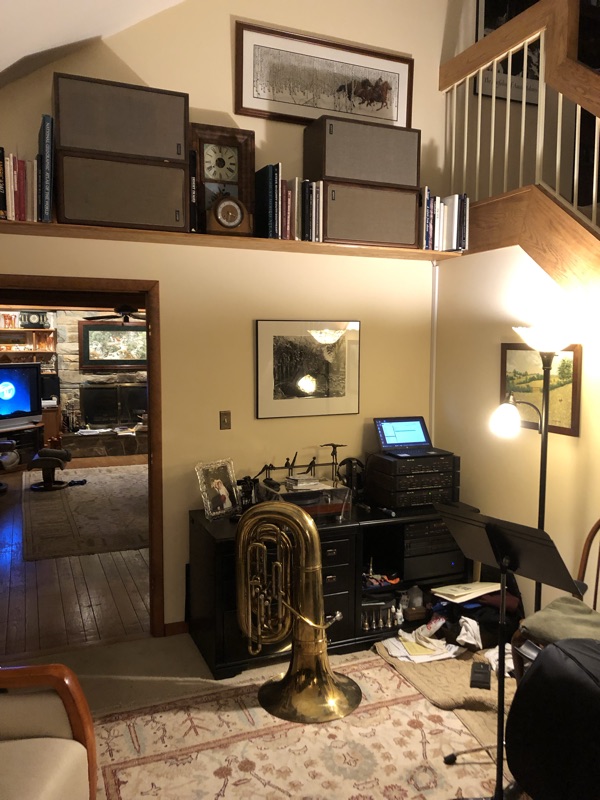
Does it make me less of a purist that I choose to live in my house as the architect designed it? As the wife demands? As I demand? Could be. Whatever. I have an imperfect space and that's just the way it is. A key problem in my space is that the floor along every wall is consumed by one thing or another. I have a grand piano at one end, comfy chairs with a map case that I use for art prints and my own large photos between them. Then, a case for CD's in the corner (acts as a bass trap--prove me wrong). An "open concept" opening into the den. A stereo desk that is actually a two-drawer lateral file cabinet full of music with my turntable on top of it. A matching shelf unit next to it where I put the rest of the equipment. The chair I sit in to play tuba, and all my tubas along the remaining bit of wall that is actually the side of a staircase going to the loft area and second floor of the house. Next to that is an opening into the entrance hall of the house. There's just no place to position speakers according to purist standards. So, I put them on a shelf mounted to the wall above the stereo equipment, far too close to the ceiling, especially on the left channel, and with too little separation. Just about everything is wrong with my speaker location, if detail and imaging is my goal.

(My neighbor down the hill built his house with a custom listening room, optimized and perfected. It's awesome. He does not equate listening to music with enjoying natural light and beauty as I can from my living room. And he also lives by himself.)

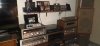
So, I turned everything back on and analyzed again, and set up my awesome Yamaha YDP2006 parametric equalizer. The result is reasonably linear up through about 15KHz, which is where the Advents start rolling off. No matter--my ears roll off lower than that. The comb effects are still there, but my listening position is 15 and 18 feet away from left and right channel speakers, respectively. Guess what? The Yamaha will apply a slight delay to the left channel so that it will arrive in correct phase alignment (for those frequencies low enough to matter) with the right channel. If that equalizer adds any mud to the sound, either I can't hear it or my Advents can't do any better anyway. But with it in place, the room sounds more controlled, and I hear more of the ambiance of the recording space (important with well-miked classical recordings, in my view).

But detail? Recorded piano sounds pretty close to the real piano in the room, differences in the instruments considering. Imaging? Well, not so much.

But for sheer dynamics, that's where the two pairs of Advents really shine. Each pair is driven by its own high-current B&K amplifier, in what I call a Dual Stereoblock (R) setup. There are not many affordable bookshelf-mounted speaker arrangements in my experience that can produce the same "slam". Four 10" woofers move a lot of air, and being part of an acoustic suspension design do so with discipline. Four tweeters heat up a lot less than two driven to the same SPL.

I think the point of the Grateful Dead wall of sound was visual as much as aural--the concertgoers have two speakers at home, and these guys had 200 of the same sorts of speakers (or at least they look that way). You hear what you see.

The pic is old--many equipment changes since then, and far better air management for cooling.

IMG_5077-dsqz.JPG


Rick "music practice is a messy business" Denney

 
The point is, other unused speakers in a room can have an effect on the sound. Is it audible? I don't know and don't care. Having a bunch of speakers in a room especially unused can have a measured effect on the sound.

Sure, so do drapes, floor coverings, furnishings, windows, acoustic influences due to room size/design and countless other factors that the vast majority of us are in gross violation of.

Kind of like the guy who orders two triple cheeseburgers & large fries fretting over whether to wash it all down with a Diet Coke or regular...
 
Last edited:
This was brute force SPL. It was for show as much as sound. There was no thought about how to optimize this.

Actually, quite a lot of thoughtful engineering went into that Wall of Sound. Much of it was pioneering. It was continuously evolving as they sought the best performance. And it was for sound quality, not appearance.

Later bands *did* often employ dummy speaker stacks solely for appearance.

Today, the same SPL could be achieved with a quarter of the hardware and provide WAY better sound quality for everyone in the venue.

The Wall of Sound had unique sonic characteristics. The ubiquitous flown arrays seen today provide far better coverage with regards to intensity and frequency response, but can only provide stereo imaging to a few dozen people in the audience down the middle. With the Wall of Sound, each hand member had their own dedicated main speaker section in a distinct stage position, so each was localizable to most of the audience.
It eliminated the need for monitors, as the mains *were* effectively oversized monitors. But that required some unique mic solutions.
In the end, I believe it was abandoned for the reason you stated- it was very complicated, bulky, expensive, and labor intensive.
 
Sure, so do drapes, floor coverings, furnishings, windows, acoustic influences due to room size/design and countless other factors that the vast majority of us are in gross violation of.

Kind of like the guy who orders two triple cheeseburgers & large fries fretting about whether to wash it all down with a Diet Coke or regular...

I almost understand why anyone would have multiple pairs of speakers. With that said; having a bunch of unused speakers just sitting there has an negative effect on the sound. Since it's measurable it can't be denied. I know there are numerous people who just want to look at and periodically swap speakers and other gear in and out.

I've heard several setups using stacked Advents. They've always sounded better when stacked. Every instance I've heard of stacking different speakers never sounded as good as a pair by themselves

Having a bunch of speakers in the room IMO makes one's room look like an audio emporium. I want my room to look like it's part of my home.

My listening room is the result of knocking down the wall between my living and dining rooms. There are a variety of room correction devices I use such as abfusors, diffusers, bass traps, insulated drapes, a DSP and various tchotchkes. Yet, it still looks like a room in someone's home.

In any case, I have 4 panel speakers (a pair of Magnepans, a pair of Acoustats) and five subwoofers. The fifth sub is for the center channel. It to is a panel (Magnepan). All of this is in my "room" and used on a daily basis. Besides, I have no other speakers anyway.

If stacking different speakers works for you then it does. Nobody, least of all me, is going to tell you you can't/shouldn't stack. I'm just reporting what I've heard. That's what most of us rely on.

FWIW: My system measures -1dB@ 26Hz for my left channel and +/- 0dB@ 26Hz for the right channel.

Please excuse my off thread meandering.

This thread has got me wondering what a stacked pair of Magnepan LRS's would sound like.
 
so on the topic of of un-used speakers, is this specifically when they aren't connected to anything, or just anything in the room that isn't actively making noise? I have my main system, a console stereo, and a temporary rig that I'm using for checking some tapes currently. All are connected to amplifiers, but I only run one at a time.
 
Back
Top Bottom