• The move to the new server is done. There are some software and database maintenance updates in process. This has us passing the hat around to help out. We appreciate any donations. Seriously, even a dollar helps. The payment page may be found here - https://www.audiokarma.org/support.html

Speaker Wire, Gauge, etc.

Thrill Kille

Active Member
I've read in another forum a good argument against smaller (12, 10, 8) gauges of cable in most systems. Especially in those less than about $7,500 or so.

Anyhoo, It was brought up, and I had to agree. That a fellow 'Phile was going to use 14 or even 16 GA wire for DIY speaker cables. Saying that [...the audio engineers at McIntosh in their good wisdom chose that size wire for the internals of their tube amps...] He wasn't sure if it was 14, or 16 GA. But he was going to find out. Paraphrasing here.. That if it was good enough for inside of the amp. Then it should be good enough to run from the amp to speaker.

So, I looked under my own MC30. And the wiring was indeed small. Looked like 16 GA and non-spiral strand(ICBW).

I do want to try this out. Also use two separate wires. And twist them together for about a 7-8 ft run.

Any thoughts on this? TIA!
 
Register to hide this ad
I've read in another forum a good argument against smaller (12, 10, 8) gauges of cable in most systems. Especially in those less than about $7,500 or so.

Anyhoo, It was brought up, and I had to agree. That a fellow 'Phile was going to use 14 or even 16 GA wire for DIY speaker cables. Saying that [...the audio engineers at McIntosh in their good wisdom chose that size wire for the internals of their tube amps...] He wasn't sure if it was 14, or 16 GA. But he was going to find out. Paraphrasing here.. That if it was good enough for inside of the amp. Then it should be good enough to run from the amp to speaker.

So, I looked under my own MC30. And the wiring was indeed small. Looked like 16 GA and non-spiral strand(ICBW).

I do want to try this out. Also use two separate wires. And twist them together for about a 7-8 ft run.

Any thoughts on this? TIA!
You'll be just fine and don't let anyone try to convince you otherwise. Proceed to the next stop and collect your reward. :king:

In long before the inevitable conclusion. :rolleyes:
 
Last edited:
You are basing your long run speaker wire selection on a 6-inch chunk of old wire used inside and 50-year old component? Let's not upset the apple cart or try anything new. Might be just fine with that little 30 watter.

I have always likened using the thin stuff to hooking up a garden hose to a fire hydrant when using a high powered amp. Something over 100 and runs of more than mono amp distances, 8 feet or so. If I go further I like a little more copper in the path.

Give me $25,000 speaker cable, I'll use em but I won't buy em. I'm good with a nice copper cable.
 
Last edited:
The resistance of a wire is proportional to both its gauge and its length. The short internal runs of relatively thin wire inside an amp have very low resistance because they're short.

In general, if you're concerned about resistive losses in a speaker wire, the longer it is the thicker it should be.

There are numerous wire gauge/resistance calculators available online. E.g., https://www.cirris.com/learning-center/calculators/133-wire-resistance-calculator-table

Calculating how much energy (i.e., watts) is lost in a given length of speaker wire is left as an exercise for the reader. :biggrin:
 
10 or 12 seems to work pretty well.

22 gauge will work in most instances as will 4 gauge but to me, 12 seems like a good number for systems up to about 200 watts per channel at which point, I move to 10 gauge.
 
I tend to keep things simple for myself by just following the advice given by the speaker and/or amplifier manufacturers. For my speakers, 18 gauge is recommended for runs up to 20 feet, and 16 gauge for runs up to 30 feet. 18 gauge would have been fine for me, but I already had some 16 on hand, so I used it.
 
I'd like for somebody to explain the reason for speaker wire heavier than 14 gauge copper. That's what I use. I'm not making any judgments but would like scientific proof that heavy speaker wire is better and I'm not saying that heavier wouldn't be better.

Most houses in my area use 14 gauge wire throughout most of the electrical system and would most likely be used anyplace a stereo would be. Most likely you would have more than just an amp/receiver sharing that same circuit. Most people don't run speaker wire very far in their house. I'm not sure what gauge most of my equipment cords are but they sure don't look very heavy. Why would you need heavier wire going out of a amp/receiver than what is coming in. Some of the incoming power is lost to heat or whatever.

I'm not talking about the 1% with the elite systems with dedicated circuits. I'm just talking about the average guy even though that would cover a wide variety and quality of equipment.

I'm not wanting to start a flaming war but just would like some facts.
 
Why would you need heavier wire going out of a amp/receiver than what is coming in.

I'll grab my shining chance at getting in before the lock to address this in particular.

I'd say the most quibble-proof reason is that the wires coming in are carrying a higher voltage than almost any power amplifier output ever reaches; therefore the incoming wires need to carry less current to deliver the same amount of power, and can be lighter gauge.

There are other reasons, but getting into topics like the effective series resistance of a power amplifier's output vs. the ESR of a household power outlet is probably just going to accelerate the thread's demise.

Cheers,

chazix
 
I just made a set of 16 gauge Radio Shack 25' wires with new bananas and it made a difference that was noticeable to my ears.

I don't think that the improvement was as much a result from the wire but that the terminal connectors are conveying more of the signal now with less resistance.

IMG_3184.JPG
 
I just made a set of 16 gauge Radio Shack 25' wires with new bananas and it made a difference that was noticeable to my ears.

I don't think that the improvement was as much a result from the wire but that the terminal connectors are conveying more of the signal now with less resistance.

View attachment 921830
Could be that or it could just be that the wires were poorly connected to the terminals before. Could also be the Magic Dragon of "expectation bias." :dunno:
 
Old wires get corroded, kinked, etc.

One wire statement I will agree with is that fresh new wire should be better than old. Beyond that...:lurk:
 
There are other issues concerning wire to be considered in addition to internal resistance. There is capacitance between the two conductors and depending on the type of cable inductance maybe an issue. But if the amps you have chosen are easily influenced by your choice of wire then your speaker choice will influence your amp many many times over, So I would look for different amps and speakers. That was one thing about Roger Russell's designs. They were nice to amplifiers. No wild swings in resistance and minimal reactance issues. Plus the woofers were crucially damped which meant optimum performance from a large number of amps. Where some speakers have to be used with an amp with just the right characteristics to get the best performance.
 
There are other issues concerning wire to be considered in addition to internal resistance. There is capacitance between the two conductors and depending on the type of cable inductance maybe an issue. But if the amps you have chosen are easily influenced by your choice of wire then your speaker choice will influence your amp many many times over, So I would look for different amps and speakers. That was one thing about Roger Russell's designs. They were nice to amplifiers. No wild swings in resistance and minimal reactance issues. Plus the woofers were crucially damped which meant optimum performance from a large number of amps. Where some speakers have to be used with an amp with just the right characteristics to get the best performance.

You also have to look at inductance as well. The tables I've looked at for solid wire show that as the wire gets thicker the inductance increases. I don't know if stranded wire has more or less inductance than straight wire, but you have to consider all three - is less resistance at the cost of more inductance always the best choice? It's really an engineering problem to decide what is best, or you can stick to the standard charts and pick the lowest recommended gauge to minimize inductance while keeping capacitance as low as possible.

upload_2017-5-2_10-59-33.png
 
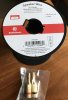
50'- Radio Shack 16 gauge speaker wire: $5.00, store clearance.

4 sets banana connectors, $5.00

Improved sound, priceless.

IMG_3196.JPG
 
50'- Radio Shack 16 gauge speaker wire: $5.00, store clearance.

4 sets banana connectors, $5.00

Improved sound, priceless.

View attachment 921866

All excellent unless the metal banana plugs touch each other with the speaker wire connected and live on the amp. Then the amp may have problems, depends. I use dual banana plugs to avoid shorting out the bananas to each other for that very reason. I don't want to find out if my amps can handle a dead short.
 
Many theories on larger or smaller gauge wire. I'm not exactly quoting. Ohm Accoustics, long time USA manufacture of quality speakers, wrote on thier site that they designed thier speakers with 12 gauge wire in mind. Customers can deviate from that, larger or smaller, depending on length of runs.
 
Back
Top Bottom