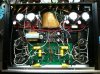
ChongX caps? That should have been up in smoke from the beginning.
Hey Man, you must be from California!!




ChongX caps? That should have been up in smoke from the beginning.


Didn't musichal post a detailed description and schematic in his first post (seemingly long ago)?
Edit: I see now that there is a schematic but no part values, only identifiers. So you're probably going to have to have a go (and a magnifier with light source) to read the values off the installed components.
Might a PM to rustnrot get you a full schematic with parts values and parts list?
Edited:
what kind of " " electrolytics are those, what are the supposed values vs schematic values, and why the heck are (inexpensive or the C-word) Chinese/Taiwanese caps doing in a nice amp like this? At the risk of offending the original builder, why aren't known quantity major maker Japanese or American made low ESR caps installed assuming availability, size and voltage ratings are met? Are the caps run at / near their limits, or are they just old and failing? Any evidence of venting below on the circuit board.
Does one know the age of this amp and when it was built? And if the cap is failing as with the failure of the tube, other parts of the circuit will be stressed so looks like Moe has more troubleshooting to do, especially all the coupling caps.
Some people say the big bad cap debacle of the 1999-2007 era of consumer electronics was created when Japanese cap makers came up with a new water and additive formula for low ESR caps which gave much better specs in smaller packages with lower cost - win, win, win. Some industrial espionage led to an incomplete formula being used by rival Taiwanese cap makers supplying the rapidly expanding motherboard industries and then consumer electronics like TVs, media players, and other consumer electronics. Even Japanese electronics makers were enticed by the cost advantages and used Taiwanese caps to their eventual detriment. All products using these bad caps were experiencing failure symptoms within 6-24 months of initial turn on. So IMO its important to get absolutely newly made caps and avoid any, ANY Taiwanese or unknown brand name caps, or any NOS caps from that era, no matter how nice they look - and yes, Rubycon had a run of these as well because they had a supplier of theirs make the caps in Taiwan.

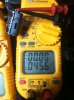


Congrats on batting 1000 out there, Morgan.
The amp was built a year ago, give or take a couple months. I'm second owner.
Replace all the caps you feel like doing, Morg. If you leave any Chong in there, then pair them with Cheech's as I believe someone above subliminally suggested.

Wonder what they'd do if you tested them at rated voltage. I suspect it would tell a little more than its off value.

im not familiar with the brand myself... figured they were boutique caps
i had planned on going back in with nichicon stuff. i havent looked for the big blue caps but they definitley have something for the black caps. no venting whatsoever on anything i have seen so far. im not sure what voltage is running through them but hal had put 4500 or so hours on this amp and who knows how many more were put on before that. im guessing age, heat, and excess current from a runaway tube may be at fault? i may look for a cap with a longer life expectancy. maybe a 12k hour cap like this guy...
http://www.mouser.com/ProductDetail/Nichicon/UCA2W470MHD/?qs=sGAEpiMZZMtZ1n0r9vR22caaJbuRiMQkroi8RdKVqhI=
or maybe a 20k hr?
http://www.mouser.com/ProductDetail/Nichicon/ULD2W470MHD1TN/?qs=sGAEpiMZZMtZ1n0r9vR22Sv8wqItuvVy8kdxmzwKSzy%2b9kldVKM87A==
(i just grabbed a couple really quickly)
its buddy was in spec
View attachment 839818
EDIT: 1K POSTS!!!!
Cheng X caps are very inexpensive. CapacitorWorld on eBay has them.
Here is a couple pics before I dig into anything. This is a really top notch amp! Gotta be one of the nicer st-70's there is. Other than the output transformers I can't think of a single other part that is found in a stock 70...
View attachment 839789
I really love this setup up top. Individual test points for each tube and the little holes with the blue trimmers are your bias adjustment points
View attachment 839790
Nice backside!
View attachment 839791
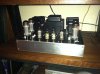
Looking at the amp in the second image of the trio Morgan posted above:
The bias test points adjacent to each power tube with their corresponding points in a square grid in front of the PS Xformer are handy, but that one single black-ringed test-point over to the left is a mystery to me. What is its purpose?

The stock Dynaco bias setting is 50ma per tube, which is not actually abusive. As long as the plate voltage is not above the original design, the 45ma its at won't hurt anything. Stock plate dissipation is 18.5 watts and the EL34 is rated for 25 watts. Compared to a lot of vintage amps, this is not running them hard by any stretch.
Dynaco ST-70: Base Line Testing
personally I'd run it at the setting it's designed to run at and replace the tubes every 5000 hours.


 )