

You are using an out of date browser. It may not display this or other websites correctly.
You should upgrade or use an alternative browser.
You should upgrade or use an alternative browser.
Stop fearing the sub, learn to love it!
- Thread starter cubdog
- Start date


Rob41
Don't stop believin'
Getting the crossover right is key. Where to cross and the slope required for a seamless integration is not one size fits all. Room and drivers will dictate how to best implement it. Calling it distributed bass doesn't change any of that.
You're right on the money.

dnewma04
The Healer
It's a filter, just as its name implies. A high-pass filter, a low-pass filter, or a band-pass filter. You could also term it a frequency attenuator.
Crossovers split an audio signal into separate frequency bands. Filters attenuate frequency ranges and, when combined together in a crossover, split audio signals into separate frequency bands.
Semantics. You will often see things described as a high pass filter or high pass crossover. There is no need to distinguish between the words or nitpick them.
dnewma04
The Healer
Getting the crossover right is key. Where to cross and the slope required for a seamless integration is not one size fits all. Room and drivers will dictate how to best implement it. Calling it distributed bass doesn't change any of that.
I think that sometimes a proper distributed bass system gets confused with having multiple subs. In a proper distributed bass system, each woofer is going to provide different levels of bass, different crossover points, different phase settings, etc. It's all determined by measurements, position, room, etc. Just adding a couple of subs will get you some of the benefits of distributed bass, but to me, it's really the implementation of a distributed bass methodology that makes all the difference in the world. My experience (along with Welti's, Geddes, Parhams, etc) has shown that a fairly generic implementation can get most people to a really good starting point, but in the end, to get the most performance, it will take some care and time to get the most benefit.
dnewma04
The Healer
.....a front-firing sub is non-directional above 35 hz?....but, it doesn't matter if it's directional or non, if you overlap the range of the main with the sub's range, you're going to get distortion and mud....and don't just tell me I'm wrong, tell me why I'm wrong.....
I've written a number of posts about this over the years with more technical detail, so I'll try to keep this dealing with a higher level description. There are a few things going on in systems in regards to how the room interacts with speakers determined predominantly by the rooms dimensions but also by other acoustical factors. The dimensions will be the primary factors in most systems unless great care has gone into the construction of the room. In regards to the dimensions, you will have three regions. Above the frequency whose wavelength correlates with the rooms smallest dimension, frequency response is almost solely determined by the speaker. Above that frequency, all (most) rooms will sound largely the same. Below the corner frequency of the room, rooms behave similarly, as well. It's pretty easy to get smooth frequency response below the corner frequency. When you run across response graphs of subwoofers, in room, the region from 15hz up to 40-50hz is largely smooth and predictable, you'll rarely ever see any anomalies in this range. From the corner frequency up to the first range discussed is referred to as the modal region. This is where wavelengths of the music don't exceed room dimensions, they fall within the room dimensions and you'll get loads of cancelling and some of the destructive properties I believe you were referring to when you said mudiness and distortion. This is the region where distributed bass (and digital room correction) can have a profound impact on performance. In practice, this is typically 40-200hz but in smaller rooms can extend up to 300hz range. I usually focus on 40-200hz. With the distributed bass method, the intent is to add more sources of bass to the room. It overwhelms the rooms modes and smooths out the frequency response in that range. Typically, there is only one sub providing a significant amount of the output. The additional subs will have significantly lower output and only exist to wipe out some of the nulls and peaks.
The mudiness/distortion you discuss from multiple sources playing the same frequencies is absolute reality in the region above the modal region, which is why great care is take with the design in speakers that employ multiple drivers in this region but in the modal region, the room acoustics will actually cause single drivers to exhibit similar behavior that is detrimental. I don't know that this analogy is perfect, but I've often used it to help people visualize what is going on. If you have a pan of water and you move it gently back and forth, you'll get a wave that moves back and forth with very distinct peaks and nulls. If you then move it side to side, you get waves crossing each other in two directions. The result is that a distinct wave becomes a couple of less distinct waves. When you continue to add more sources of waves, you'll end up with a significant number of waves that have very little amplitude and have a smoother water surface.
I have measured probably 2 dozen rooms for friends over the years. With 2 speakers playing down into the 20-30hz range, I have yet to measure one with less than 15dB peaks and valleys in the modal range. Not one. The one that had 15dB variation in the response had a couple of bass traps and a fair amount of acoustic treatment and a couple of big windows (that actually are fairly transparent to bass regions and will help with bass smoothness). I was in a room that was purpose built from the ground up to be a listening room employing some acoustics experts in the design and even in that room, I believe the owner was still getting 7-8dB swings in response. In a number of the rooms I've measured for friends, employing distributed bass has resulted in 6-7dB variation and in one case, we got it down to 2dB variation from 40-200hz. In my own room, with cheap subs, I was able to get the variation down to 4dB from 22hz to 200hz with no peaks, and a couple of small nulls. These were using some 150.00 subwoofers I bought purely to create a thread here on the process and how it can be done inexpensively.
I have had the most success following the general guidelines put out there by Geddes. I choose one of the front corners in the room and put a subwoofer in that position that is capable of the most output and lowest frequency extension. That sub will handle about 80% of the bass duties in the room. Next, along the sidewall opposite the corner chosen, I'll add the second sub, and finally, in the back of the room, I'll add the third. In an ideal, purpose built room, the side or back sub would reside in the upper half of the room, vertically, but you can get away all of them residing all on the floor. The side and back subs aren't providing much of the output, they are intended to tackle room modes. If in the room, the modes are extremely strong and focused, purpose built bandpass subs operating in just the regions most effected can do an excellent job. Also, there is no need for the additional subs to play down into typical subwoofer territory. A woofer capable of 50-200hz range with adjustments will work wonderfully.
Finally, because multiple sources of output in the modal range is beneficial, not high passing the mains can be beneficial. Naturally, if the mains are only capable of 80hz and you are slamming them with 30hz content, obviously, that can result in all sorts of issues where a crossover would be beneficial but in a proper distributed bass system, trying to keep the speakers from overlapping is not advantageous and can be detrimental to the systems performance. Personally, my current mains play to 30-35hz or so, in room. My front subwoofer is playing from 15hz to about 80. My side subwoofer is covering from 25-150 and my rear subwoofer I believe is actually set to play to 200hz. I'd bet an awful lot of money that not a single person could detect it.
My input on this entire thread would be that you should throw out any preconceived notions about how to implement subwoofers when attempting to use distributed bass. It's intent is entirely based on resolving room issues, not speaker issues and room issues *will* exist in every one of our systems. The conventional rules about implementing subwoofers, in my experience, will always result in performance that falls short of world class.
FWIW, DRC is capable of the same benefits as Distributed Bass, but it's usually just in a position or two in the room, not necessarily throughout the entire room. Since most of us only listen from a couple of positions in our rooms, it can be a very elegant option to choose.
Last edited:
dnewma04
The Healer
Good for you, cubdog. Good for you for finding something you like and good for you for taking the initiative to utilize untapped performance you had at your disposal.
For those of you who have found subs a positive addition to your set up, allow me to suggest the next step toward maximizing what they have to offer.....DRC (digital room correction). A stand alone unit that corrects 160 Hz and down only will set you back about $350, but short of loading your room up with an ungodly amount of bass trapping or subwoofers it is THE best way to make sure the LF response in the room is perfectly balanced.....which is a near impossible feat as every domestic living space will have room nodes and the associated standing waves that disrupt balanced reproduction of the first two octaves of of content. I went from four subs to two with DRC and the results have been overwhelmingly convincing. Unless your subs are just total pieces of crap, all of the negative stereotypes that are generally associated with subwoofers will become problems that belong to someone else when you implement a good DRC unit. I don't get game changers in my hobby very frequently these days...but this one qualifies.
Art, if you think you might ever want to give subs a try again you'd be denying yourself a fair opportunity to see what is truly possible if you neglect to include a proper DRC unit. Using subs without it is a bona fide compromise and IMO you haven't heard what subs can truly add to your rig if you haven't tried them with DRC.
I wanted to echo these comments, as well. Kudos to cubdog to joining the club of those that have tried to play around with distributed bass. I have only run across one person in the last 7-8 years that tried it and didn't like it, and that person didn't follow any of the recommendations that are out there. To me, it's the single most reliable upgrade you can make in a system (DRC is right there with it because it tackles the same problem).
dnewma04
The Healer
Bass is clearly directional on my system using only the subs from 85Hz down. That doesn't leave a lot of spectrum for upper harmonics.
Sine waves as used by Tom Nousaine bear little resemblance to music or any instrument. I encourage anyone to try stereo bass for themselves. Unfortunately, the LFE channel is mono. So if you want to try it you'll need an electronic crossover of some type. LP's are not adequate for such auditioning. Deep bass on LP's is always mixed in mono.
DSPeaker must agree on some level as their dual core model is stereo
Joe, I think there is something to what your saying without completely agreeing with it, either. My mains will handle all of the localized content because they are running stereo and being supplemented by a mono distributed bass system. Before learning of distributed bass, I ran stereo subs and quite liked them. In the case where the mains aren't capable of really deep bass themselves, there may be good reason to run stereo subs up front, but I'd still add distributed bass to that and would expect very real objective and subjective performance upgrades.
I can't see it. What is it?
cubdog
Wierd - not sure what happened to my picture.
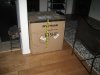
Here is the great big box:
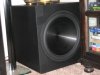
And here she is - quite a beauty:
So far very pleased with it. I have a serious woofer fetish.
Thanks!
Attachments

cubdog
banging through drywall
Jesus. My fingers are sore.
Thanks for that. I won't pretend I understand all of it but others may so your discomfort might be rewarded. I wish I had a dedicated listening room where I could implement a proper distributed bass system. For now I'm happy with two subs in an imperfect setup.
Hopefully others will shed their misconception that subs degrade main speaker performance and realize that properly implemented they can only be beneficial.
cubdog
Rob41
Don't stop believin'
Jesus. My fingers are sore.
And they should be!!!
Thanks so much for your very detailed information in your previous post. I have bookmarked it so I can use it as a reference later. :thmbsp:
Rob41
Don't stop believin'
Thanks for that. I won't pretend I understand all of it but others may so your discomfort might be rewarded. I wish I had a dedicated listening room where I could implement a proper distributed bass system. For now I'm happy with two subs in an imperfect setup.
Hopefully others will shed their misconception that subs degrade main speaker performance and realize that properly implemented they can only be beneficial.
cubdog
Yes sir!
I've yet to implement a DB system but realize the truth of what I've read. It appears it is one of the single biggest positive changes you can make to a system, and possibly DRC as well. I think I'm someone who badly needs both of those things. :yes:

davidro
Lunatic Member
Not sure why you brought up stereo or mono....again
Ya mentioned it again right before there so...
With that said, of course you should go with whatever sounds good to your ears.:thmbsp:
no argument there.

Speaking of room modes, does anybody remember a bass trap product from back in the 1980's that was "active"? I can't recall the name, but it was basically a sonotube mounted powered sub with a microphone in it that played back whatever came at it (in the bass region) out of phase to create bass cancellations in the corners of rooms. Does anyone remember these devices and/or anything about them? Seems like Stereopile or Absolutley Unsound did a review on them and like them, but I can't remember the name of the darn things for anything. anyone?


JoeESP9
ESL's & tubes since 83
Joe, I think there is something to what your saying without completely agreeing with it, either. My mains will handle all of the localized content because they are running stereo and being supplemented by a mono distributed bass system. Before learning of distributed bass, I ran stereo subs and quite liked them. In the case where the mains aren't capable of really deep bass themselves, there may be good reason to run stereo subs up front, but I'd still add distributed bass to that and would expect very real objective and subjective performance upgrades.
Thanks for giving me a listen. In the 15 years I've been using dual sub woofers I've tried every variation of connection you can imagine. I've done DB, mono and stereo. In my system stereo sub woofers just sound better to me. This is especially so after adding and using DSP in the feed only to my sub woofers.
I've been vilified and belittled for what I've posted. I really don't care as I've posted about what I've actually observed by trying things. Others are free to try things or not as they see fit. I only ask that before you dismiss my thoughts you actually try the various options. Do not listen to some self appointed "guru" or a test done with only sine waves.
Last edited:
Rob41
Don't stop believin'
I've been vilified and belittled for what I've posted. I really don't care as I've posted about what I've actually observed by trying things. Others are free to try things or not as they see fit. I only ask that before you dismiss my thoughts you actually try the various options. Do not listen to some self appointed "guru" or a test done with only sine waves.
Please don't ever get discouraged to the point you stop posting about your experiences. Your opinions carry weight as do the experiences of others and are what I use to guide me to the next level.