

You are using an out of date browser. It may not display this or other websites correctly.
You should upgrade or use an alternative browser.
You should upgrade or use an alternative browser.
Stylus Microscopes
- Thread starter Karma16
- Start date
Aage said:Sparky: yes, I will try it. Question though; how did you take photos through your 'scope? Put the camera on macro and hold it up to the eyepiece? I didn't see your method in your post, or perhaps your 'scope has fittings for a camera...?
HI Aage,
If you review this thread you will find that I did not post any pictures. That's because I have never taken any pictures through my scope. My scope is as ill equipped for pics as yours. Sorry.
Let us know how your experiment goes. I'm very curious.
Sparky

the-real-mandak
Super Member
Aage try and explore this page, all you ever wanted to know about microscopes: http://www.microscopy-uk.org.uk/full_menu.html
the-real-mandak said:Aage try and explore this page, all you ever wanted to know about microscopes: http://www.microscopy-uk.org.uk/full_menu.html
Thanks, Mandrake, I've saved the link and will try wading through it.
the-real-mandak
Super Member
Ok, a first try update the scope arrived.
First impressions of the E.Microscope:
This is one pies of plastic crap, the design and idea is good but the final product is difficult to work with due to poor assembly and lack of adjustment features.
The main problem is the stage, it can only move up and down and this in a rough way. There is no possibly for fine adjustment, so focus is difficult. But nothing compared to the trouble of placing the subject at the right place on the stage, which took quite a bit of patience.
The second major problem is parts moving when trying to adjust focus, which means every thing, is moving, the optics, the stage, well every darn thing. So the subject often moves out of the picture when trying to focus.
The third thing is a problem due to what must be a production error; the stage can not move enough down to focus on things that are not at the same level as the stage surface. But moving up, the stage will hit the optic before the maximum up position.
The first run:
Ok time to make fixes, took the stage apart so the cartridge would be placed in the “cup” beneath the stage surface and allow focus. For placement of the subject on the “new” stage I used a flash light pointed down thru the optic from the camera end, which gives a rough idea of placement.
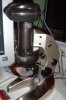
The pictures represent the 3 different magnifications with no other light than the lamp mounted on the microscope. In the last one I used the flash light to ad a little light. You will notice that the angel is a bit off the center. This was not an attempt to se wear and tear of the diamond but just a try out.
Final Thoughts:
To see how used a needle is there has to be made tweaks to the microscope, like adding light and finding a way to align the center axis of the diamond with the optics. Maybe also use a 2x eye pies to increase the magnification, fun and tryouts lays ahead.
NB. I do not recommend to use this scope until a good tweak and fix list is made, it is way too crappy to work with as it comes out of the box.
A last thing… It is only a piece of $60 plastic so no miracles, but a bunch of good ideas
First impressions of the E.Microscope:
This is one pies of plastic crap, the design and idea is good but the final product is difficult to work with due to poor assembly and lack of adjustment features.
The main problem is the stage, it can only move up and down and this in a rough way. There is no possibly for fine adjustment, so focus is difficult. But nothing compared to the trouble of placing the subject at the right place on the stage, which took quite a bit of patience.
The second major problem is parts moving when trying to adjust focus, which means every thing, is moving, the optics, the stage, well every darn thing. So the subject often moves out of the picture when trying to focus.
The third thing is a problem due to what must be a production error; the stage can not move enough down to focus on things that are not at the same level as the stage surface. But moving up, the stage will hit the optic before the maximum up position.
The first run:
Ok time to make fixes, took the stage apart so the cartridge would be placed in the “cup” beneath the stage surface and allow focus. For placement of the subject on the “new” stage I used a flash light pointed down thru the optic from the camera end, which gives a rough idea of placement.
The pictures represent the 3 different magnifications with no other light than the lamp mounted on the microscope. In the last one I used the flash light to ad a little light. You will notice that the angel is a bit off the center. This was not an attempt to se wear and tear of the diamond but just a try out.
Final Thoughts:
To see how used a needle is there has to be made tweaks to the microscope, like adding light and finding a way to align the center axis of the diamond with the optics. Maybe also use a 2x eye pies to increase the magnification, fun and tryouts lays ahead.
NB. I do not recommend to use this scope until a good tweak and fix list is made, it is way too crappy to work with as it comes out of the box.
A last thing… It is only a piece of $60 plastic so no miracles, but a bunch of good ideas
Attachments




absolon
Super Member
Interesting!
The Intel version suffers some flex also but with a 4cm range has no trouble with stage clearance. I found using a microscope slide with some blu-tack to hold the stylus in place very effective but the Intel has clips to hold a slide in place while still allowing adjustment. Stage adjustment is a bit tricky due to the flex but with a bit of practice gets easier. Locating the subject is also easy as you can move from 10X to 60X to 200X making the minor adjustments required as you go. I found a bodkin to be very handy to move the stylus/slide about; kept my fat insensitive fingers away from the moving parts.
The Intel version suffers some flex also but with a 4cm range has no trouble with stage clearance. I found using a microscope slide with some blu-tack to hold the stylus in place very effective but the Intel has clips to hold a slide in place while still allowing adjustment. Stage adjustment is a bit tricky due to the flex but with a bit of practice gets easier. Locating the subject is also easy as you can move from 10X to 60X to 200X making the minor adjustments required as you go. I found a bodkin to be very handy to move the stylus/slide about; kept my fat insensitive fingers away from the moving parts.

I haven't actually done this yet, but I think that a standard microscope -- not too hard to come up with cheaply -- could work well with two MiniMag flashlights, and possibly even better with the LED conversion, which costs a whopping 9 bucks. You'd need to come up with some sort of clamply things to hold the flash lights, but you could manage to do this pretty cheaply -- it doesn't make sense to spend tons of money on a fancy setup to check stylii -- why not just use the money to buy a bunch of new stylii?
the-real-mandak
Super Member
Nat you forget all the fun about messing around with all this plastic
Just remember it has to be min x200 optical (witch mine is not at the moment).
Just remember it has to be min x200 optical (witch mine is not at the moment).

rulerboyz
AK Member
Stylus photos
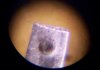
Here is a photo of my Shure M97xe stylus after 1 year of service. I am using one of those cheap $14 microscopes and a relatively poor quality digital camera (Kodak Easy Share 3.2 which has no optical zoom). The first photo is 80X and the second is at 100X.
Here is a photo of my Shure M97xe stylus after 1 year of service. I am using one of those cheap $14 microscopes and a relatively poor quality digital camera (Kodak Easy Share 3.2 which has no optical zoom). The first photo is 80X and the second is at 100X.
Attachments


Pio1980
AK Member
Carried forward from a link to a recent thread;
It bothers me that;
(1) there is no mention of J. Rabinow and E. Codier's seminal research that resulted in the RAB(inow)CO(dier) arm, websearch Rabinow and Codier for the related dox.
(2) No mention of Lou Souther's simple and effective motor-less tangental arm which predated some of the others mentioned. The Clearaudio tangental arms were derived from Lou's arm when Peter Souchy of Clearaudio obtained the rights to Lou's design.
The scanning electron microscope (SEM) gives the best views of a stylus tip, not universally available or really necessary if one's playback system has sufficent resolving ability to reveal stylus contact area attrition and the hearing of the listener is both sufficiently acute and educated to recognise the maltracing effect of it on inner detailing long before mistracking manifests. Under those conditions, one replaces the stylus tip when it no longer sounds good or right. In my case, that was 60-70 hours of play, roughly 200 sides. Optical confirmation could be had with a 10 power loupe and a strong light where a tiny flash of light off the sub-microscopic facets could be seen as the assembly was turned in multiple axis under the light.
Goodness is had by getting the basics right, glory is found in attending to the details.
S.B.
Any who wants to know a bit more about the famous Rabco arms and other tangential tables, go here: http://www.soundfountain.com/amb/ttrabco.html
It bothers me that;
(1) there is no mention of J. Rabinow and E. Codier's seminal research that resulted in the RAB(inow)CO(dier) arm, websearch Rabinow and Codier for the related dox.
(2) No mention of Lou Souther's simple and effective motor-less tangental arm which predated some of the others mentioned. The Clearaudio tangental arms were derived from Lou's arm when Peter Souchy of Clearaudio obtained the rights to Lou's design.
The scanning electron microscope (SEM) gives the best views of a stylus tip, not universally available or really necessary if one's playback system has sufficent resolving ability to reveal stylus contact area attrition and the hearing of the listener is both sufficiently acute and educated to recognise the maltracing effect of it on inner detailing long before mistracking manifests. Under those conditions, one replaces the stylus tip when it no longer sounds good or right. In my case, that was 60-70 hours of play, roughly 200 sides. Optical confirmation could be had with a 10 power loupe and a strong light where a tiny flash of light off the sub-microscopic facets could be seen as the assembly was turned in multiple axis under the light.
Goodness is had by getting the basics right, glory is found in attending to the details.
S.B.
Boy -- if your stylus wore out in 60 to 70 hours, I hope it wasn't an expensive one. Given that there are plenty of $1000 plus cartridges that suggests every side of a record could be costing you 7 or 8 bucks. Even a $100 dollar cartridge is going to be costing you half a buck every time you play a side. No wonder people love CDs and downloads!
Seriously -- I've never heard of such low hours (except with sapphire stylii), and wonder if there isn't some other issue at play than just standard wear.
Seriously -- I've never heard of such low hours (except with sapphire stylii), and wonder if there isn't some other issue at play than just standard wear.
Here is a photo of my Shure M97xe stylus after 1 year of service. I am using one of those cheap $14 microscopes and a relatively poor quality digital camera (Kodak Easy Share 3.2 which has no optical zoom). The first photo is 80X and the second is at 100X.
Maybe it's just the resolution, or my feeble eyesight, but I think it looks like the diamond tip has fallen out.
:scratch2:

Doug G.
Lunatic Member
Maybe it's just the resolution, or my feeble eyesight, but I think it looks like the diamond tip has fallen out.
:scratch2:
I pick the latter because it sure looks obviously there to me.

Doug
Oh, yes yes yes, I see it now. I was looking at the end of the cantilever, thinking that was the diamond.
Jeepers, from that low res picture of the diamond, how can you make any objective decisions as to its condition?
Or, "Maybe it's just the resolution, or my feeble eyesight, et cetera..."
Jeepers, from that low res picture of the diamond, how can you make any objective decisions as to its condition?
Or, "Maybe it's just the resolution, or my feeble eyesight, et cetera..."
Pio1980
AK Member
Boy -- if your stylus wore out in 60 to 70 hours, I hope it wasn't an expensive one. Given that there are plenty of $1000 plus cartridges that suggests every side of a record could be costing you 7 or 8 bucks. Even a $100 dollar cartridge is going to be costing you half a buck every time you play a side. No wonder people love CDs and downloads!
Seriously -- I've never heard of such low hours (except with sapphire stylii), and wonder if there isn't some other issue at play than just standard wear.
You are right about it being difficult to justify a great cartridge for the limited hours of enjoyment vs cost I would have before it started to grate on me.
I could hear the deterioration at ca 60-70 hrs and it bothered me. Others probably have a higher tolerance and/or or simply don't hear it happening nearly as early as I could back then. I'm not sure I can hear that now, given encroaching congenital deafness. Nonetheless, I still enjoy my system and appreciate high-end sound and performance as much as ever. I have started playing records on my TT again now that I have my tube phono preamp back in the set-up. My present pick-up is an O'fon X3-MC high-output moving coil with line contact stylus and yes, it's probably way past overdue for rebuild by my old criteria. We shall hear once I "get my ears back on", such as they are now.
Goodness is gained by getting the basics right, glory is found in attending to the details.
S.B.

Pio1980
AK Member
For all practical purposes in a high-resolution system it is optically visible long after it's objectionally audible. Only a scanning electron microscope can show the affected portion with any useful resolution at that point of audible deterioration, IMO. *Any* change of the stylus/groove wall interface due to stylus tip attrition is detrimental to proper accurate low-distortion signal recovery, only a bit of perceptable attrition is analogous to being only a little bit pregnant. Either it's capable of delivering the optimal performance one pays for or it isn't. For my ears an inexpensive but decent fresh-tipped pick-up trumps any pick-up of any cost with flats worn into the tip, however slight.
Addl; Finally replaced the forementioned worn-out X3-MC with a factory-fresh updated O'fon MC-3 Turbo. The magic is back, bliss!
S.B.
Addl; Finally replaced the forementioned worn-out X3-MC with a factory-fresh updated O'fon MC-3 Turbo. The magic is back, bliss!
S.B.
Last edited:
The difficulty with any definition of stylus wear is that you do have to make an arbitrary decision about when its worn too much -- the instant the stylus contacts vinyl for the first time, its worn. Obviously it would be ridiculous to retire it after its first second of playing, but where do you draw the line? Its also obvious that it depends on how good your ears (and your system) are, and how much you care about record wear. If, as many of us do, you play lots of used records, it would make sense to be less persnickety about stylus condition. On the otherhand, if all you play are 180 gram audiophile pressings, I would guess it would make sense to change stylii pretty often.
It sounds to me like you are more stringent in your routine than I am -- I use used cartridges all the time, on records of various states of wear, and though I have a pretty good system, I'm not bothered by stylus wear very often -- I would guess I change cartridges out of boredom rather than concern for wear.
Maybe I'm fooling myself, but I like being cheap and cheerful. And given that I do have speakers with pretty revealling high ends (DQ 10s and ESS Transtatics) I don't think I'm doing too much damage.
Maybe those of you who are very careful about changing stylii at routine and early intervales could make some of your money back or earn karma by passing them on to us slobs...
It sounds to me like you are more stringent in your routine than I am -- I use used cartridges all the time, on records of various states of wear, and though I have a pretty good system, I'm not bothered by stylus wear very often -- I would guess I change cartridges out of boredom rather than concern for wear.
Maybe I'm fooling myself, but I like being cheap and cheerful. And given that I do have speakers with pretty revealling high ends (DQ 10s and ESS Transtatics) I don't think I'm doing too much damage.
Maybe those of you who are very careful about changing stylii at routine and early intervales could make some of your money back or earn karma by passing them on to us slobs...
HI pio,
You pose an interesting question for which I'm not sure there is a definite answer. I'm also not sure whether you speak from a point of view of experience or theory. I don't think that theory will work towards a definite resolution in this case. In fact, there is no theory that I know of.
Have you ever used a purpose designed stylus microscope over an extended period of time? I think not.
Long experience with thousands of styli has shown me the optical test is valid. However, most of these styli were on customers machines that came into my shop. Thus, I had no opportunity to track wear as it developed. Usually, the styli were so worn that there was no question that replacement was needed. This was not nit-picking.
For a complete wear history I must depend on my on my own styli for which I can (and have) maintained complete control. Because it is logistically inconvenient, I don't examine a stylus on a daily basis. Or even monthly. I wait until I hear an anomaly then examine the stylus optically. At that point the optical view either confirms the sound or it doesn't. Almost always, I see very small wear facets. This confirms what I heard and I replace the cartridge and the problem disappears.
On my own styli I never see large facets. I catch the problem long before it gets that severe. I value my records too much to ignore wear.
Occasionally, the optical view does not confirm the sound. I have learned to trust these results. Something else, not wear, is wrong. The problems vary but arm setup, stylus suspension, or encrusted dirt (which is painfully obvious) are the usual culprets. Fix these and the world is right again.
So, I find the optical view to be very sensitive and informative. But, I still depend on my ears to give early warning of wear. However, it is always confirmed optically. An electron microscope would be serious over kill and out of reach for almost everybody.
BTW, I have about as high a resolution system as can be had. Vintage sound this system is not.
Sparky
You pose an interesting question for which I'm not sure there is a definite answer. I'm also not sure whether you speak from a point of view of experience or theory. I don't think that theory will work towards a definite resolution in this case. In fact, there is no theory that I know of.
Have you ever used a purpose designed stylus microscope over an extended period of time? I think not.
Long experience with thousands of styli has shown me the optical test is valid. However, most of these styli were on customers machines that came into my shop. Thus, I had no opportunity to track wear as it developed. Usually, the styli were so worn that there was no question that replacement was needed. This was not nit-picking.
For a complete wear history I must depend on my on my own styli for which I can (and have) maintained complete control. Because it is logistically inconvenient, I don't examine a stylus on a daily basis. Or even monthly. I wait until I hear an anomaly then examine the stylus optically. At that point the optical view either confirms the sound or it doesn't. Almost always, I see very small wear facets. This confirms what I heard and I replace the cartridge and the problem disappears.
On my own styli I never see large facets. I catch the problem long before it gets that severe. I value my records too much to ignore wear.
Occasionally, the optical view does not confirm the sound. I have learned to trust these results. Something else, not wear, is wrong. The problems vary but arm setup, stylus suspension, or encrusted dirt (which is painfully obvious) are the usual culprets. Fix these and the world is right again.
So, I find the optical view to be very sensitive and informative. But, I still depend on my ears to give early warning of wear. However, it is always confirmed optically. An electron microscope would be serious over kill and out of reach for almost everybody.
BTW, I have about as high a resolution system as can be had. Vintage sound this system is not.
Sparky