• The move to the new server is done. There are some software and database maintenance updates in process. This has us passing the hat around to help out. We appreciate any donations. Seriously, even a dollar helps. The payment page may be found here - https://www.audiokarma.org/support.html

SX-850 low voltage on dial lights

mstewart

Active Member
Just did a full recap on my SX-850. I replaced several transistors throughout. Voltages all check out on the power supply board but the voltage on the light panel is low. I'm getting about 6.7-7.2 vac. The manual states it should be 8 v. Bias and offset have been set. From what I can tell this is coming straight from the transformer. The reason this is an issue is if I have led lights installed they will flicker if I have the volume turned up and moreso when the bass is hitting. Incandescent lights don't react this way. They just seem dim to me. Anyone have any ideas what's going on or what I could check?
 
Register to hide this ad
I've had a similar issue before - is there a pop sound when turning on your speaker input as well?

Can you provide the replacement components you used in the power supply board?
 
The 8Vac spec is a nominal rating, not a critical value. Typically it runs lower when loaded with lamps. The issue with LEDs is four-fold. An incandescent bulb glows from heat, so a momentary drop in voltage is not visible to the human eye, as the filament stays hot and glowing. An LED produces light from an emission of photons directly, if the voltage on the pn junction drops (and resulting current), so does the photon emission, which can be seen by the human eye as a flicker. When a large current is drawn through the transformer, as with heavy bass and loud volume, normal output voltage drops on all windings. The filter/reservoir caps after the rectifiers in the power supplies mediate this issue, but an ac winding output will be directly affected. This is a normal 'transformer regulation' issue, especially if the transformer is being used close to its max rating. That fourth part requires an answer to a question: What LEDs are you using and how are you powering them?
 
Last edited:
Can you provide the replacement components you used in the power supply board?

AWR-101: C10: 470uF 80v ACH-038: 647-UHE2A471MHD 470uF 100v
AWR-101: C11: 470uF 80v ACH-038: 647-UHE2A471MHD 470uF 100v
AWR-101: C12: 2200uF 35v ACH-060: 647-UPW1V222MHD6 2200uF 35v
AWR-101: C13: 1000uF 25v CEA: 647-UPW1E102MPD6 1000uF 25v
AWR-101: C14: 220uF 10v CEA: 647-UPW1V221MPD6 220uF 35v <=== This was incorrect. It had a 47uf 25v. I used 47uf 35v UPJ1V470MED1TA because it's all I had on hand.
AWR-101: C15: 470uF 63v CEA: 647-UPW1J471MHD 470uF 63v
AWR-101: C16: 47uF 16v CEA: 647-UPW1V470MED 47uF 35v
AWR-101: C18: 47uF 50v CEA: 647-UPW1H470MED 47uF 50v
AWR-101: C19: 47uF 35v CEA: 647-UPW1V470MED 47uF 35v
AWR-101: C20: 100uF 63v CEA: 647-UPW1J101MPD6 100uF 63v
AWR-101: C21: 47uF 16v CEA: 647-UPW1V470MED 47uF 35v
AWR-101: C23: 100uF 35v CEA: 647-UPW1V101MPD 100uF 35v

Q1 2SD313P ---- MJE15030G
Q2 2SB507P ---- MJE15031G
Q4 2SA720 ---- KSA1220AY
Q6 2SA720 ---- KSA1220AY
Q8 2SD313P --- MJE15030G
Q9 2SD313P --- MJE15030G

Power Supply Readings:

Schematic Actual
Pin 2,3= 5.4= 5.6
Pin 4,5 = 13.9= 14.2
Pin 6,7= 51.5= 51.9
Pin 8,9,10= 36.5= 36.9
Pin 11= 28= 28.1
Pin 13= -13.5= -13.84
Pin 14= -51.5= -53.2
Pin15= -19= -19.6
Pin 24= 8 vac= 7.5 vac
Pin 22,23= 8 vac = 6.9 vac


It keeps taking my spaces out when I enter the power supply stuff.​
 
Last edited:
is there a pop sound when turning on your speaker input as well?
No it sounds great. Other than a sort of high pitched hiss when listening to FM in stereo. All of my receivers do this btw. I'd really like to figure that out. I have to use the filters to try to get rid of it.
 
The 8Vac spec is a nominal rating, not a critical value. Typically it runs lower when loaded with lamps. The issue with LEDs is four-fold. An incandescent bulb glows from heat, so a momentary drop in voltage is not visible to the human eye, as the filament stays hot and glowing. An LED produces light from an emission of photons directly, if the voltage on the pn junction drops (and resulting current), so does the photon emission, which can be seen by the human eye as a flicker. As a large current is drawn through the transformer, as with heavy bass and loud volume, normal output voltage drops on all windings. The filter/reservoir caps after the rectifiers in the power supplies mediate this issue, but an ac winding output will be directly affected. This is a normal 'transformer regulation' issue, especially if the transformer is being used close to its max rating. That fourth part requires an answer to a question: What LEDs are you using and how are you powering them?

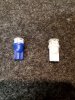
leds.jpg

I have a few different wedge leds 8v 300mA. I have used them in my 1050 and 1250 and they haven't had this issue. But then again I don't turn those up as much.

Second part of your question, I'm just plugging them into the light holders like an incandescent light.
 
Last edited:
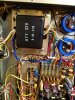
I can tell the transformer was replaced in this receiver before I bought it. The windings on the posts look like they were rewound and soldered. Also, two of the nuts that hold the transformer in were replaced with different ones.
 
View attachment 1896867

I have a few different wedge leds 8v 300mA. I have used them in my 1050 and 1250 and they haven't had this issue. But then again I don't turn those up as much.

Second part of your question, I'm just plugging them into the light holders like an incandescent light.
The SX-1050 and SX-1250 both have toroidal transformers. That design has better transformer regulation, and have lower impedance between the AC input and the output windings than the traditional EI laminate core transformers. That improvement is why there is a 'soft start' circuit on those amps, to limit inrush current from the AC line.
Is the new transformer the same part number as the original? ATT-302?
 
Is the new transformer the same part number as the original? ATT-302?
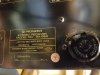
20200613_161308.jpg

Nope! Just found out something new. Something is odd about this thing. I replaced the scratched dial scale and the replacement was different than the one that was on it. I had a post about it because I was confused about that.
 
Just did a quick search and there's the same one on ebay. The listing says it came out of a SX-850.

EDIT: Looking at the service manual for the hg/s model it shows the ATT-329 as the transformer.
 
Last edited:
The SM I have show ATT-302 on page 21 and 41 for the US model KU Sx-850.
It does show in the schematics there are different transformers for the various multi-voltage models.
What is the label on the one you have?
Never mind, I saw the picture, you have a multi-voltage model. What voltage setting is it on?
 
Is there a way to modify the light circuit so the voltage remains constant even when there is a heavy load on the transformer?
 
You could add a secondary transformer just to power the lighting circuit. That opens infinite possibilities.
The other option is to convert the ac to a higher dc voltage with a voltage doubler. This becomes problematic if you try to use the same load. If the LEDs draw significantly less current than the incandescent bulbs this can work ok.
 
You could add a secondary transformer just to power the lighting circuit. That opens infinite possibilities.
The other option is to convert the ac to a higher dc voltage with a voltage doubler. This becomes problematic if you try to use the same load. If the LEDs draw significantly less current than the incandescent bulbs this can work ok.
Which of the two options would be best? If I doubled the voltage are you saying it would end up being ~14v going into the leds? i don't understand what you mean about it being problematic if I use the same load.
 
Which of the two options would be best? If I doubled the voltage are you saying it would end up being ~14v going into the leds? i don't understand what you mean about it being problematic if I use the same load.
A voltage doubler uses two stages of half wave rectifiers. The power output will be less than the power input because of the losses in the circuitry. You can get a dc output of about double the ac input voltage, but you have less than half the output current available. Power = Volts x Amps. a single LED will put out more light for the same raw power consumed than an incandescent because less is wasted on heating the filament so it glows. The wedge lamps have other circuit components in them to use ac instead of dc. Some of them are designed to waste power so they look like incandescent lamps for the automotive computers that monitor lamp current to 'warn' you of a failed incandescent bulb. It is not as simple as 'just drop in a different bulb', as you are seeing. Did your LEDs come from the 'bay?
 
The incandescent lights look so dim that in the dark they barely light up the dial scale.
Are those original lamps, or were they replaced by the person who worked on this before? Can you tell? If they put 12v automotive wedge lamps in there (because they fit, are easy to find, and cheap) that may be part of the problem. The goto guy on AK for vintage lamps is member dgwojo: DGWOJO.COM
 
Are those original lamps, or were they replaced by the person who worked on this before? Can you tell? If they put 12v automotive wedge lamps in there (because they fit, are easy to find, and cheap) that may be part of the problem. The goto guy on AK for vintage lamps is member dgwojo: DGWOJO.COM
The lamps are Stanley brand 8v .3a. I discovered Dave a while ago. I've bought lights from him a few times now.
 
Back
Top Bottom