I built that DAC for my CD collection and RPi streamer. I don’t have software beyond 16 bit/44.1 kHz, but you can probably downsample higher rez files via software.
How do you send the signal in to the raspberry?


I built that DAC for my CD collection and RPi streamer. I don’t have software beyond 16 bit/44.1 kHz, but you can probably downsample higher rez files via software.

How do you send the signal in to the raspberry?
And how can I downsample dsd to pcm?If you clicked the hyperlinked RPi text in my previous reply, you’ll see that it has an Allo Digione SPDIF HAT. My #71 post also has the same info + more.
And how can I downsample dsd to pcm?
Well, question is, as sources I would use a cd/sacd player that is also streamer, and i would like to use the RPi which controls a NAS. Now I am using a DAC board with that, how could I play, as an example, a DSD in my NAS picked by RPi, let him downsample it, and send it to your tube dac? Via USB? What drivers would I need?
Thank you!

how could I play, as an example, a DSD in my NAS picked by RPi, let him downsample it, and send it to your tube dac?
LMS, running on RPi, will access your NAS, and has a plugin to play DSF/DFF. LMS can be controlled via its web interface (running the Material Skin pkugin) from any smart device on your network. Don't know how to integrate your CD/SACD streamer.
If you have removed the oversampling filter without changing the output imaging filter to match the 44k1 sample rate, you may be getting more image products than desired.1. Removed the Saa7220 digital filter, the BB runs NOS.
5. All caps and resistor are the originals...

I have a BB2, and I by-passed the discrete output stage using a 33 ohm wirewound resistor's. I also swapped the TDA1541 for an 8X TDA 1387, and using a coupleSorry for reviving an old thread but maybe someone can use my opinion or help me maybe understand if I have "broken" ears...
I have few Dacs, 2 of them are the Arcam BB 1 and the Chinese TDA1541 Dac that was mentioned by the OP.
My Arcam fails to impress me in comparison to the Chinese Dac.
The "only" changes I've made are:
Arcam BB1
1. Removed the Saa7220 digital filter, the BB runs NOS.
2. Removed Arcam digital reciever.
3. Connected Dir9001digital input module directly to the resistors before the I2S input of the TDA1541, using only it's optical input.
4. Replaced the original TDA1541A with TDA1541A S1.
5. All caps and resistor are the originals... For now.
Chinese TDA1541 Dac
1. Runing NOS.
2. Changed the original I/U resistor to 1.8K resistor to match the Arcam BB output level (which BTW is about 2.5V rms and not 2V)
3. At first I used the original input structure but also tried the following, Removed the CS8412 and replaced it with Dir9001 digital input module.
4. All caps and resistors are the originals... For now.
5. Tried TDA1541, TDA1541A, and the TDA1541A S1 (to my ears the difference is subtle if at all).
6. I/U 5534 opamps replaced with AD825, LPF/buffer 5534 opamps replaced with OPA604
Now for the sound....
The Arcam has a little more "air" around instruments and voices, soundstage and 3D feel is about the same as the Chinese dac, there is a very small advantage to the Arcam.
The Chinese dac soundstage sounds a bit forward/closer to my seating spot.
The Arcams has a little more "punch" in the bass freq and it feels more accurate where the Chinese dac bass is more rounded.
Now where the Arcam disappoints my ears....
The TDA154A in general should have sweet midrange and sound "warm" and the Chinese dac provide it in spades where the Arcam mids, especially the lower mids is thin and a bit cold.
In medium/high volume and after not very long listening session the Arcam can be a little annoying because it is a bit "brighter" than the Chinese dac.
Piano key strokes have more weight with the Chinese Dac.
Now I know the OPA604 very well and this is it's sound signature in general but I was expacting more from the Arcam's discrete class A biased output stage.
The perfect sound for my ears would be a combination of both of the Dacs, but to be honest I can live happily with the Chinese dac.... Not so sure about the Arcam.
I do plan to recap(power supplies, DEM, decoupling) both of the Dacs soon.
Now after this long writing maybe someone can give his idea how the Arcam can be improved and which part of it has the most significant effect on it's sound.
Thanks guys.
Hi.I do plan to recap(power supplies, DEM, decoupling) both of the Dacs soon.
Now after this long writing maybe someone can give his idea how the Arcam can be improved and which part of it has the most significant effect on it's sound.
Thanks guys.
Thanks.If you have removed the oversampling filter without changing the output imaging filter to match the 44k1 sample rate, you may be getting more image products than desired.
The original 4x oversampling to 176k4 allowed the use of a gentler, simpler imaging filter, since the image products are much further away from the audio band. Reducing the sample rate back down to 44k1 means the imaging products are very close to the audio band, and you need a very steep filter to remove them; IIRC, Sony used a complex, 9th order filter, which is expensive and hard to make flat in gain & phase response.
Thanks for your suggestion regarding the tube output stage, I'll look into it but at the moment I don't wish to mess with tubes.Hi.
There is no passive I/V resistor in this board.
It uses NE5534 as active (transimpedance amplifier) converters.
Right size for a passive I/V conversion resistor for this chip is 33-47 Ohm but you will need to bypass the opamps.
Anyway, if you want to improve the sound of either DAC, you can go full-tube.
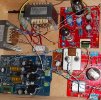
Went ahead and did that, using the same chinese board as a start for my 'maximalist' all-tube NOS DAC.
Have done some PSU mods to it (tantalum caps, chokes etc) and it did help.
View attachment 3076959
For output, tried SRPP with 2C51 but decided it sounds best with single-ended triode (common-cathode) output.
Using a Soviet 6N8S at the moment, but i had also great results with a 6N23P.
6N8S is biased pretty hot and sound crispy and punchy, but you can choose any tube you like.
If you look at the picture I use Nichicon radials in place of the smaller 0.1uF that came with the board.
These 10 decoupling caps are quite important to the sound of the TDA1541.
Unfortunately, space is limited on this PCB. If i print my own, custom PCB for it in the future I will leave a lot of space for bigger and better capacitors.
The Nichicon radials are a pretty good compromise though, given the limited space.
Thanks.I have a BB2, and I by-passed the discrete output stage using a 33 ohm wirewound resistor's. I also swapped the TDA1541 for an 8X TDA 1387, and using a couple
8 uf poly's for coupling. I like it better than my Chinese TDA 1541 board that I used to build a NOS DAC. You need some gain to compensate for the low output,
but I have plenty in my DIY Bulwark preamp that I feed into my re-vamped B&K ST-140.
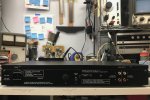
I just by-passed the discrete part. All the parts are still there, I just ran jumpers on the back side of the board directly from the AOL and AOR, pin 6 and 25Thanks.
So if I understand correctly you basically removed all the BB2 parts and using only it's input stage, is that correct?

Thanks.I just by-passed the discrete part. All the parts are still there, I just ran jumpers on the back side of the board directly from the AOL and AOR, pin 6 and 25
from the DAC chip, cut the trace feeding the DAC output that previously went to the discrete output, if that makes sense?
Also, check the voltage going to the DAC chip. Arcam used 6 volts, the max going to the chip, and it will eventually fry the chip. Needs to be dropped to 5 volts.
Just checked, and as you know it is pin 26 of the TDA1541. I had pulled the -6 line and installed a 7905 for the DAC since it seems that there was another chipThanks.
You are correct, I forgot to mention that I also changed the 470r resistor to 360r in the lm337 circuit to lower from - 6V to - 5V voltage to the TDA1541.

The original digital input board is using the - 6V also but I removed it completely as I'm using an external digital input board because I need an optical input.Just checked, and as you know it is pin 26 of the TDA1541. I had pulled the -6 line and installed a 7905 for the DAC since it seems that there was another chip
somewhere that was also using the -6 supply and I wasn't sure that it would be ok with -5 instead of the -6, but apparently it works fine the way that you did it
The fact that it is much shallower means that a significant fraction of the imaging products are not adequately attenuated.Now I know it's much "shallower" filter but isn't the lpf at the output stage takes care of some of the high frequencies you described
Do you know if it's possible and where do I need to to connect the I2S lines (data, bck, lrck, mclk) from my digital input module to the SAA7220 P/B?The fact that it is much shallower means that a significant fraction of the imaging products are not adequately attenuated.