

You are using an out of date browser. It may not display this or other websites correctly.
You should upgrade or use an alternative browser.
You should upgrade or use an alternative browser.
The beastly beast Allen Organ C-3


interesting. Looks more or less the same idea as a Leslie, but probably just different enough to avoid patent issues. Spin the whole speaker instead of just a cone sitting on top of it. Guessing that must have had slip rings and brushes to make it all work.As suspected, this amplifier was mounted inside its own cabinet, and not inside the organ.


Bill Ferris
Lunatic Member
A most excellent job! Should last a long, long, long time.
OT: ever seen one of these? It makes the Ampeg SVT tone, sound tiny. Never restored one. Just a couple SVTs.
http://www.timeelect.com/400-PS-IDX.htm
View attachment 1781734 View attachment 1781735
I`ve restored several of those monster Fender tube amps back in the nineties, and one was offered to me at a attractive price later on, so it now resides in my vintage guitar/tube amp collection.
I also restored a handful of the Ampeg SVT`s as well, back then, and one was offered to me to buy shortly after, and also resides in the collection.

Hi Guys,
I've been working on the input stage of the C-3, trying to improve it.
Just for info, that stage was originally using a pentode 6AU6. I found it noisy so I converted it as a triode with great result.
Then I wanted to try a genuine triode as a test, for even reducing the noise a bit.
I found the 6AV6, a good triode also 7 pin which was a good candidate. This tube is 1/2 of a 12AX7.
After some research I came up with this design, using a led instead of a cathode resistor + bypass cap.
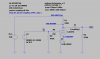
The simulation showed a much better response in the low frequencies, thanks to the led with no dynamic resistance so no bypass cap.
The highs for the audio spectrum were pretty much identical.
Here what the freq response looked for the 6AV6 on the left and the 6AU6 as a triode on the right.

Then I did implement the 6AV6 in one amp and gave it a shot.
On the bench here are the 2 actual amp bode responses, 6AU6 on top and 6AV6 at the bottom.
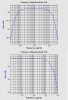
As the model predicted, the actual amplifier measured as expected. Better low response, mids and highs identical.
Now on an actual listening track here is what I have done.
Same known track, played in mono to both amps, and I was listening each amps one at the time.
I had to adjust the balance level and the 6AV6 had much more gain.
First the 6AV6 had more white noise than the 6AU6. I was expecting the reverse. So kinda disappointed.
That aside, I can't tell the difference.
Both are totally excellent, and I can't honestly say I have heard a change.
Maybe, I say Maybe the highs were better with the 6AV6 but I am not even sure.
And the lows are identical to my ears, despite the 6AV6 showed a better low response, but so low in the pectrum that it really does not make a change to human ears, left alone my old ones in particular after decades of heavy metal .
.
So as a conclusion, unless someone sees something obviously wrong with my test, I think I'll pass on implementing that modification as it really does not pay off.
Thanks for reading guys.
Brice.
I've been working on the input stage of the C-3, trying to improve it.
Just for info, that stage was originally using a pentode 6AU6. I found it noisy so I converted it as a triode with great result.
Then I wanted to try a genuine triode as a test, for even reducing the noise a bit.
I found the 6AV6, a good triode also 7 pin which was a good candidate. This tube is 1/2 of a 12AX7.
After some research I came up with this design, using a led instead of a cathode resistor + bypass cap.
The simulation showed a much better response in the low frequencies, thanks to the led with no dynamic resistance so no bypass cap.
The highs for the audio spectrum were pretty much identical.
Here what the freq response looked for the 6AV6 on the left and the 6AU6 as a triode on the right.
Then I did implement the 6AV6 in one amp and gave it a shot.
On the bench here are the 2 actual amp bode responses, 6AU6 on top and 6AV6 at the bottom.
As the model predicted, the actual amplifier measured as expected. Better low response, mids and highs identical.
Now on an actual listening track here is what I have done.
Same known track, played in mono to both amps, and I was listening each amps one at the time.
I had to adjust the balance level and the 6AV6 had much more gain.
First the 6AV6 had more white noise than the 6AU6. I was expecting the reverse. So kinda disappointed.
That aside, I can't tell the difference.
Both are totally excellent, and I can't honestly say I have heard a change.
Maybe, I say Maybe the highs were better with the 6AV6 but I am not even sure.
And the lows are identical to my ears, despite the 6AV6 showed a better low response, but so low in the pectrum that it really does not make a change to human ears, left alone my old ones in particular after decades of heavy metal
.So as a conclusion, unless someone sees something obviously wrong with my test, I think I'll pass on implementing that modification as it really does not pay off.
Thanks for reading guys.
Brice.
Unless your speakers can really do way down, I'm not too surprised it wasn't audible. Looks like its pretty good to about 50hz. You might be able to bump the measured LF response on the 6AU6 just by increasing the value of the bypass cap. Try a 220uf or so.
wonder if the LED is the source of the noise. Might help to bypass it with a film cap.
wonder if the LED is the source of the noise. Might help to bypass it with a film cap.

FretFool
New Member
Regarding the spinning speaker array - Allen Organ called that the "Random Whind" effect, going back to roughly the 1960's. Yes, they spelled Whind with an "h".
About the same time, in my early teens, I had access to one of these amps and attempted to use it in various ways as a mono audio amp and guitar amp. Given that it weighed almost as much as an engine block, the latter purpose wasn't so practical. It was already sort of old and trouble-prone. I didn't have the desire or wherewithal to do anything with it. Chalk it up to youthful disinterest. The transformers are here somewhere.
The example that I had was setup differently for input. I don't recall there being the two- jack/pot configuration at the left front. Rather, there were two small aluminum-boxed modules that alternately plugged into an octal socket at the top-left-front corner of the chassis. One had an RCA jack and a single pot and was intended for line-level input. The other was larger, with a single pot on top, along with a single threaded mike connector, intended for mike-level signals.
I grew up about 20 miles from the Allen Organ HQ, and a friend of my grandfather was a big fan of this amp. He had four of them.
About the same time, in my early teens, I had access to one of these amps and attempted to use it in various ways as a mono audio amp and guitar amp. Given that it weighed almost as much as an engine block, the latter purpose wasn't so practical. It was already sort of old and trouble-prone. I didn't have the desire or wherewithal to do anything with it. Chalk it up to youthful disinterest. The transformers are here somewhere.
The example that I had was setup differently for input. I don't recall there being the two- jack/pot configuration at the left front. Rather, there were two small aluminum-boxed modules that alternately plugged into an octal socket at the top-left-front corner of the chassis. One had an RCA jack and a single pot and was intended for line-level input. The other was larger, with a single pot on top, along with a single threaded mike connector, intended for mike-level signals.
I grew up about 20 miles from the Allen Organ HQ, and a friend of my grandfather was a big fan of this amp. He had four of them.

Hi All,
I've just finished to restore another beast: The Allen Organ C-3, AKA Allen Organ 60.
I found one, and then it took me some time to get a second one to be able to make an identical pair.
Here is how they look like:
Very little info on that beastly beast. Date: unknown. Designer:unknown. Nothing.
All transformers are made by the AirDesign company from PA. Almost no info on the AirDesign company.
Thanks to hammr7 member to give me some info on it:
"Airdesign was formed by Leon Edward Pamphilon during WWII to supply high quality transformers for military applications. The company continued after the war by supplying consumer applications.
I know they tried to branch out (I have seen other airdesign electrical components) but I don't remember seeing much from them after the early 1960's, and don't know whether they shut down, were bought out, or morphed into something else. They were located at 241 Fairfield Ave., Upper Darby, Pa, which by the early 1980's (and possibly a decade earlier) was home to the Bible and Medical Missionary Fellowship(later known as Interserve). I think Pamphilon died in the late 1970's or early 1980's."
Maybe some other AKer have more info. Please let us know
Nice work on some great amps.
Some general info is that Philadelphia and the surrounding area was once a 'hot bed' of electronics. Philco/Ford just up Rt 309 and RCA (central NJ - Princeton, etc.) were both here and they had a large group of suppliers to support their efforts. Allen Organ is still located in Macungie, PA on Rt 100 about a mile down the road from what's left of Mack Trucks. I don't know the name of the small semiconductor fab in Montgomeryville, PA, but it was once RF Devices and there was the larger Commodore computers fab in Valley Forge & HQ in West Chester, PA. RCA had a large LP pressing plant in Pitman, NJ which became a Sony CD pressing plant. Not sure what has become of it, but last I heard was they had saved the LP presses and they have been refurbished and are still running somewhere (in Pitman?).
As an aside, my wife graduated from Pendergast HS which is down the road from where Airdesign was located. There was a "cottage industry" of small 'high tech' companies (high tech for the days during & after WWII) for ideas & products that spun out of the engr'g & science depts of Penn, Drexel, Temple and the other universities & colleges in the region. The area up around the 69th Street Terminal (local public transit hub) is "not so nice" these days, though it is better than it was from about 1975 - 2010, or so.

Brice,
Maybe you don’t need that first stage. An Allen 20 that belonged to a friend had a similar noise issue. I eliminated the first stage which resulted in an input sensitivity more normal for hifi use and the noise was gone. The organ was set up for a lot more gain in the amps. Maybe try injecting your audio input to the first 6SN7 section and see what happens.
John
Maybe you don’t need that first stage. An Allen 20 that belonged to a friend had a similar noise issue. I eliminated the first stage which resulted in an input sensitivity more normal for hifi use and the noise was gone. The organ was set up for a lot more gain in the amps. Maybe try injecting your audio input to the first 6SN7 section and see what happens.
John

Based on the schematic provided, some rough calculations indicate that the sensitivity at the input of the first 6SN7 tube is somewhere between 4.5 and 6.5 volts AC RMS, depending on how much NFB is being applied back to the first 6SN7 stage. For the sensitivity I'm suggesting, I'm figuring about 6-10 db of NFB. In any event, a sensitivity of this level would challenge even a high gain active preamp like an Eico HF-85.
If you consider then that for a 60 watt high fidelity amplifier, an input sensitivity of about 1.5 volts rms is appropriate, it means that the input stage should have a gain of about 3-4 to bring the estimated basic power amp sensitivity (i.e., that circuit within the global NFB loop) in line with the suggested target sensitivity level. Since it appears that you're using a high gain 12AX7 stage with an estimated gain of about 60, there is little doubt of a rather poor S/N ratio such a combination would produce. The use of such a large grid stopper resistor will also guarantee a limited HF response as well.
I would consider:
1. Moving the 470K grid return resistor to the grid side of the 15K resistor.
2. Upping the value of the 15K resistor to 100K.
3. Add an appropriate NFB resistor from the output of C1 back to the grid of the tube. Start with 680K, and adjust as appropriate to achieve the desired tartet sensitivity.
4. Diode bias is a form of fixed bias, but also has the tube amplifying any noise produced by the diode. Good design practice then would still have the diode bypassed to minimize the amplification of any noise from the diode.
5. Input impedance would be approximately 110KΩ.
I hope this helps!
Dave
If you consider then that for a 60 watt high fidelity amplifier, an input sensitivity of about 1.5 volts rms is appropriate, it means that the input stage should have a gain of about 3-4 to bring the estimated basic power amp sensitivity (i.e., that circuit within the global NFB loop) in line with the suggested target sensitivity level. Since it appears that you're using a high gain 12AX7 stage with an estimated gain of about 60, there is little doubt of a rather poor S/N ratio such a combination would produce. The use of such a large grid stopper resistor will also guarantee a limited HF response as well.
I would consider:
1. Moving the 470K grid return resistor to the grid side of the 15K resistor.
2. Upping the value of the 15K resistor to 100K.
3. Add an appropriate NFB resistor from the output of C1 back to the grid of the tube. Start with 680K, and adjust as appropriate to achieve the desired tartet sensitivity.
4. Diode bias is a form of fixed bias, but also has the tube amplifying any noise produced by the diode. Good design practice then would still have the diode bypassed to minimize the amplification of any noise from the diode.
5. Input impedance would be approximately 110KΩ.
I hope this helps!
Dave
KentTeffeteller
Gimpus Stereophilus!
Nice work on some great amps.
Some general info is that Philadelphia and the surrounding area was once a 'hot bed' of electronics. Philco/Ford just up Rt 309 and RCA (central NJ - Princeton, etc.) were both here and they had a large group of suppliers to support their efforts. Allen Organ is still located in Macungie, PA on Rt 100 about a mile down the road from what's left of Mack Trucks. I don't know the name of the small semiconductor fab in Montgomeryville, PA, but it was once RF Devices and there was the larger Commodore computers fab in Valley Forge & HQ in West Chester, PA. RCA had a large LP pressing plant in Pitman, NJ which became a Sony CD pressing plant. Not sure what has become of it, but last I heard was they had saved the LP presses and they have been refurbished and are still running somewhere (in Pitman?).
As an aside, my wife graduated from Pendergast HS which is down the road from where Airdesign was located. There was a "cottage industry" of small 'high tech' companies (high tech for the days during & after WWII) for ideas & products that spun out of the engr'g & science depts of Penn, Drexel, Temple and the other universities & colleges in the region. The area up around the 69th Street Terminal (local public transit hub) is "not so nice" these days, though it is better than it was from about 1975 - 2010, or so.
Correction: RCA's New Jersey Plant in that era was in Rockaway. (Now headquarters for Party City Stores). The Pitman, New Jersey record pressing plant was Columbia Records owned. Both labels Sony Music now.
Thanks Dave.
It certainly does help.
I am now experiencing with CSS on the anode side, just to learn new tricks.
I had reserve before about mixing modern parts with tubes (the usual sand and tube dilemma) but in fact this could result in the best of both world.
Thank you
Brice.
It certainly does help.
I am now experiencing with CSS on the anode side, just to learn new tricks
.I had reserve before about mixing modern parts with tubes (the usual sand and tube dilemma) but in fact this could result in the best of both world.
Thank you
Brice.
Just be aware that using a CCS on the anode side will act to increase the OL gain of the stage to mu, and also make for a very high output impedance indeed.
Dave
Dave
Agreed, the output impedance is bad. But the THD goes down too. Worth trying.
I am back with the 6AU6 as I like that little tube.
I'll start to apply the same ideas you gave me to lower its gain and see how it sounds like.
Then I'll play around with css anode and cathode, diode bias and the likes
It's all fun.
Thank you.
I am back with the 6AU6 as I like that little tube.
I'll start to apply the same ideas you gave me to lower its gain and see how it sounds like.
Then I'll play around with css anode and cathode, diode bias and the likes
It's all fun.
Thank you.
The high output impedance primarily an OL characteristic. Once the local NFB loop is closed around the tube, the output impedance issue is taken care of, as it will be lowered considerably.
Dave
Dave

turnitup
No, the stereo won’t break the crystal...Oh CRAP!
I wish I had the knowledge that you gentlemen have in this space. Obviously, many years of experience, and deep a passion for your trades/hobbies.
Love to see historical builds from this era restored and appreciated. These are a thing of beauty, even before they are powered up - beautiful job!
Love to see historical builds from this era restored and appreciated. These are a thing of beauty, even before they are powered up - beautiful job!

trobbins
Super Member
The photo of the C-3 amp in the Gyrophonic Projector is from Dorf's July 1954 article in Audio. The Gyrophonic Projector was patented (US2491674) in 1949 by J.Markowitz, the founder of Allen Organ, and advertised that year - there is a short sales article in Aug 1950 Radio Electronics (but no details of amplifier used, but saying two 25W speakers were used). It seems then that the C-3 chassis in the Gyrophonic Projector was replaced by the Allen 90 during the later part of the 1950's.
Allen also made a C-3 organ from 1955. I've just posted over on OrganForum if anyone has photos or details of the early B or C series Allen organs, as it may be that those organs just used the external Gyrophonic Projector, rather than a speaker/amplifier built in to the organ console.
Allen also made a C-3 organ from 1955. I've just posted over on OrganForum if anyone has photos or details of the early B or C series Allen organs, as it may be that those organs just used the external Gyrophonic Projector, rather than a speaker/amplifier built in to the organ console.
