• The move to the new server is done. There are some software and database maintenance updates in process. This has us passing the hat around to help out. We appreciate any donations. Seriously, even a dollar helps. The payment page may be found here - https://www.audiokarma.org/support.html

The best phono preamp under $1000 (aka the Hagerman Bugle upgrade thread)

Just so you know. I don't find that individual opamps have a "sound" that is independent of what can be extracted from their specs and the details of their utilization, so take all that I write with a grain of salt based on that reality. This is not your usual audiophile recommendation based on "sound".
 
Just so you know. I don't find that individual opamps have a "sound" that is independent of what can be extracted from their specs and the details of their utilization, so take all that I write with a grain of salt based on that reality. This is not your usual audiophile recommendation based on "sound".

Burn him!!!

:)
 
Just so you know. I don't find that individual opamps have a "sound" that is independent of what can be extracted from their specs and the details of their utilization, so take all that I write with a grain of salt based on that reality. This is not your usual audiophile recommendation based on "sound".
So the LM833 I'm currently using (for MM) is probably also a good choice due to its low input current noise? (about 0,35 pA/√Hz if I read the graph correctly)
https://www.ti.com/lit/ds/symlink/lm833.pdf?ts=1667933411315&ref_url=https%3A%2F%2Fwww.ti.com%2Fproduct%2FLM833
Slew rate (7 V/μs) and gain bandwith product (16mhz) are not the highest but THD is ok I guess? (0.002%)

I think using this amp as a MC version was a bit of an afterthought if I look at the timeline.
 
Last edited:
Is it possible, I wonder, to specify the best op amp (based on technical merits) for each position, or are there always trade-offs/compromises that make that an impossibility?
 
Yes. I know it’s on the bugle2 parts list when ordering a bugle2 board. It’s very lightweight plastic and I don’t like the end covers. I think it weighs in at a negative 9 grams in the plastic because it moves all over the place once you connect your cables.


if you have the dimensions you may be able to find the same size case in aluminum. This looks like the same basic style as the cheap aluminum project box I used for my subsonic filter but about twice as deep. The one I used was about 15 bucks on Amazon, but I know they exist in lots of sizes. Its still not real heavy but probably a bit more stout than the plastic. I considered adding a hunk of 1/4" steel mounted inside the top cover of mine just for ballast.
 
Noise? Sounds like a grounding issue.

Nah.
What I'm describing is a lot worse than a ground buzz.
Initially, I thought maybe the wall wart had shorted.
But it tested fine and using another psu gave the same hair-raising result.

Replaced the Bugle 2 with the Bugle 3 and it worked great for six months, then did the same damn thing as the Bugle 2.
Both were bought used. I've no idea how old they were.

Currently quite happy with the offerings from Darlington Labs.
No problems at all.
 
if you have the dimensions you may be able to find the same size case in aluminum. This looks like the same basic style as the cheap aluminum project box I used for my subsonic filter but about twice as deep. The one I used was about 15 bucks on Amazon, but I know they exist in lots of sizes. Its still not real heavy but probably a bit more stout than the plastic. I considered adding a hunk of 1/4" steel mounted inside the top cover of mine just for ballast.

It would be kinda nifty were someone to create a spreadsheet of all the project boxes with internal dimensions such that we could find compatible boxes
 
So the LM833 I'm currently using (for MM) is probably also a good choice due to its low input current noise? (about 0,35 pA/√Hz if I read the graph correctly)
https://www.ti.com/lit/ds/symlink/lm833.pdf?ts=1667933411315&ref_url=https%3A%2F%2Fwww.ti.com%2Fproduct%2FLM833
Slew rate (7 V/μs) and gain bandwith product (16mhz) are not the highest but THD is ok I guess? (0.002%)

I think using this amp as a MC version was a bit of an afterthought if I look at the timeline.

I don't think that it's the best choice as far as distortion is concerned. The 0.002% distortion is specified up to 20kHz, unity gain, which is good, but will likely be 34x worse due to the gain stages operating at a noise gain of 34, so we're approaching 0.07%, and this is for a single gain stage at 1vrms.
For comparison/reference, the WP MC phono stage has total distortion levels for the whole chain included of < 0.0003% at 10kHz (I cannot measure THD for 20kHz) with 70-80dB of total gain at an output of 3v rms. You probably don't think that this is important, but I have my reasons for believing it is.
The WP phono also has an equivalent input noise resistance of 45 ohms (0.85nv/rt Hz) at 1kHz using OPA1612s and 35 ohms (<0.8nv/rtHz) using AD797/LT1115s. This is about 12dB or so better than the Hagerman.
 
Is it possible, I wonder, to specify the best op amp (based on technical merits) for each position, or are there always trade-offs/compromises that make that an impossibility?

For this build I know the specs are going to matter and change performance. How to tell I cannot. I do think it’s worth a try with the opa2210 and the one 1612 for some truly phenomenal low end response. Do you want to really see what your set up is capable of for a stand up bass?

The 3 2210 will probably be more defined across the range without provoking your inner 17 year old want of 18” velodyne subs (plural).

I just had one (2210) with added adapter mailed out for $16 or so. It’s not hard at all to pull out and replace them to suit your needs.

I only tried 3 permutations (not combinations because the ‘order’ matters. Guess who has taught mathematics?)
I tried all 3 in 2210 liked, all 3 in1612 didn’t like, and 2 2210 with one 1612 in the 3rd slot farthest from the input end w ground ( production of the ample bass with everything mi,mm, mc that I have available including AT 13e, Empire 66 w both conical and elliptical, Empire’s 2000z w s2000z stylus and retip s915e w LC diamond, and an AT-F7 with beyerdynamic SUT. ) I want to note that my build choice was with the bugle2 in the lowest gain configuration of ~ 36 dB. I believe Oranda chose something higher near ~ 40 or 42 dB gain. I don’t remember the exact number as I am walking the dog right now and don’t want to look it up. I might be off a couple of dB.

But neither of us use it in the full gain design mode for mc. I don’t remember if Oranda tried it out in mc mode without a SUT. I haven’t seen an inexpensive design that does both exceptionally well. (I now believe that the WP model will do both MM & MC very well. I don’t know as I have yet to build one. I’m working on it and hopefully convince the OP to add one to his collection. I do believe there’s a member here who can accurately verify the performance of the WP design.)

I hope this helps,

DR

 
Last edited:
For this build I know the specs are going to matter and change performance. How to tell I cannot. I do think it’s worth a try with the opa2210 and the one 1612 for some truly phenomenal low end response. Do you want to really see what your set up is capable of for a stand up bass?

The 3 2210 will probably be more defined across the range without provoking your inner 17 year old want of 18” velodyne subs (plural).

I just had one (2210) with added adapter mailed out for $16 or so. It’s not hard at all to pull out and replace them to suit your needs.

I only tried 3 permutations (not combinations because the ‘order’ matters. Guess who has taught mathematics?)
I tried all 3 in 2210 liked, all 3 in1612 didn’t like, and 2 2210 with one 1612 in the 3rd slot farthest from the input end w ground ( production of the ample bass with everything mi,mm, mc that I have available including AT 13e, Empire 66 w both conical and elliptical, Empire’s 2000z w s2000z stylus and retip s915e w LC diamond, and an AT-F7 with beyerdynamic SUT. ) I want to note that my build choice was with the bugle2 in the lowest gain configuration of ~ 36 dB. I believe Oranda chose something higher near ~ 40 or 42 dB gain. I don’t remember the exact number as I am walking the dog right now and don’t want to look it up. I might be off a couple of dB.

But neither of us use it in the full gain design mode for mc. I don’t remember if Oranda tried it out in mc mode without a SUT. I haven’t seen an inexpensive design that does both exceptionally well.

I hope this helps,

DR

Is there documentation somewhere for decreasing gain to 36db? I dropped the gain on my TC-750 to 34db because my preamp has a 2.5v input limit beyond which it will clip, and I occasionally run aftermarket styli on Shure cartridges and they can be a bit hot.
 
Is there documentation somewhere for decreasing gain to 36db? I dropped the gain on my TC-750 to 34db because my preamp has a 2.5v input limit beyond which it will clip, and I occasionally run aftermarket styli on Shure cartridges and they can be a bit hot.

Edit: See above ^. Yes, well sort of. You can use an online app to calculate your resistor values needed for your desired gain.

Once you calculate what you need for resistors, you have to choose the closest available value resistor.

It will be close but not exact because it’s not always possible to get what you want. Mick Jagger can help you get what you need however.
 
Last edited:
I wonder how important the C4 and C5 (from the bugle2 schematic) capacitors are for the sound, besides having the correct value. I mean they go to ground.
C6 is the only capacitor in the signal path.
It's a fallacy that capacitors which "go to ground" are not in the signal path. They are. WP explains their function below. Capacitors which produce distortion in those locations will distort the signal.

The first 220n cap sets the 318 and 3180us TC. Essentially all frequencies in the audio band between 20 Hz and 2k Hz are subject to whatever distortion the cap creates to a lesser or greater extent.
The 10nF cap sets the 75us TC, and all frequencies from 1kHz on up are subject to its distortion to a lesser or greater extent.
The second 220nF cap sets the LF -3dB cutoff at about 8Hz and will hardly affect the distortion.
 
Last edited:
For this build I know the specs are going to matter and change performance. How to tell I cannot. I do think it’s worth a try with the opa2210 and the one 1612 for some truly phenomenal low end response. Do you want to really see what your set up is capable of for a stand up bass?

The 3 2210 will probably be more defined across the range without provoking your inner 17 year old want of 18” velodyne subs (plural).

I just had one (2210) with added adapter mailed out for $16 or so. It’s not hard at all to pull out and replace them to suit your needs.

I only tried 3 permutations (not combinations because the ‘order’ matters. Guess who has taught mathematics?)
I tried all 3 in 2210 liked, all 3 in1612 didn’t like, and 2 2210 with one 1612 in the 3rd slot farthest from the input end w ground ( production of the ample bass with everything mi,mm, mc that I have available including AT 13e, Empire 66 w both conical and elliptical, Empire’s 2000z w s2000z stylus and retip s915e w LC diamond, and an AT-F7 with beyerdynamic SUT. ) I want to note that my build choice was with the bugle2 in the lowest gain configuration of ~ 36 dB. I believe Oranda chose something higher near ~ 40 or 42 dB gain. I don’t remember the exact number as I am walking the dog right now and don’t want to look it up. I might be off a couple of dB.

But neither of us use it in the full gain design mode for mc. I don’t remember if Oranda tried it out in mc mode without a SUT. I haven’t seen an inexpensive design that does both exceptionally well. (I now believe that the WP model will do both MM & MC very well. I don’t know as I have yet to build one. I’m working on it and hopefully convince the OP to add one to his collection. I do believe there’s a member here who can accurately verify the performance of the WP design.)

I hope this helps,

DR
Heck, I measure and publish the results up to the limits of my test environment, and SOTA has confirmed them up to their limits which are less exacting than mine. So, do what you will.
 
Heck, I measure and publish the results up to the limits of my test environment, and SOTA has confirmed them up to their limits which are less exacting than mine. So, do what you will.

I’m not able to say which op amps will work best based on the specs. I’m just trying to help @cgallery with what I have tried & share my experience with what I tried out. I do know that it will make a difference.

Is it possible to tell which op amp will produce a better bass response? I’m curious why the 1612 does this when placed in the 3rd slot with the 2210 in the first two? It would be nice to see how or why it does that.
 
image.jpg

Silly people.

And to the OPA rollers. If you can't measure it leave it stock

^ Absolutely, 100% unequivocally Not! If you haven’t built it and tried it. I could not have predicted the results, repeated results from 2 different builds and 2 separate sets of both opa s.

Measuring results on a meter may show differences with limits that I can’t hear. Measured results with my ears always show results that I can hear. Strange.

Edit: I won’t comment on a build that I haven’t tried. I’m sure WP pa is phenomenal and I am on my way to building one.
But what I do know, is this build, the one Oranda labored through and currently listening to with Stan Getz, does exactly what I have posted.

With my experience, it performs well above the original Bugle2.

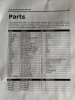
Here’s a pic of the parts list for those who want it on here.
 
Last edited:
Back
Top Bottom