• The move to the new server is done. There are some software and database maintenance updates in process. This has us passing the hat around to help out. We appreciate any donations. Seriously, even a dollar helps. The payment page may be found here - https://www.audiokarma.org/support.html

The Consumer Electronics Hall of Fame: McIntosh MR 78 Tuner

If my memory serves me correctly there was a article in Audio magazine about the back story of the refinement of the MR77 into the MR78.

I also believe there was a friendly rivalry between Mr Mac and Saul Marantz over tuner designs and performance and being unprofitable for their respective companies.

The back story of the MR78 was that a customer in Connecticut could not get his favorite station from NYC because of alternative station interference from a local station.

DOB over dinner one night volunteered he was the pack mule who hauled around a prototype battery powered tuner to test it's ability to reject adjacent stations.

I seem to remember someone telling me the complaining customer was Modeferri himself.........do not remember who.

I got the impression that Modeferri believed his own press releases.....did any other tuner license his circut?

The Mr80 made use of the Sanyo sourced variable diodes if I remember correctly similar to what Tandberg did with their contempory receivers.

Later tuners were designed for multiroom local reception.......DXing as a hobby faded.
 
The back story of the MR78 was that a customer in Connecticut could not get his favorite station from NYC because of alternative station interference from a local station.

Epilogue to that story - even the MR78 was still unable to reject the local transmitter (literally across the street) in order to receive the weaker classical one in NYC. RM did manage to pull it in clearly with a "mess" consisting of some combination of 2 MR67 and an MR71 all wired together in some way. RM's job was to get that tangled affair into one box which became the MR78 - but a number of compromises had to be made and still fell short of the 10B which the man kept using. However it was still leaps beyond the MR77 which had failed miserably at the man's house. Larry Fish claims he could've done a tuner that, in his words, "would have beat the pants off" the MR78 or MR80 but the exorbitant costs involved made it unfeasible. CDs had come out by then and they felt the market was not there for such an expensive tuner to justify production.

Personally I felt the MR80 had a slight edge over the MR78 myself.
 
RM's job was to promote RM, still is.

I believe the backstory about the Mr Mac, Saul story was that Saul lost money on every 10 B they built, the MR78 was in production for 10 years, $900 to $1700 over that time.

I still wonder if RM managed to license anyone else to use his design.
 
RM's job was to promote RM, still is.

I believe the backstory about the Mr Mac, Saul story was that Saul lost money on every 10 B they built, the MR78 was in production for 10 years, $900 to $1700 over that time.

I still wonder if RM managed to license anyone else to use his design.
Chris - wasn't the 10B responsible for the demise of Marantz due to the money invested in its development?
 
There has been rumor of that. I have also heard that they were notoriously hard to alighn and keep properly alighned once in the field. I have had no personal experience with one.

After Sony decided to set up their own U.S. distribution cutting out Superscope, Superscope was desperate to find a new partner to distribute........I am sure money and promises were prevalent.

Having personally gone thru the Clarion/McIntosh situation I can sympathize with must have happened in the culture clash.
 
Never had any issues with 10B alignment as this should not be done. Opto-couplers were a different issue though. Regardless of alignment the 10 B will be effected by HD radio noise where the MR78 will not.

thanks,
Ron-C
 
Was the MR78 their most successful in terms of sales?, has anyone ever compared production figures of the various models over the years?
 
Out of curiosity, was Modeferri an employee or consultant to McIntosh? Did he get any royalties from sales?
 
I think RM's stint at Mc was shorter than most engineers. His main contribution seems to be the MR77 and MR78 after which he departed in the early '70s and Larry Fish became Mc's tuner man. Larry had previously been employed by HH Scott which had a solid reputation for its tuners.

- I once read 10B's alignment was so precise, it had to be done in some sort of oven at the factory and the 10B's development and production was so costly, it put Marantz in financial straits.
 
It is not rumor, Saul B. Marantz had to sell the Marantz Company to Superscope in 1964 due to that exact reason.

Wow, a sad and fairly significant event in audio history. How different would things have been had Marantz continued as a high-end American manufacturer?

I can’t help but wonder if the over spending on the 10B development was excessively (i.e. ego) driven by competition with Mc, bad management or just an honest miscalculation.
 
The Marantz 10 and 10B development was complex, lengthy, and the tuner was sold too cheaply for the Marantz Company to make their costs back. Marantz lost money on every 10 and 10B they built. This sank the company. And forced the sale. Marantz should have designed and built a less complex high end conventional tuner, with simpler circuitry with the Marantz build quality and engineering and sonic excellence first. That could be sold at a profit. Saul B. Marantz and crew likely made an honest miscalculation which cost them the company over the 10 and 10B. The Marantz 10B should have sold for $1500 new, so the company would have made a profit on every one. I'd have done the conventional high end tuner, built it to Marantz standards, and competitive with McIntosh and HH Scott's Broadcast Monitor line, and gained expertise from building those. That mindset and keeping the oscilloscope a separate component a la McIntosh's offering would have been more practical.

REL(Radio Engineering Laboratories) built and over engineered the Precedent, the inspiration for the Marantz 10 and 10B. REL had the same problem, and they had no expertise in manufacturing consumer equipment (the Precedent was built more like broadcast equipment) and introduced and sold the Precedent at a loss on every tuner sold. Once REL realized they were losing money, they ceased selling and producing the Precedent. REL's focus and expertise was in broadcasting and two way radio.
 
In 1970 as a first year engineer out of college making $11,200 gross I stuck my neck out and purchased a new MR73 for $550. At the same time the 10B was going for $650. The extra $100 was more than I could swing. I would note that even if I had the extra $100 I probably would not have bought it since it was tube and I thought that was like a Model T. I was more upset later in the year when Mac dumped the one year old MR73 and came out with the MR77 for $595.
 
Wow, a sad and fairly significant event in audio history. How different would things have been had Marantz continued as a high-end American manufacturer?

I can’t help but wonder if the over spending on the 10B development was excessively (i.e. ego) driven by competition with Mc, bad management or just an honest miscalculation.

I actually read that it may have been the Fisher FM1000 that drove Saul Marantz to develop the 10b that lead to him having to sell Marantz due to the financial strain on the company to make the 10b. I could just imagine what Marantz would have been if Saul M. didn't sell the company.
 
I could just imagine what Marantz would have been if Saul M. didn't sell the company.
Anyone who lets his ego cloud his business decisions is not really a great businessman. He should have raised the price to at least break even or dropped the product and moved on.
 
Epilogue to that story - even the MR78 was still unable to reject the local transmitter (literally across the street) in order to receive the weaker classical one in NYC. RM did manage to pull it in clearly with a "mess" consisting of some combination of 2 MR67 and an MR71 all wired together in some way.

RM's job was to get that tangled affair into one box which became the MR78 - but a number of compromises had to be made and still fell short of the 10B which the man kept using. However it was still leaps beyond the MR77 which had failed miserably at the man's house.

Personally I felt the MR80 had a slight edge over the MR78 myself.
That's an EXTREME condition, being across the street from a local station! It's almost like being in the 'near field' of the broadcast antenna array (not really though). Setting up an FM tuner literally across the street from an FM transmission tower could swamp out other stations at moderated distances away.

Looking at the broadcast and receive antenna directivity (beamwidths) in both azimuth and elevation patterns would be complex but doable today. Back in that era it wouldn't be feasible—especially a 3D Link Budget. They could have easily done a LOS (line of sight) calculation for LOCAL and REMOTE stations to get a handle on requirements.

P(RX) = P(TX) + G(TX) - L(TX) - L(FS) - LM + G(RX) - L(RX)

https://en.wikipedia.org/wiki/Link_budget#Equation

One would not expect to FM DX across the street from an FM station. Trying to design and build a tuner for THAT application would bankrupt any company, me thinks. Modafferi insisted on being able to tune NYC from that location? Was he let go from McIntosh for that reason? :idea:

How about the shelved MR 81? What McIntosh tuner was going to have a built-in multipath and tuning scope?

Chicago FM DXing

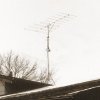
I loved my MR 80 setup in Chicagoland (Arlington Heights) with TWO switchable antennas for gain comparison. There were two or three STRONG stations in the area, and the Channel Master 4408 FM Probe antenna took care of that situation—see beamwidth animation in URL below. Milwaukee stations were the best, when the 4408 antenna was roughly broadside to downtown Chicago. No ordinary tuner with an FM dipole tacked on wall could pull them in with any fidelity, if at all.

http://ham-radio.com/k6sti/probe9.htm

4408G_Chicago.jpg
4408 in Arlington Heights pointed north:

Chicago FM Log on the WayBack Machine (1988)

https://web.archive.org/web/20010407005345/http://members.home.net/g-abbey/ChicagoFM.htm

The ultimate McIntosh DXer would have an MR 78 or MR 80, a rotatable FM beam antenna, and a MPI-4 tuning/antenna pointing scope.


This post, in part describes an `adventure in McIntosh FM DXing´. It was worth the effort and expense! Many hours of enjoyable listening and a fun project. :thumbsup:


-Greg
 
Last edited:
One would not expect to FM DX across the street from an FM station. Trying to design and build a tuner for THAT application would bankrupt any company, me thinks. and Modafferi insisted on being able to tune NY from that location? Was he let go from McIntosh because of that? :idea:

How about the shelved MR 81? What McIntosh tuner was going to have a built-in multipath and tuning scope?

As far as I'm aware Richard's departure from McIntosh was voluntary in order to pursue other interests.

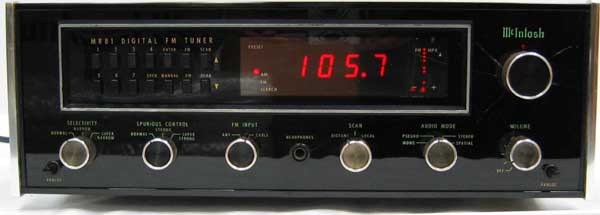
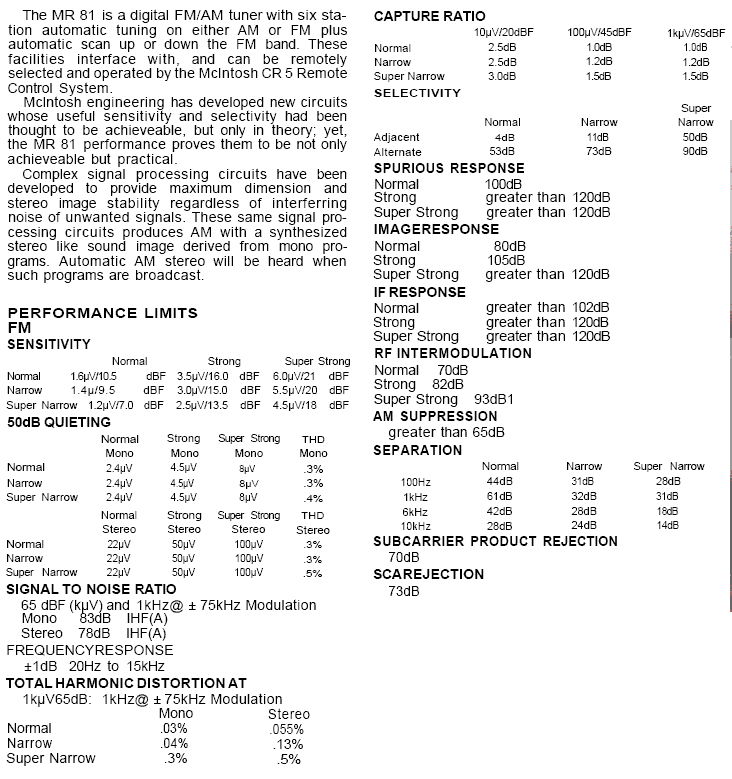
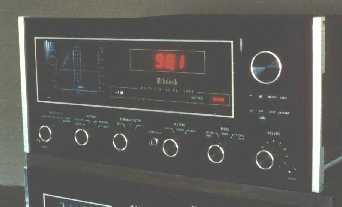
To my knowledge the handful of MR79s that were made are in the hands of a select few McIntosh engineers. I'm not certain if the MR79 was anything more than a basic MR80 + scope but I believe the MR81 did have significant improvements. I haven't studied the specs to verify but I provided them below.

One notable difference was the elimination of the touch pad buttons which I think was probably a good idea.

This would probably qualify as the "holy grail" of McIntosh tuners.

MR-81 (Prototype)
mr81i.jpg


mr81.gif


mr79.jpeg
 
Last edited:
Back
Top Bottom