Hi
@FlaCharlie,
The purpose of collar batteries is to stop the dog from barking. Will they affect the sound of the ”Flow”?

More seriously, I wondered if you tried the battery in parallel with the tube, rather than in series with the input? I think you mentioned it somewhere, but I can’t find it now. Was the concern the quicker discharge of the battery that way through the grid to ground resistor?
I started looking for the LS165W - 2T SMPS and can’t find it anywhere, including AliExpress.us. I must be looking at the wrong places. Could you list a couple of sources your dealt with before, as example sources?
I’ve used a few battery bias methods.
One uses a battery between the cathode and ground where it replaces the cathode resistor. In that configuration the positive of the battery connects to the cathode and the negative goes to ground.
Since current flows through the battery (just as it does through a cathode resistor) you have to use re-chargeable batteries. Regular batteries will be damaged (probably blow up). And even re-chargeable batteries can be damaged (and eventually blow up) if the current is too high. I found that out the hard way after I tried to use this method on an output tube. I caught it before it exploded but the battery was bulging.
I used this method successfully on the preamp tube of an amp using a 9v re-chargeable. The big advantage of battery cathode bias is that it eliminates the need for a cathode bypass cap.
But I wasn’t using the amp regularly and re-chargeable batteries discharge (slowly) on their own even if they aren’t being used. So every time I wanted to use the amp I had to remove the battery and put it in a charger.
Another downside to battery cathode bias is that, even if you use the device regularly and keep the battery charged, there are fewer types / voltages of batteries that are available in re-chargeable form and they are relatively expensive.
So I switched to battery grid bias which, IMO, is much more workable and convenient. There are two ways to do battery grid bias. They each have advantages and disadvantages.
One way, which is what you seem to be referring to, is to put the positive of the battery to ground and connect the negative to the bottom of the grid leak resistor. Or, to put it another way, the battery goes between the grid leak resistor and ground.
I used this method to bias the 1626 tubes in my Boogie Factor preamp.
The advantage of this method is that you can use one battery to bias both preamp tubes. The disadvantage is that it requires you to use DC blocking caps on the inputs.
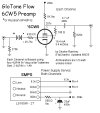
The method used in the Flow puts the battery in series with the signal. The advantage of this method is that you don’t need DC blocking caps on the input. The disadvantage is that you need to use a separate battery (or battery pack) for each tube.
This is the method (the Flow) I’ve come to prefer though my preference is really just based on my preference for fewer caps. I don’t hear any difference between the two methods of battery grid bias. Battery cathode bias sounds fine too but I just find it too limiting and cumbersome.
The SMPS I used for the Flow seems to only be available on AliExpress. Sellers come and go there and the seller I bought them from no longer has them in stock.
If you search for
High Power Tube Preamp Switch Power Supply you’ll find some. Prices and shipping charges vary wildly. Best I saw was ~$30 shipped. As usual, some sellers list a similar price for the item and charge crazy shipping prices. And some listings might say "Welcome Deal" which means that the price is only for buyers who have never bought anything on AliExpress before.
There is a slightly smaller one that can be found on eBay. I tried it too and it will work but I don’t like that it only has two connections for the power cord (line and neutral) and no connection for the safety ground. The most obvious difference is that the one I prefer has two yellow transformers while the smaller version only has one. It can be found using the same search terms on both AliExpress and eBay.
Of course, you could also use the larger SMPS that's used in the Simplissimo and the RLT 6N6G that my granddaughter built. They seem to be ~$50 and can be found on eBay.