• The move to the new server is done. There are some software and database maintenance updates in process. This has us passing the hat around to help out. We appreciate any donations. Seriously, even a dollar helps. The payment page may be found here - https://www.audiokarma.org/support.html

The Idiot's Guide to Using DeOxit (revisited)

I tried to copy this video at the 2:10 time stamp to show the volume pot on the end. The first two pots on the shaft are open at the top but the rear two you will need to put the straw in that little rectangle endentation and give it a squirt. It appears to be located under the gyro tuning wheel and you may be able to get at them from the side once cover is off. At the 4:05 time stamp there is a closeup of what I believe is the volume pot.
I have some extra spray straws and use various methods to bend them to get to hard to reach places, sometimes heating them then bending and holding in that position until cooled works and other times I will bend them and use electrical tape to hold them in the position I need until done squirting.

 
Last edited:
Gosh, got some DeOxit to clean up my MCS3253 and just got to spraying some into the pots and now i'm double checking i have the right stuff. Using D5 to spray out the balance potentiometer, did i just **** it up? didn't even know there was a "right" and "wrong" spray to use on the potentiometer, the guide didn't mention which spray to use so I used D5..... which ones the correct one? Still have the little bottle of D100L to save this
 
Gosh, got some DeOxit to clean up my MCS3253 and just got to spraying some into the pots and now i'm double checking i have the right stuff. Using D5 to spray out the balance potentiometer, did i just **** it up? didn't even know there was a "right" and "wrong" spray to use on the potentiometer, the guide didn't mention which spray to use so I used D5..... which ones the correct one? Still have the little bottle of D100L to save this
Probably not. The spray D5 is pretty forgiving. There have been a few mentions on this thread about using the green label "Fader Lube" for pots with plastic, but I never worried about it. I didn't have any have any sliding controls to worry about until I decided to clean my 1980's Technics receiver. I bought a can of the Fader Lube and it worked great on those. But, for me, it was always regular D5 spray on everything, followed by the Gold despite some of the pots having that brownish plastic component to them. Never any issues. I think it probably helps that the Gold has some lubricant or conditioner added to it - I believe, it's been a long time since I read this whole thread - that either negates or diminishes the concerns about the plastic becoming brittle.
 
Not impressed with Deoxit D5, I used it on headphone jack speaker contact switches, cleared the static for a couple of hours and then static came back, so tried a second time, static came back again. Finally used Stabil Rust Stopper, it has no solvent, is fairly thick, no more static and cutting in/out!

Oh, the straw that came with it literally was blown out of the spray cap, had to dig through straws from other spray cans to find one that fit tight. This was the Deoxit D5 with the adjustable spray cap, so I think the new version of the can.
 
Not impressed with Deoxit D5, I used it on headphone jack speaker contact switches, cleared the static for a couple of hours and then static came back, so tried a second time, static came back again. Finally used Stabil Rust Stopper, it has no solvent, is fairly thick, no more static and cutting in/out!

Oh, the straw that came with it literally was blown out of the spray cap, had to dig through straws from other spray cans to find one that fit tight. This was the Deoxit D5 with the adjustable spray cap, so I think the new version of the can.
Well it turns out the headphone jack speaker switches were not the problem, so have not really tested Deoxit D5.
 
Well it turns out the headphone jack speaker switches were not the problem, so have not really tested Deoxit D5.

I think the beauty of the initial/ OP is that it's a framework to follow when problem solving AND just a guide for general maintenance. If something doesn't work, follow the steps to clean the unit. If you're just trying to get rid of a little scratchiness, follow the steps to clean the unit.

It's (DeOxit- D5 and all it's relations, FaderLube, etc) a quality product and it is almost at legendary status for sorting problems that seemed - often - like they were something more serious. It's the first simple thing that anyone can do to tune or troubleshoot their gear with little chance of causing harm.

Good luck finding the issue.
 
I think the beauty of the initial/ OP is that it's a framework to follow when problem solving AND just a guide for general maintenance. If something doesn't work, follow the steps to clean the unit. If you're just trying to get rid of a little scratchiness, follow the steps to clean the unit.

It's (DeOxit- D5 and all it's relations, FaderLube, etc) a quality product and it is almost at legendary status for sorting problems that seemed - often - like they were something more serious. It's the first simple thing that anyone can do to tune or troubleshoot their gear with little chance of causing harm.

Good luck finding the issue.
Thanks, turns out the problem was a mute relay, will have it replaced soon.
 
Never used DeOxit because it is unknown to me. What I did discover was that opening switches and cleaning them with alcohol 96% gives a good result. I do not use grease and if there are more switch blades that are interchangeable I change them. Each blade has its own wear on the contacts and change them from position gives them almost a new switch ground to work on. I sand souble sided switchblades with lesser quality copy paper.

There are switches we use a lot less and still cracks. I push or rotate them gently a lot of times and the static disappears. These switches suffer more from standing still than from use. For potentiometers I use silver graphite for locks after cleaning them first with alcohol. Add a small amount of sg-powder on the resistor strip and turn it slowly a few times.
 
I thought I would share how I use DeOxit. Given the price I was tired of trying to get the spray to go into little, tiny holes and gaps in switches only to have the spray go everywhere else but where I wanted it. One of my early DeOxit purchases included one of the small 2 oz. cans with the metal tip. I loved how much control the smaller metal tip gave me and how much less DeOxit I was using. So after the small can was gone I tried to use the metal tip with the larger cans but that didn't work plus the nozzles are different so you can't switch those. Instead I have been able to shove the metal tip inside the red plastic spray tip that comes with the larger cans. It is not an easy fit, and it falls out occasionally but it does work. It allows me to get the nozzle tip inside small holes instead of holding the nozzle up against the hole and hoping some goes inside. Getting the spray right where you want it and not all over the outside saves a lot of product. Because the nozzle is bent you can swivel it to get behind or under switches and it extends my reach so I can now get to deeply buried switches that would normally require further tear down. I tried to find other metal spray tips that would fit better but had no luck.

IMG_20250217_132146743.jpg
 
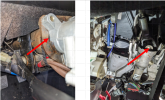
I discovered a new use for Deoxit. My 1989 Toyota MR2 developed a strange intermittent horn problem. After testing it like it was a piece of electronics, I realized that there was a bad ground contact in the first stage of the steering column, between the steering wheel and universal joint that allows adjustment of the steering wheel height. I was about to start taking things apart further when I decided to spray Deoxit all over the place. The right figure shows a small opening just below the steering wheel, and the left picture shows the far end where the universal joint is just visible. Happily, it solved the problem, the next stage of tear down was not something easy. Also when I steer the car there is no more static.

1742682528741.png
 
I discovered a new use for Deoxit. My 1989 Toyota MR2 developed a strange intermittent horn problem. After testing it like it was a piece of electronics, I realized that there was a bad ground contact in the first stage of the steering column, between the steering wheel and universal joint that allows adjustment of the steering wheel height. I was about to start taking things apart further when I decided to spray Deoxit all over the place. The right figure shows a small opening just below the steering wheel, and the left picture shows the far end where the universal joint is just visible. Happily, it solved the problem, the next stage of tear down was not something easy. Also when I steer the car there is no more static.

View attachment 3461810
Let me turn you on to this.

 
I've not read the whole thread but I have used a ton of deoxit. Love it. Only thing I would never do is use it on a damped potentiometer as it will utterly annihilate the grease and leave you with a horrible gritty feeling volume knob.
 
I have an Adcom GFP-555 that works great, except I have to turn the balance back and forth a couple times to get the left side working the way it should be. I have not tried swapping the speakers yet, but it could probably use some deoxit given its age.

I have a can of D5, Fader Lube and CRC QD Electronics cleaner. Which of those should I use? Do I need anything else?
 
I have an Adcom GFP-555 that works great, except I have to turn the balance back and forth a couple times to get the left side working the way it should be. I have not tried swapping the speakers yet, but it could probably use some deoxit given its age.

I have a can of D5, Fader Lube and CRC QD Electronics cleaner. Which of those should I use? Do I need anything else?

Which Caig product to use is answered here: https://audiokarma.org/forums/index...or-100-faderlube-or-gold.271531/#post-3309824

The Caig products dissolve oxidization but are expensive. Products like CRC QD clear chunks of dissolved junk, so great for use after using Caig products, and CRC QD is cheaper so better for higher volume uses like clearing junk away. So, dissolve oxidization with the right Caig product and then use CRC QD to clear out all the dissolved junk... so long as you don't need the lubricant from Caig FaderLube or Caig Gold to remain.
 
Which Caig product to use is answered here: https://audiokarma.org/forums/index...or-100-faderlube-or-gold.271531/#post-3309824

The Caig products dissolve oxidization but are expensive. Products like CRC QD clear chunks of dissolved junk, so great for use after using Caig products, and CRC QD is cheaper so better for higher volume uses like clearing junk away. So, dissolve oxidization with the right Caig product and then use CRC QD to clear out all the dissolved junk... so long as you don't need the lubricant from Caig FaderLube or Caig Gold to remain.
This is helpful, but that's just it. I don't know whether ot not I need the lube to remain. It is a balance knob so it presumably has a pot (I have not opened it up yet). So faderlube and CRC? Or vice versa? Or D5 then CRC or vice versa? Sorry it has been a long time since I used this stuff. I should probably clean the other pots while I am in there too.
 
This is helpful, but that's just it. I don't know whether ot not I need the lube to remain. It is a balance knob so it presumably has a pot (I have not opened it up yet). So faderlube and CRC? Or vice versa? Or D5 then CRC or vice versa? Sorry it has been a long time since I used this stuff. I should probably clean the other pots while I am in there too.
Balance is a potentiometer (typically a ganged pair of them.
 
Back
Top Bottom