• The move to the new server is done. There are some software and database maintenance updates in process. This has us passing the hat around to help out. We appreciate any donations. Seriously, even a dollar helps. The payment page may be found here - https://www.audiokarma.org/support.html

The Idiot's Guide to Using DeOxit (revisited)

Yes , it's Mar 09, 2022, more than 13 years since Arkay's OP. Just spent most of the afternoon reading all 543 posts and many of the links and videos. Most of the questions and experienced answers apply to cleaning up OLD contacts and connections. To the speaker rebuilders and cable makers, and anyone using NEW parts [ rca connectors, binding posts, crimp connectors, quick connects, bare wire etc. ] - have you used, and do you recommend using one of the DeoxIT GOLD products to " improve conductivity and provide long-lasting protection on gold, base metals and other precious metal contacts and connections (gold, silver, rhodium, copper, bronze, nickel, etc.)."

Don't do it! Unskilled and/or people lacking knowledge can easily mess up good equipment by trying to improve things. I often buy equipment and speakers at bargain basement prices because the previous owner thought that they knew what they were doing and ruined their equipment.

For new equipment, cables, and connections, nothing is needed except to connect and use the equipment. The materials are supposedly clean and not oxidized or corroded. You cannot improve a solid metal to metal connection by using any spray type chemical.

This does not foreclose proper long term preventative maintenance. For example, it is good practice to remove and inspect RCA and other connections every year or so. If they look good, reseating them will re-establish a good connection. Nothing more is needed.
 
Yah buddy ...give it a try...Mine was horrible. I took the cover off and hit it from both sides too....I had to work it for a while too...I could feel the gunk breaking up almost every time I worked it. Took almost 5 minutes along with the application of the F5 fader to get it nice and smooth....let it dry a while and gave it a try.... hope it does the trick for you too eh.....I know I love my old 929 and regretted having to set it aside....... it's back in the stack again!
Goggles Pizano! Absolutely perfect one of my favorite episodes.
 
Yah buddy ...give it a try...Mine was horrible. I took the cover off and hit it from both sides too....I had to work it for a while too...I could feel the gunk breaking up almost every time I worked it. Took almost 5 minutes along with the application of the F5 fader to get it nice and smooth....let it dry a while and gave it a try.... hope it does the trick for you too eh.....I know I love my old 929 and regretted having to set it aside....... it's back in the stack again!

I cleaned mine today and all the scratchiness is gone. Mine is actually a SA-918, the younger brother of the 929. It's still working and sounding great all these years later. I think I bought it in the late 80's, but I don't remember exactly. All I know is that is has served it's purpose for a long time. Listening to it right now on my cheap testing speakers. Just got it hooked up to the old stand-up Fishers in the tool shed and they make it sound even better. DeOxit strikes again! ;)
 
View attachment 2566538 View attachment 2566539

Does it matter which type of “bottle” of D5 and G5?

Is this not the right liquid version of the D5 and G5?

Now I’m thinking D5 and D100 and their “G” counterparts may not be the same at all. :confused:


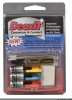
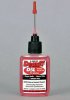
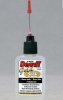
All of those are the concentrated versions. The small pic with the 3 pack is D5 (regular DeOxit), Fader Lube, and G5 which is the "Gold" mentioned in the original directions. Red - D5 is general cleaning, Yellow - G5 is for maintenance after D5, and the Blue/Green - Fader Lube is specifically for sliding controls. A little dab'll do ya here. These are the concentrated versions.

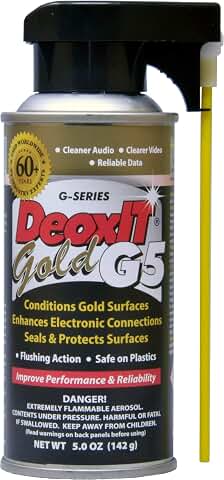
The sprays are what many of us have used. All the same cleaners and conditioners, just in a milder, more dilute mix. I'm going to transition to the concentrates, myself. They seem to be better suited for precision while the sprays can be messy. The flip up tubes to get in tight places are not great and tend to carpet bomb instead of actually getting into tight places directly. But the above pictures you have provided are the same products as these sprays, just in a more concentrated form.
61R57+z3u6L._AC_UL480_QL65_.jpg
715IcogtBmL._AC_UL480_QL65_.jpg
 
as someone who will literally be doing this for the first time I’m thinking I better just follow the directions with the exact same specific versions that the OP is referencing.

Which exact ones is the OP talking about when saying the D5 and G5 sprays and ‘liquid versions of the same in bottles?’

That’s what I’m trying to decipher.
 
as someone who will literally be doing this for the first time I’m thinking I better just follow the directions with the exact same specific versions that the OP is referencing.

Which exact ones is the OP talking about when saying the D5 and G5 sprays and ‘liquid versions of the same in bottles?’

That’s what I’m trying to decipher.

So the ones I've used are the ones in the spray cans I pictured above.

There has been some discussion in the thread about what you are asking, but I explained it about as best and concisely as I could. The ones you pictured are the concentrated versions of the sprays and will work fine. A little dab'll do ya. They'll work the same as the sprays.

You can delve into the entire thread if you'd like. I've read it all, but it has been a while. As with most everything, there are differing opinions and questions about changing formulas and other conundrums over the years' lifespan of this thread. I look at this as white noise... The sprays work great and by the vast majority of accounts it's the same magical mix. The first page is a fabulous guide to use as a checklist as you work.

The sprays can be messy and some have lamented over spray and a resulting stickiness on the circuit boards, but I have not found this to be a problem. I have only used the spray, myself, but I'm going to transition to the concentrates the next time I run out of the sprays. The sprays do a great job.

Good luck.
 
I use WD-40 specialist electrical contact cleaner then follow up with CRC contact cleaner & protectant which seems to work well. Working the controls and switches each time and work hard at only using the minimum spray amount needed and not flooding the contacts/switches/controls.
 
Hmmm - I was testing some Pro audio gear donated to the the church this week and it seems
to have some intermittent touchy spots on the Main faders for this Behringer Mixing console.
I got an (older red) spray can of DeOxit D5 - do you think that's safe to shoot into the sliders
and work them up and down a few times when its powered off?
Heather-Mixer-BAD2C2250507.jpeg
 
Arkay,
When I show input on the right meter there is no output to the speaker. Any suggestions? I am going to clean everything. Just need to order the DeOxit red and gold.
Again, thank you for all you have done. Will let you how it went.
The Brew
 
With a lot of volume controls using plastic parts now, wouldn't the FaderLube be a better choice than standard DeOxit? I've been using DeOxit and the Gold stuff for 30 yrs but have never tried the FaderLube.
 
Thanks. This thread reminded me to try DeOxit on an old volume pot that was unbalanced until the volume was up higher than I wanted (and no one likes to adjust the balance control). I gave it the D5 then F5 fader treatment. Problem solved. And probably mentioned in earlier posts, I also noticed the nozzle can be adjusted from 1-low to 3-high. Hard to imagine needing anything but the smallest possible mist on home audio gear.
 
Last edited:
Back
Top Bottom