• The move to the new server is done. There are some software and database maintenance updates in process. This has us passing the hat around to help out. We appreciate any donations. Seriously, even a dollar helps. The payment page may be found here - https://www.audiokarma.org/support.html

The "Knob-to-Button Ratio" as a measure "Vintage-ness" in receivers!

illinoisteve

Super Member
I'm guessing that others have also noticed that there was a time when the number of buttons on AM-FM stereo receiver faces began to quickly accelerate. In the 60s and 70s there were lots of knobs on them, but by the 90s, some receivers only had one knob.

Here are a couple of examples:

-- (1971) Kenwood KR-5150:
Knobs: 7
Sliders: 1

Buttons: 6

Knob-to-Button Ratio: 8/6 *

* Note that I count slider potentiometers as knobs. I would also count joystick controls as knobs, since the joystick on my Fisher 404 Quadraphonic receiver actually controls 4 potentiometers.

-- (1980) Kenwood KR-750
Knobs: 4 (3 of which are extremely tiny)

Buttons: 14

Knob-to-Button Ratio: 4/13


I have some other receivers I could cite, but I thought I would throw the question to out to other AKers -- what are the Knob-to-Button ratios of your favorite vintage receivers? And what are those for receivers you know that just don't have that vintage look or feel to them from your point of view?

Do you find the Knob-to-Button ratio a useful shortcut for recognizing "vintageness" in receivers?
 
Register to hide this ad
***Threadcrap deleted by Moderator***

There are AKers who seem to prefer vintage solid-state and tube equipment for their sound as well as other features --including appearance-- but how sound might correlate with the Knobs-to-Button Ratio isn't the question I wanted to start with -- though some responders might want to bring it up. And that is fine with me.

If the question of the appearance of equipment is to be deemed mere fluff and beneath the dignity of AK forums, then several dozen (if not several scores) of postings per day are similarly inappropriate. People are always posting pictures of equipment, with many others responding appreciatively about the look, the style, and the relationship between design and function. To all those making such posts (and responding to them) I guess the message is "Sorry, people, some among us think such issues are a waste of time."

When I'm not interested in somebody's topic, I just ignore it. I don't try to step on it.
 
Last edited by a moderator:
When I'm not interested in somebody's topic, I just ignore it. I don't try to step on it.

As it should be.

As to the question in the OP...I have vintage receivers that are excellent performers but they were also designed to look good. A Marantz 4400 and a Pioneer QX9900 for example. At the time, knobs and buttons were part of the style.

In the 80's, cheaper equipment began to add as many knobs and buttons as possible in order to "wow" people. At the same time, the better equipment went the other way, perhaps to place as much distance between them as possible.

Older equipment had selectable options using knobs. With the advent of smaller ss components, the reduction of wanted accessories such as tape and tt's, and the failure rate and cost of multi-position knobs, buttons made more sense. They are also easier to operate; they require just one finger rather than two. I would posit that the trend to a limited attention span and instant gratification was a very suptle , and early, influence here.
 
***Threadcrap deleted by Moderator***

Good example of why I care. My 1997 Pioneer SX-205 is 4/18. I will sometimes get a call from my wife on the rare occasion she wants to enjoy the living room stereo system. One time her description was that a little sound was coming out of the speakers so she just felt she needed to crank the volume all the way up. NOOOOOOOOOOOO! The tape monitor button is right below the CD button and she bumped it before hitting the CD button. Wound up putting on a jumper to avoid this in future. Not a problem on my vintage units below as both are either toggles or a real button not BOB.

1979 Criterion Mark VII 9/7 high real button count only because of the larger amount of filters.

1973 Sony STR-6036A 7/5 Real buttons.
 
Last edited by a moderator:
I've always thought my ARC SP-9 has the ideal ratio of knobs to buttons/switches. Four of each is a 1 to 1 ratio.
 
It's actually an interesting subject. If you consider the increasing cost of real metal knobs, potentiometers and switches, you can see a progression over time from very solid construction of the past (or high end), to plastic knobs with metal shells, to plastic knobs, to digital stuff with no actual hardware at all. Not sure where vintage tube "console" amps fit, with brown and yellow plastic knobs and brass metal caps!
 
As it should be.

As to the question in the OP...I have vintage receivers that are excellent performers but they were also designed to look good. A Marantz 4400 and a Pioneer QX9900 for example. At the time, knobs and buttons were part of the style.

In the 80's, cheaper equipment began to add as many knobs and buttons as possible in order to "wow" people. At the same time, the better equipment went the other way, perhaps to place as much distance between them as possible.

Older equipment had selectable options using knobs. With the advent of smaller ss components, the reduction of wanted accessories such as tape and tt's, and the failure rate and cost of multi-position knobs, buttons made more sense. They are also easier to operate; they require just one finger rather than two. I would posit that the trend to a limited attention span and instant gratification was a very suptle , and early, influence here.

I think the question of why this change happened is interesting, as is too the question of whether too many knobs (or too many controls altogether) can indicate lower quality. Also, it might be worth noting that the role of buttons changed over time. Originally most buttons turned a feature on or off, or selected between two different states of something. By the mid-90s pressing a single button repeatedly might let one "scroll through" a series of choices, much more like a knob-bearing selector switch in the 60-70s.
 
Last edited:
***Threadcrap deleted by Moderator***


Gee, it's too bad for us that you can't be troubled to mention an example or two of "sought after vintage equipment" that would defy the notion of that more knobs than buttons might indicate origins in something that might be called a vintage time period. For your doing that would be responding to my initial question about whether exploring this idea of a ratio might be useful. Obviously it is far, far better to tell me (and other AKers interested in this odd-ball notion I introduced) that it's all just garbage.

How many other garbage threads have you found this morning? AK is so lucky to have someone taking on such an important job, telling others what they should be interested in. Maybe somebody will give you a medal.
 
Last edited by a moderator:
Point of order ... how does one count flipper switches?

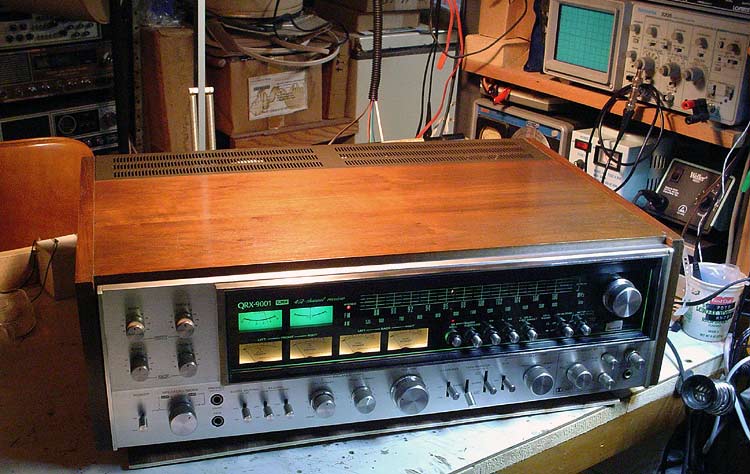
Sansui QRX 9001

front-panel-lit.jpg


17 - knobs
07 - buttons
08 - switches

(I included the CD4 adjustment pots on the back as knobs, and counted the front/rear balance ganged pot as two knobs.)

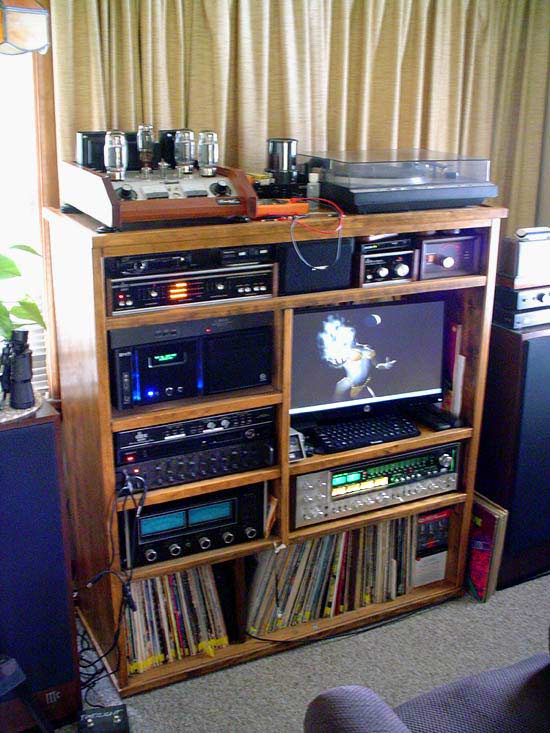
Give me some warning if we start to count the same in a SYSTEM ... I might need a couple daze ... <G>

home-again.jpg


PS ... I also use the Sui as a pre for an external tube amp. That has six knobs. Can I count those? Can I canicaniCANI ?? <G>
 
Hey sKiZo, you left out the *** SIX METERS *** on that monster! Wow! If you want to make a case for how to count switches, it's fine with me.

Others, let me suggest a situation when awareness of the Knob-to-Button Ratio could possibly come in handy. If you are someone who is likes vintage audio equipment, its sound, its look, someone who finds vintage audio equipment more interesting -- and you walk into the middle of a large flea market, with many, perhaps acres of vendors with a variety of wares, and looking across in one direction you see a booth with what seems to be a lot of electronic equipment, but at the same time in the opposite direction you see another booth with a lot of electronic equipment, too. Despite the distance, you can tell that one of these vendors has equipment that has very few knobs on it, but the other vendor's stock contains several items with probably at least as many knobs as buttons on them. Which direction do you go to start shopping?

Of course, the knobby equipment vendor might have a lot of crap, and it might turn out that something at the other place was what you liked and bought, but what would be your hunch...from a distance and starting from your vintage equipment interest and preference?
 
There are AKers who seem to prefer vintage solid-state and tube equipment for their sound as well as other features --including appearance-- but how sound might correlate with the Knobs-to-Button Ratio isn't the question I wanted to start with -- though some responders might want to bring it up. And that is fine with me.

If the question of the appearance of equipment is to be deemed mere fluff and beneath the dignity of AK forums, then several dozen (if not several scores) of postings per day are similarly inappropriate. People are always posting pictures of equipment, with many others responding appreciatively about the look, the style, and the relationship between design and function. To all those making such posts (and responding to them) I guess the message is "Sorry, people, some among us think such issues are a waste of time."

When I'm not interested in somebody's topic, I just ignore it. I don't try to step on it.

I for one don't have a problem with people expressing different preferences. Everyone has a different approach to the hobby. If I could have a custom made integrated amp, the front panel would have a power switch, source selector, volume control and continously variable loudness control on a semigloss black faceplate. That's what I have a use for. Bass/treble controls and all the other things are of no use to me. That's just my approach though. Everyone else has the right to do as they please with their own systems. If we can discuss our varying approaches civily, why not? Don't let one poster's contrary comments bother you.

Also, you're doing the right thing by staying out of threads that don't interest you. There are several that I don't open. The title says it all and I just have nothing but contrary views. Stating them in that thread only serves to upset the OP and most of the other posters therein. Others, I'm not sure on by the title. I'll open them, see that the intention of the OP and/or the general consensus is opposite of how I feel and I get out. No need to stir up a hornets nest.

So, just don't worry about na sayers. We'll carry on.
 
Last edited:
This is all about KPD.

Knobs per dollar.

Knobs, switches, buttons, dials and meters all count one each.
 
Great idea for a thread!

Yamaha CR-620 (1977-1979)
Knobs: 7
Buttons: 8

Sansui R-50 (1980)
Knobs: 7
Buttons: 3

Akai AA-A35 (1985)
Knobs: 0
Buttons: 28
 
Last edited:
. . . . If I could have a custom made integrated amp, the front panel would have a power switch, source selector, volume control and continously variable loudness control on a semigloss black faceplate. That's what I have a use for. Bass/treble controls and all the other things are of no use to me. That's just my approach though. . . .

So, just don't worry about na sayers. We'll carry on.

SuperjaszzyJa, you know, I hardly ever use my tone or balance controls, so in practice my personal preferences are pretty close to yours. And if I think of automobile shopping (if I ever get a new vehicle again), I wonder how I could get something with about 75% less stuff on the dash board than they cram in there now.

Taking your advice, and my own better judgement, I'm not going to respond further to any people trying to trash the topic. It is a wacky idea, and I was fully prepared for people responding in a joking way, having some fun with it. People calling the topic a waste of time or garbage, is not something I have seen happening ever, that I can recall, in my multiple years as a member here, and it caught me off-guard.

I've started threads that gathered little interest, some that garnered days or weeks of discussion, and a couple that have gone on, or been revived periodically for a few years. I didn't have grand hopes for this one, but obviously some AKers find it useful or fun to think about and engage with. If you started a topic about what are the fewest controls you need on your amp or receiver, I'd want to read and participate in that one, too.
 
home-again.jpg


^ @sKiZo, I beg of you: please get all that cool gear out of that unit and put them in something that allows them to breathe as they need to with the vents they have to allow heat to escape! It would be a shame that your gear would wear out early or otherwise fail due to excess heat exposure over time. :( You have some nice pieces, let 'em breathe! ;)

Anyway, as for the theme of this thread, I think this is a fun metric in aesthetics. :) As for some of my gear, here's some random examples:

Sansui 7070 (1976): 10 knobs, 0 switches, 10 buttons - 1 to 1 ratio! lol
Yamaha CR-2020 (1978): 12 knobs, 3 switches, 11 buttons
Kenwood KR-7050 (1979): 7 knobs, 7 switches, 7 buttons - 2 to 1 ratio! lol
Toshiba SA-750 (1978): 7 knobs, 7 switches, 0 buttons
Pioneer SX-636 (1974): 6 knobs, 0 switches, 9 buttons
Sherwood S-7210 (?): 7 knobs, 0 switches, 5 buttons
Luxman R-406 (1981): 4 knobs, 0 switches, 26 buttons
Rotel RX-855 (1980's): 6 knobs, 0 switches, 19 buttons
JVC RX-815V (1994): 2 knobs, 0 switches, 45 buttons!
JVC RX-880V (1996): 5 knobs, 0 switches, 22 buttons
And the king kahuna - the Pioneer VSX-D1S (1990): 2 knobs, 0 switches, 78 BUTTONS!!! LOL! 49 of which are on the outside panel! The other 29 are inside the flip down panel! lol :O

As for the tally, the "winners" are:

Knobs: Yamaha CR-2020 with 12.
Switches: A tie between the Kenwood and the Toshiba with 7.
Buttons: Pioneer VSX-D1S with 78!!! That is ridiculous. lol I never thought about how many buttons it had until this thread. lol ;)

This is a fun exercise in the aesthetics of different receivers from different eras. If anything, it is just fun to see what the breakdown is. I was thinking though, would it be worthwhile to add how many meters a receiver has to the tally as well? Meters are generally more of a "vintage look" than most of the stuff from the 80's on up. Just a thought. Cheers. :)
 
Last edited:
Back
Top Bottom