• The move to the new server is done. There are some software and database maintenance updates in process. This has us passing the hat around to help out. We appreciate any donations. Seriously, even a dollar helps. The payment page may be found here - https://www.audiokarma.org/support.html

The midrange in music, how important?

catman

Addicted Member
Banned
G'day all, one of the things that converted me back to 47 k loading with the M97xE is the improved 'midrange' I'm now hearing and I've realised that I'd never placed that much importance in the midrange, mainly concentrating at the bass and treble ends.

Yet I now realise the midrange possibly is represented most in terms of musical content and is thus very important in the overall musical scheme of things.

Regarding the M97xE specifically, with 47 k loading I am finding 'vocals' much more apparent and articulate, and in general terms enhanced midrange seems to have altered the general sound of recordings in a very pleasant way.

One definition I read today referred to 'midrange' as the 'presence' range. True, no doubt, but can anybody define what 'presence' means? :scratch2: Regards, Felix aka catman.
 
Last edited:
Register to hide this ad
I've recently talked with Arcorob about this, regarding the sonic differences in his comparison between a Technics SL-1200 MK2 and an Audio-Technica AT-LP120-USB. Quoting myself:

High frequencies make instruments like cymbals, maraccas, vocal sibilance and fret noise more noticeable. Trumpets' tone has a sharper, more incisive quality. At least where I live, people refer to that sound quality as "brightness". Music sounds "bright" if those instruments ring loud and clear.

But vocal presence (I mean, not "ss", "sh" or "zz" but vowels' notoriety, for instance) isn't about "brightness". Middle frequencies (around 800 Hz - 1 kHz) are what make vocals and mid-pitched percussion instruments like congas more noticeable. And this is what I feel more pronounced on example #1.

When low and high frequencies are stronger than middle ones, the overall sound has a more "hi-fi" quality because mid frequencies are "scooped". That's why, in most cases, people adjust graphic equalizers' sliders in a "V" or "smile" shape. In most cases, this gives a "prettier" sound quality. Raising middle frequencies robs that "prettiness" from the sound, but gives a richer, fuller sound quality. That's why the term "critic" or "crucial" is often associated to middle frequencies by experts: As on a good meal recipe, you must learn to apply the exact amount of middle frequencies to find the right balance between "fullness" and "prettiness". And that's the hardest part of getting a well-balanced sound.

Here's what I said about the comparison clips he recently posted:

I want to say that, although the sound differences aren't prominent, I definitely prefer the quality of 1a, 2, 3 and 4 (AT ones, according to my guesses). Certainly, the "Technics" ones have more of a hi-fi quality because of the more pronounced "smile" EQ curve, but the "AT" ones definitely have a fuller sound. Middle frequencies aren't that prominent to make the samples sound like an old radio, yet the music has more of an "in your face" feel. Anyway, both are great-sounding tables.

And here's what I told him in a PM:

Being a bass player myself, I'm perfectly aware of the importance of middle frequencies in a band's overall tone. In the case of my instrument, mids are the ones that make it "cut-through" a mix. That's why, contrary to many people, a strong mids presence (without exaggerating it) is very important to me. As I said before, mids are "critical"/"crucial" frequencies.

I think all of the above summarizes what I think about this topic.
 
If I remember correctly, my JBL 4311s had a pot to adjust presence for the mids, and one marked brilliance for the tweeters. It can be a bit misleading though- some guitar amps have a presence control that changes the amount of negative feedback which helps a guitar cut through a midrange heavy mix by adding a little bit of top end.
 
mid-range is the magic of single driver speakers -- I've grown away from bass heavy systems towards spot-on mids & highs

Altho , having it all is the dream
 
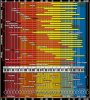
An interesting chart, kind of relevant.

Meh...I give up, no pics that I attach of late... show up :( Got it :)
 

Attachments

  • main_chart.jpg
    main_chart.jpg
    131.4 KB · Views: 13
Last edited:
Midrange is everything to me, and the primary reason I run all tubes all the time.

Same here! A speaker's midrange can sound magical, when powered with tube amplification. Jazz and vocals sound as smooth as silk. I guess I'm a tube guy for life!
 
I like to hear it all, if possible, but if not then I would rather hear accurate midrange. Accurate midrange, to me, determines whether something sounds real or not. I'll take a great midrange driver with an economy woofer vs the other way around. Same way with the rest of the system. Also the reason I love valves.
 
Last edited:
It has been said that if a given system can't get the mids right the rest just doesn't matter how good that is, and I would agree. There are others that prefer their LP sound be adjusted to personal taste and preferences.
 
Lets see......

I always place maximum effort in midrange. For example I am rebuilding my Klipsch speakers, Nothing less than Mundroff silver/oil coupling cap & although the auto transformer could be upgraded from Bob Crites for $80, I had to go with custom dual C core from Germany. Only $288 shipped. Oh, not enough, had to go for titanium diaphragms for only $160.

I do not have enough money left for tweeters, but...............only kidding. :D
 
With my first systems in the 70's-80's. I was more concerned about dynamics. How deep the bass could go, crisp highs and how loud the system would play before clipping. With little emphasis on the midrange. Now I'm more concerned about how natural sounding and resolving the system is. With my current system, I think I'm finally approaching this level of sound quality.

The great thing about this hobby is. How one can evolve and mature in their listening and component choices over time. I wonder if changes in musical tastes, can be an influence on the current systems we end up owning/using?

I do know that I wouldn't be happy, with the system(s) that I once owned 25-30 years ago. In contrast to my current system. I believe they would be very fatiguing to listen to, over an extended period of time.
 
Midrange is everything to me...

Absolutely. That's always been numero uno for me when choosing my gear. If the mids aren't right, what's the point of having good lows and highs? The mids are what it's all about.

That's what I had in mind when putting together my current system. The 2000x, the Dual 1019, the Wharfedale W90's, .... They're all known for having those perfect mids (and that's part of why they go so-well together). Out of the three, the W90's are probably the best example of great midrange response. That's why they make such great jazz/classical speakers. I'm a musician (as was Gilbert Briggs), so I'm good at recognizing good/bad timbre, and the midrange is a crucial part of proper timbre. Can't have good timbre without good mids, and this is one of the reasons why I love certain Wharfedale models 'cause that's what they do best. It's the same with my 1019. Great mids/timbre.
 
Last edited:
Your ear canal is shaped in such a way that your hearing is much more sensitive to the mid range than the bass or treble.

This is why the mids can be such a hassle. Since I use EQs; I've found dialing in the bass and treble are pretty easy (or for me since I know what tonal color I want...and can tell what the speakers need). But, the mids have always taken the longest for me to dial in. Small changes will have a larger impact.

Sent from my SPH-M910 using Tapatalk 2
 
I can be even more specific than just "mids" in my case. To me it is the upper mid-range to lower treble that makes or breaks a system. Not only is our hearing very sensitive and selective in that range, but the identifying timbres of instruments and voices lies there. Getting the levels set for the tweeters on my NS-690s isn't that difficult, but setting the mid drivers can often take me a dozen or more recordings to get to my satisfaction.
 
Forgot that this thread is in the Turntables section. I think Dual tables in general are known for having proper timbre, as are Thorens tables. I was originally gonna' buy a Thorens, but I was outbid by a guy who ended up getting the thing for $20 more than I could spend. Bastard. It was a sweet table too. Had an SME 3009 Improved on it. A real turnkey street-machine. That was the moment when I started looking for a 1019 and found a nice one for $150, and I love the thing. I'm becoming quite-fond of idlers in general (and tube-era gear in general), and the 1019 was one of the last really-good ones, along with the 1219 that replaced it. If I could choose a Thorens model now, it would be one of their idlers (although I would probably avoid a TD124 due to the skyrocketed prices these days. But idlers in general have a fullness to them in the midrange. Not an overemphasized midrange, just proper, rich, musical, lifelike mids (like the sort of thing you'd hear in a big pair of early '60's Bozak speakers), and that's what I'm looking for in a turntable (Or maybe I'm just looking for whatever table will make the "Smash Hits" LP I'm playing right now sound it's best :D ).
 
I can be even more specific than just "mids" in my case. To me it is the upper mid-range to lower treble that makes or breaks a system. Not only is our hearing very sensitive and selective in that range, but the identifying timbres of instruments and voices lies there. Getting the levels set for the tweeters on my NS-690s isn't that difficult, but setting the mid drivers can often take me a dozen or more recordings to get to my satisfaction.

I have a pair of NS-690 in storage awaiting a little TLC, I remember them as magnificently well-made and very decent sounding.
 
In this case it´s just a frequency tilt, a slightly lower treble, it doesn´t make any midrange difference per se.
gusten
 
Back
Top Bottom