Regrouping for Success
Have you ever had a project -- any project -- that got so involved and complicated that one detail starts to interfere with another, and so on until the whole game plan begins to come into question? That was starting to happen with this project, such that too many of the individual best ways to go after individual performance parameters all started colliding with one another. At those times, it's always best to take two steps back, not only to gain fresh insight and perspective, but also to remember how much this hobby we love is as much about the fine art of compromise, as it is science. For the last few days, that's exactly what I've been doing.
As part of that effort, I went back and reviewed all of my notes (nearly two dozen pages worth), and found two items I had missed. One was of little significance (using the calculated NFB figure of the original design, rather than the actual measured value, although they were pretty close), but the other was was quiet significant: With the poor power bandwidth performance observed in the original and modified 8417 versions above 10 kHz, I never even bothered to test for this performance in that region with the 6550 version. Shame on me. I would have eventually caught this in my final testing ritual, but I should have caught it sooner than I did. I also noted that because I started the modified/redesigned versions using the alternate output loading arrangement from the get-go, I never really investigated the possibilities of the original loading scheme with 6550s either (obviously until just recently), primarily because the alternate loading scheme looked so promising with the modified 8417 version.
With that revelation, I then went back and rechecked EVERYTHING regarding the output tube/output transformer interface, and the best way to apply NFB around them. Here is a summary of the rechecked and verified findings:
1. Push-pull feedback from the 70 volt winding: As was originally determined, this can only be used in small amounts (as in controlled amounts back to a possible driver stage), as larger more useful amounts of feedback from this winding (i.e. feedback directly to the output tube cathodes) promoted instability.
2. Feedback from the dedicated NFB winding was initially observed and again confirmed to be less effective in distortion reduction than feedback from the loaded winding, regardless of the loading arrangement used. However, it was also again observed and confirmed that this method of obtaining NFB produces the most stable results with respect to HF stability. Importantly, it was also found that this winding was much more effective with distortion reduction and achieving HF stability when the traditional loading arrangement was used, as opposed to the alternate loading arrangement that was used from the beginning of the modification/redesign efforts. That is the reason that efforts to use this winding were abandoned early on.
3. It was confirmed that feedback from the loaded winding is the most effective in distortion reduction, and can even be made sufficiently stable with regards to HF stability as well, but the best stability is obtained using the dedicated NFB winding with the original loading arrangement.
4. 8417 tubes provide nearly as much 1 kHz power as 6550 tubes do, but do so at less distortion. It was also noted that 8 Ohm distortion was lowest when the alternate loading arrangement was used, and is virtually equal to that of 16 Ohm distortion performance -- this since both of these taps reflect back a nearly identical impedance to the output tubes when the alternate loading arrangement is used.
5. 6550 tubes produce the most 1Khz power, but at about twice the distortion levels produced by 8417 tubes, when both use the alternate loading arrangement. However, with an 8 Ohm load using the original loading arrangement, distortion for the 6550 version drops significantly. As a result, since 8 Ohm 8417 distortion actually rises with the original loading arrangement (over that of the alternate arrangement), the 8 Ohm distortion produced by both tubes is then virtually identical when using the original loading arrangement for both tubes. Since the 16 ohm tap reflects the same impedance back to the output tubes regardless of which loading configuration is used, 8417 tubes have an edge at this frequency and load impedance.
HOWEVER, the power and distortion findings just quoted all fall to pieces in one way or another above 10 kHz. In this region, the poor power bandwidth performance -- both in the original, and the modified 8417 designs -- is largely due to use of the 8417 tubes themselves. I haven't investigated this to the point of cause determination, but may at some later date, outside of this project. Suffice to say however, that performance in this region is dramatically, and markedly improved simply from the use of 6550 tubes -- made even better by using the original loading arrangement for 8 ohm operation.
Taking all of this data into account, and taking those two steps back for reflection, significant changes have now been made to the 6550 design, which collectively and together then produce a very solid and capable amplifier for home high fidelity stereo use. Because individual specifications aren't everything, the fine art of performance parameter compromise has been used to emphasize that which (in my opinion) is most important to quality sound (flat frequency and power response, good transient response, absolute stability with no tendency towards ragged response under abnormal load conditions, and reasonably low output impedance), while other parameters (maximum power output and absolute distortion levels) have taken a very close, but none the less back seat to the important ones mentioned. The results have been so rewarding with the revised 6550 version both sonically and in the lab, that further work on the 8417 version has been halted indefinitely. In certain parameters, the 8417 can outperform the 6550 in this amplifier -- as has been noted through out this thread -- but taken in total, I can only endorse the 6550 version going forward for the re-purposed use intended.
Pics and further comments include:
1. A 10 kHz square wave of the revised 6550 design indicates a slightly slower rise time over that of the original version, but is still acceptably fast enough for an amplifier with an OPT of this size and quality level. Note that the wave top is still well damped after the slight overshoot on the leading edge.
2. Here is the same 10 kHz square wave, except with no load on the amplifier at all except for a .47 uF cap. The wave is exaggerated as would be expected, but of note, the waveform is still very smooth and controlled, without the intense and/or uncontrolled ringing that is often produced under these conditions. This waveform shows the very high degree of stability for the amplifier under abnormal load conditions, with zero tendency towards outright oscillation. This high level of stability could only be achieved using the dedicated NFB winding with the original loading arrangement for 8 Ohm operation.
3. With the 6550 version, a 100 watt RMS 20 kHz power bandwidth is readily achieved, as shown here. Distortion is about 3.75% at this frequency, which is very good given the design restrictions of the original OPTs.
4. On the other hand, the 8417 version at 20 kHz -- operating otherwise under the same conditions as that of the 6550 design, is struggling to produce anything close to a sine waveform, belching out 15%+ THD. This is with the NFB loop closed, and EFB operational -- it being far worse without the latter installed. A decent sine waveform and similar distortion reading as that of the 6550 amplifier at this frequency is not regained until power is reduced under 50 watts.
5. Lots of changes made. More data is provided now that it is becoming finalized. More voltages are provided, as is output tube current draw. Note the use of the dedicated NFB winding now. Note too that the OPT impedance values are all normalized to the 8 ohm output, to better reflect output stage operating conditions. Also note the distortion performance documented. At 1 kHz and 100 watts, .40% THD is produced. With the NFB loop providing a distortion reduction of some 7 times, that means that open loop distortion is running (and is confirmed to run at) around 2.8%. This is smack in the middle of the distortion values typically published for these tubes (2.5-3.0%) when operating in 100 watt pentode mode, with perfectly regulated B+ voltage levels. In practical economic installations such as this amplifier represents, this open loop distortion level would not normally be achievable. However, because the EFB circuits constantly work to maintain the output stage's low distortion quiescent operating point under all dynamic and power supply conditions, the theoretical open loop minimum distortion level is then realistically approached, even though regulated B+ power sources are not employed. The use of EFB then allows for the absolute minimum distortion to be produced from the NFB loop employed.
So, the 6550 wins in overtime -- but it deserves to. Comparison of the overall performance of this design to that of the original product is quite substantial. Power output rating is maintained, while power bandwidth is extended. Distortion is significantly reduced, while stability is maximized. Transient response is now in another universe, and has a decent HF response to go along with it. In short, I believe that the best overall potential of what this unit represents is achieved with this re-purposed design, and the listening room whole heartedly agrees. More listening tests are in store, and the power supply schematic still needs to be posted as well. But I can work on it while I listen and should have it posted soon.
Dave
Have you ever had a project -- any project -- that got so involved and complicated that one detail starts to interfere with another, and so on until the whole game plan begins to come into question? That was starting to happen with this project, such that too many of the individual best ways to go after individual performance parameters all started colliding with one another. At those times, it's always best to take two steps back, not only to gain fresh insight and perspective, but also to remember how much this hobby we love is as much about the fine art of compromise, as it is science. For the last few days, that's exactly what I've been doing.
As part of that effort, I went back and reviewed all of my notes (nearly two dozen pages worth), and found two items I had missed. One was of little significance (using the calculated NFB figure of the original design, rather than the actual measured value, although they were pretty close), but the other was was quiet significant: With the poor power bandwidth performance observed in the original and modified 8417 versions above 10 kHz, I never even bothered to test for this performance in that region with the 6550 version. Shame on me. I would have eventually caught this in my final testing ritual, but I should have caught it sooner than I did. I also noted that because I started the modified/redesigned versions using the alternate output loading arrangement from the get-go, I never really investigated the possibilities of the original loading scheme with 6550s either (obviously until just recently), primarily because the alternate loading scheme looked so promising with the modified 8417 version.
With that revelation, I then went back and rechecked EVERYTHING regarding the output tube/output transformer interface, and the best way to apply NFB around them. Here is a summary of the rechecked and verified findings:
1. Push-pull feedback from the 70 volt winding: As was originally determined, this can only be used in small amounts (as in controlled amounts back to a possible driver stage), as larger more useful amounts of feedback from this winding (i.e. feedback directly to the output tube cathodes) promoted instability.
2. Feedback from the dedicated NFB winding was initially observed and again confirmed to be less effective in distortion reduction than feedback from the loaded winding, regardless of the loading arrangement used. However, it was also again observed and confirmed that this method of obtaining NFB produces the most stable results with respect to HF stability. Importantly, it was also found that this winding was much more effective with distortion reduction and achieving HF stability when the traditional loading arrangement was used, as opposed to the alternate loading arrangement that was used from the beginning of the modification/redesign efforts. That is the reason that efforts to use this winding were abandoned early on.
3. It was confirmed that feedback from the loaded winding is the most effective in distortion reduction, and can even be made sufficiently stable with regards to HF stability as well, but the best stability is obtained using the dedicated NFB winding with the original loading arrangement.
4. 8417 tubes provide nearly as much 1 kHz power as 6550 tubes do, but do so at less distortion. It was also noted that 8 Ohm distortion was lowest when the alternate loading arrangement was used, and is virtually equal to that of 16 Ohm distortion performance -- this since both of these taps reflect back a nearly identical impedance to the output tubes when the alternate loading arrangement is used.
5. 6550 tubes produce the most 1Khz power, but at about twice the distortion levels produced by 8417 tubes, when both use the alternate loading arrangement. However, with an 8 Ohm load using the original loading arrangement, distortion for the 6550 version drops significantly. As a result, since 8 Ohm 8417 distortion actually rises with the original loading arrangement (over that of the alternate arrangement), the 8 Ohm distortion produced by both tubes is then virtually identical when using the original loading arrangement for both tubes. Since the 16 ohm tap reflects the same impedance back to the output tubes regardless of which loading configuration is used, 8417 tubes have an edge at this frequency and load impedance.
HOWEVER, the power and distortion findings just quoted all fall to pieces in one way or another above 10 kHz. In this region, the poor power bandwidth performance -- both in the original, and the modified 8417 designs -- is largely due to use of the 8417 tubes themselves. I haven't investigated this to the point of cause determination, but may at some later date, outside of this project. Suffice to say however, that performance in this region is dramatically, and markedly improved simply from the use of 6550 tubes -- made even better by using the original loading arrangement for 8 ohm operation.
Taking all of this data into account, and taking those two steps back for reflection, significant changes have now been made to the 6550 design, which collectively and together then produce a very solid and capable amplifier for home high fidelity stereo use. Because individual specifications aren't everything, the fine art of performance parameter compromise has been used to emphasize that which (in my opinion) is most important to quality sound (flat frequency and power response, good transient response, absolute stability with no tendency towards ragged response under abnormal load conditions, and reasonably low output impedance), while other parameters (maximum power output and absolute distortion levels) have taken a very close, but none the less back seat to the important ones mentioned. The results have been so rewarding with the revised 6550 version both sonically and in the lab, that further work on the 8417 version has been halted indefinitely. In certain parameters, the 8417 can outperform the 6550 in this amplifier -- as has been noted through out this thread -- but taken in total, I can only endorse the 6550 version going forward for the re-purposed use intended.
Pics and further comments include:
1. A 10 kHz square wave of the revised 6550 design indicates a slightly slower rise time over that of the original version, but is still acceptably fast enough for an amplifier with an OPT of this size and quality level. Note that the wave top is still well damped after the slight overshoot on the leading edge.
2. Here is the same 10 kHz square wave, except with no load on the amplifier at all except for a .47 uF cap. The wave is exaggerated as would be expected, but of note, the waveform is still very smooth and controlled, without the intense and/or uncontrolled ringing that is often produced under these conditions. This waveform shows the very high degree of stability for the amplifier under abnormal load conditions, with zero tendency towards outright oscillation. This high level of stability could only be achieved using the dedicated NFB winding with the original loading arrangement for 8 Ohm operation.
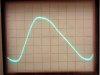
3. With the 6550 version, a 100 watt RMS 20 kHz power bandwidth is readily achieved, as shown here. Distortion is about 3.75% at this frequency, which is very good given the design restrictions of the original OPTs.
4. On the other hand, the 8417 version at 20 kHz -- operating otherwise under the same conditions as that of the 6550 design, is struggling to produce anything close to a sine waveform, belching out 15%+ THD. This is with the NFB loop closed, and EFB operational -- it being far worse without the latter installed. A decent sine waveform and similar distortion reading as that of the 6550 amplifier at this frequency is not regained until power is reduced under 50 watts.
5. Lots of changes made. More data is provided now that it is becoming finalized. More voltages are provided, as is output tube current draw. Note the use of the dedicated NFB winding now. Note too that the OPT impedance values are all normalized to the 8 ohm output, to better reflect output stage operating conditions. Also note the distortion performance documented. At 1 kHz and 100 watts, .40% THD is produced. With the NFB loop providing a distortion reduction of some 7 times, that means that open loop distortion is running (and is confirmed to run at) around 2.8%. This is smack in the middle of the distortion values typically published for these tubes (2.5-3.0%) when operating in 100 watt pentode mode, with perfectly regulated B+ voltage levels. In practical economic installations such as this amplifier represents, this open loop distortion level would not normally be achievable. However, because the EFB circuits constantly work to maintain the output stage's low distortion quiescent operating point under all dynamic and power supply conditions, the theoretical open loop minimum distortion level is then realistically approached, even though regulated B+ power sources are not employed. The use of EFB then allows for the absolute minimum distortion to be produced from the NFB loop employed.
So, the 6550 wins in overtime -- but it deserves to. Comparison of the overall performance of this design to that of the original product is quite substantial. Power output rating is maintained, while power bandwidth is extended. Distortion is significantly reduced, while stability is maximized. Transient response is now in another universe, and has a decent HF response to go along with it. In short, I believe that the best overall potential of what this unit represents is achieved with this re-purposed design, and the listening room whole heartedly agrees. More listening tests are in store, and the power supply schematic still needs to be posted as well. But I can work on it while I listen
and should have it posted soon.Dave