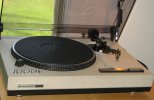
For a first table, arm, and cartridge, that is quite far up the food chain - congratulations.
Vinyl Engine is a great resource, but the gentleman who runs it has gotten so tired of people downloading manuals from the library there, and then selling them on the internet, that I'm not sure new members can even sign up any more, so I am not surprised that the Wayne just asked, rather than researched there. And I have to say that Graces are confusing - I know a couple of the well known ones like the 707, but then you get in the weeds with arms like this one, and I just looked at arms until I found what I thought was a match.
Wayne: back when your equipment was made, vinyl was the standard source, so every preamp and integrated amp had a phono stage, some very good ideed. S the idea of a stand alone one was practically unheard of - the Hegeman Probe may have been one of the first. It was a very high end product for the time, certainly out of my price range, but it had to be exceptional since there wasn't a market for standard phono stages (I should add that there were plenty of little phono transformers that allowed you to use a moving magnet with older equipment that had a ceramic/piezo phono input, or with a simple auxilliary, but everyone knew they weren't very good, and there were a few moving coil transformers and step ups, but they required a standard MM phono input).
Your perspective is a later one, when many preamps and integrateds are just line level, and where the expectation is that either there is a separate phono stage, or one is built into the turntable. So your initial confusion is understandable. But know that you will need a phono stage.
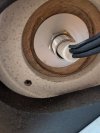
My concern is that, in scoring such a great table, but being new to vinyl, the bread and butter tasks needed to get the thing up and running may be daunting. You need to make sure that the turntable is running consistently at speed, which is relatively easy to check using the strobe, and to adjust a bit with the speed controls on top. If it isn't, you may be able to get it correct with the internal pots. Otherwise, it is recapping or relubricating time, and suddenly much more complex, and you may need help.
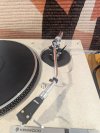
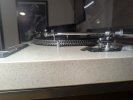
The arm bearings are probably fine, but check to see if, when balanced, the arm moves with the slightest breath both sideways and up and down. And you need to address the counterweight sag. Usually, this is relatively straightforward to accomplish, as long as you are handy. (And if you aren't, admitting it up front and getting someone else to do it will be both cheaper(!) and more responsible - you are now the owner of something useful that will probably never be made again, so futzing it up would be morally offensive and well as destroying collector value.) There are posts on how to do this.
The Accutex is probably an excellent cartridge - most of theirs were. But if the stylus is worn, you will damage your records, and if the suspension is hardened, there will be mistracking, which sounds bad and isn't good for the record. So you need to inspect the stylus under a microscope - there are tons of posts on this. If the stylus is good (which happens more than you might expect), listen to it. If the suspension has hardened, use sometimes loosens it up, otherwise there are various magical potions - fish oil (whatever that is), WD 40, wintergreen oil, and so on (oddly enough, I don't think I've heard anyone suggest Rubber Renewer, which you might think would be obvious, but perhaps i'm missing something). You may be able to find a NOS stylus, which, if the suspsension is good, solves the problem.
You could also replace the cartridge, but then you would need to learn how to align the stylus - there are infinity minus one posts on this (many of which are actually useful) but you will need a protractor and some perseverance and self confidence.