• The move to the new server is done. There are some software and database maintenance updates in process. This has us passing the hat around to help out. We appreciate any donations. Seriously, even a dollar helps. The payment page may be found here - https://www.audiokarma.org/support.html

The Official SOTA Turntable Thread

Some measurements and comparisons with the competition.....

Polar plot of the signal taken from the optical encoder on the Orion platter:

Orion Direct Drive.png

The encoder produces 360,000 pulses per revolution and is used for feedback to control the speed. The speed is checked ~10,000 times per second and can measure factional counts with 32 bit accuracy.

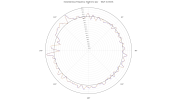
For comparison, this is the signal from a production VPI HW40 magnetic encoder on the platter:
HW40 Encoder.png

The HW40 encoder produces 2560 pulses per revolution for feedback and speed control. The count needed for 33.333 RPM is 1422.222/sec (2560/1.8) but the controller can only work with integer counts so the speed changes between 33.351 (1422 counts) and 33.328 (1423 counts).

The above plot is a bit misleading; each ring represents 0.5Hz of deviation or 0.14% (0.5/355.5Hz). On the Orion plot, each ring represents 1Hz of deviation or 0.03% (1/3125Hz). In other words, the Orion plot is ~5x more sensitive. If I plot the VPI HW40 at the same scale as used on the Orion plot, it would look like this:

VPI HW40 High Res.png

This is the spectrum of the encoder signal from the Orion DD:

Orion W&F.jpg

And the spectrum of the VPI HW40:

HW40 W&F.jpg

A lot of mfrs make wildly unbelievable claims as to the performance of their direct drive tables (1PPM accuracy, unmeasurable W&F, arc-second accuracy etc.), but they never provide any data or actual measurements. SOTA is also working on a device that will easily attach to any turntable spindle and provide high resolution measurements like those shown above so that reviewers (and users) will be able to validate (or invalidate) a lot of these claims. The Orion controller has a 3.5mm jack on the back that can directly output the signal from the optical encoder ring so testing this is very simple and they encourage people to do so (what a concept in this industry).
 
Last edited:
Going from belt drive to DD to improve speed control and W&F - this is deja vu all over again!

If you are referring to the shift in the late '70s, early '80s to direct drive, the Orion is a completely different animal. Most of those early designs used light platters and fairly simple PLL circuits to control the speed; the BW of the control loop was fairly low and they were prone to "hunting". Field Oriented Control (FOC) didn't exist in the 70s/80s; if the theory existed, the hardware to implement it didn't exist or wasn't affordable.

I hesitate to call it closed loop speed control in the case of the Orion. There are actually 2 nested PI control loops: The inner loop is a constant torque loop using FOC and high bandwidth (fast). The outer loop is more of a W&F loop to minimize deviations in instantaneous speed changes with a lower BW. We originally thought we would need a 3rd outer velocity loop to keep the speed locked at 33.333 RPM, but the interesting thing is, if you tightly control instantaneous speed variations (W&F) you automatically get stable and accurate speed. The Orion uses a custom TI 32 bit floating point DSP to implement the control scheme. This technology wasn't available in the 70's/80's; this is not your father's direct drive.

The tachometer display on the controller is not averaged and it reads 33.333 continuously. There is also zero feedback from the tachometer to the motor controller, it is only used for verification. The user has the option of displaying the tach or blanking that part of the display.
 
Last edited:
So I need to upgrade from Cosmos/Eclipse to Sota dd? Wonderful.

Sarcasm?

SOTA may have been "state of the art" when the company was first formed in the '70s, but after changing hands several times, they tended to not do anything new or innovative for decades. When I was approached by Christian in 2018, the Series V motor controller was approaching 30 years old. Since then, Christian has made changes to the platter, bearings, internal bracing as well as electronics and material science advances. They are clearly moving in the right direction. While a direct drive is a departure from their roots as a belt drive table mfr, IMHO it represents a step up in technology and meshes seamlessly with their goal of being "State of the Art". Not everyone likes DD tables and there will those who prefer SOTA's BD tables to the Orion; that's OK, people have different tastes and SOTA is trying to accommodate those different tastes. Difficult to see how this would be a bad thing?
 
Last edited:
To expand a bit on the personal taste element: I did no listening tests initially while I was refining the control loops on the Orion table, all of the improvements were done with measurements to reduce the W&F to the lowest level possible. Once that was dialed in, Christian began doing critical listening tests, but I gave them the ability to alter certain elements in the control loop in real time, while they were listening. We found that even small changes in the outer loop gain made audible differences in sound quality. Higher gain increased dynamics but could also start leaning towards analytical sounding on some systems; lower gain decreased dynamics but provided a smoother and warmer sound. Neither extreme is wrong and there is no "correct setting" so we decided to add a user programmable mode to adjust this aspect to match the sound signature of the table to not only the user's preference but to compliment their system's attributes. They are calling it "Ambience Control" and the default setting is the middle range of increased dynamics and warmth.

The motor assembly is elegantly simple; unlike a lot of the other direct drive tables, you can easily service and lube the main bearing with no tools needed for disassembly. The platter rides on an aluminum subplatter via a Morse taper so the fit is tight with solid acoustic coupling while lifting off in seconds to gain access to the bearing and no run out at the platter edge because of eccentricity. SOTA is looking at offering different platters that can be changed within seconds that offer different sonic presentations. Currently they are evaluating the stock aluminum platter as well as an acrylic one. The controller can accommodate different control loop parameters for each platter type through a user selectable menu.

The Orion is capable of 33/45/78 RPM with pitch control of ±1 RPM (33/45) and ±6 RPM (78) in 0.1 RPM steps for off-speed recordings.
 
Last edited:
phoenixengr,

Orion can challenge Technics SP-10R? Refer to your thread on turntable plinth.
Can SOTA build a better turntable plinth according to this thread?
 
phoenixengr,

Orion can challenge Technics SP-10R? Refer to your thread on turntable plinth.
Can SOTA build a better turntable plinth according to this thread?

The Orion is build on a SOTA Millennia platform which is a proven design with good performance. One of the reasons SOTA chose this was to eliminate any improvements (or deficiencies) that a new plinth would introduce. They actually ran the Orion as a belt drive before the motor controller was done and compared it to the current Mellennia and they sounded the same. Any changes in sound from that point could then be attributed to the DD motor and nothing else.
 
If you are referring to the shift in the late '70s, early '80s to direct drive, the Orion is a completely different animal. Most of those early designs used light platters and fairly simple PLL circuits to control the speed; the BW of the control loop was fairly low and they were prone to "hunting". Field Oriented Control (FOC) didn't exist in the 70s/80s; if the theory existed, the hardware to implement it didn't exist or wasn't affordable.

I hesitate to call it closed loop speed control in the case of the Orion. There are actually 2 nested PI control loops: The inner loop is a constant torque loop using FOC and high bandwidth (fast). The outer loop is more of a W&F loop to minimize deviations in instantaneous speed changes with a lower BW. We originally thought we would need a 3rd outer velocity loop to keep the speed locked at 33.333 RPM, but the interesting thing is, if you tightly control instantaneous speed variations (W&F) you automatically get stable and accurate speed. The Orion uses a custom TI 32 bit floating point DSP to implement the control scheme. This technology wasn't available in the 70's/80's; this is not your father's direct drive.

The tachometer display on the controller is not averaged and it reads 33.333 continuously. There is also zero feedback from the tachometer to the motor controller, it is only used for verification. The user has the option of displaying the tach or blanking that part of the display.
Oh, my comment was in good fun. I have absolutely no doubt the SOTA DD will be substantially improved over my upgraded Star Sapphire - which still holds good speed - but nothing like the Orion!
 
Some interesting videos showing the speed stability (or lack thereof) of some direct drive tables:

SOTA Orion Direct Drive:

VPI HW40:

Wave Kinetics NVS:

In all 3 cases you are looking at the output of the encoder tied directly to the platter which is used for feedback to control the speed. It is the most accurate way to measure platter speed stability.

All 3 tables have different encoder rates. The Lissajous pattern shows the same amount of deflection for a 1Hz deviation regardless of the center frequency. In percentage terms, the higher the center frequency, the more sensitive the display; in other words, a 0.1% W&F at 3150Hz (Orion) would rotate the pattern at just over 3 Hz rate and would look massive. At 355Hz (HW40) a 0.1% W&F would rotate the pattern at 0.355Hz and would appear much smaller.
 
Last edited:
Back
Top Bottom