• Please note that Audiokarma will be offline briefly for updates early on Monday morning, September 28th.

Thorens TP60 (headshell) gauge dimensions

Also, I believe it's true the V notch is an approximate landing zone. What tolerance does that give us?

It is a landing zone. The stylus is not supposed to be on the tip of the triangle. The Thorens diagram is not really detailed. As long as the stylus is in that triangle you should be good to go. It gives us almost 2mm tolerance.
 
Thats not what the thorens manual image shows Mr Nines

Can't really tell very much detail from that diagram.

We are making heavy weather of something simple here & that's not my intention

I agree.

I'm working to the thorens diagram for the moment (with your dimensions) & I'd really like to get it right

I understand and agree.

Where is the dimple - how deep from back face?

The tip of the triangle is 11mm from the inner wall, with 2mm worth within the dimple itself.

So, 11-3=8 ..... 8+2=10mm


.....then we have the depth of the dimple triangle & the top offset & the cutout notches on the sides - these were all there for a purpose

The depth of the dimple triangle is 2mm. The cutout notches on the sides are there to enable a good view from the side to show the position of the stylus/cantilever.

thanks for sticking with it

No probs.
 
Good morning & thanks - I'll be taking a look later

Here is a link to JAs's tonearm comparator
http://www.vinylengine.com/tonearm_alignment_comparator.php

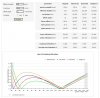
Also here is a print out of the original Thorens set up at 230mm I did a while back - you can see it is not the best performance according to the calculator


the difference between them is not more than 3mm (with added twist)

measuring backward / forward off a 230 protractor line set up & then inputting the data into the comparator will show the set up performance of your particular alignment

I took the Thorens diagram side notches / stylus position to show the amount of spacers to use in the headshell (at 24mm from top of headshell)- your photo would mean you have too many (by 1mm)
 

Attachments

  • Thorens Baerwald Din.jpg
    Thorens Baerwald Din.jpg
    82.8 KB · Views: 52
Good morning Mr. REDone. Just having a solid espresso (or two) and thinking out loud here.

I truly appreciate the extent to which you have gone in all of this. I never thought this thread would take-off like it did.

Never claimed that it was the best. I just thought these dimensions would be useful to members who would be interested.

My measurements were taken with a simple "school" ruler showing millimeters (and not fractions thereof). Are they dead accurate? Most probably not.

The way I see it is that if the dimensions were supposed to be dead accurate to a fraction of a millimeter, Thorens would not allow for a 1-2mm comfort zone within the dimple itself. Again, the way I see this is the gauge was intended to be "end-user" friendly by allowing the normal "Joe" to come within 1-2mm of correctness and not do severe damage to the record itself, or hear an audible difference in terms of distortion. Were there other ways to do this? I'm sure there were.

Take my diagrams and dimensions for what they're worth. To some they are quite a big help, while to others they are useless.

Could I have tweaked another 1mm? Probably yes. But if my records sound just fine and I am doing no damage to them why bother that extra step. If it sounds good that's where I stop.

I've been aligning like this since when I bought my Thorens (in 1975). My records have suffered no ill-effects.

Gotta get another espresso.

:)
 
Guys,

What are your thoughts on my measurement of ~5-6mm? I used the VE Thorens protractor and as I said the cartridge is turned very slightly making the cantilever parallel to the gooves at the inner null point.

Last night I measured several times and I see between 5-6mm from the tip of the stylus on my 440mla and the front edge of the headshell.

Seems close and sounds pretty good too. But if I need to be at 10mm to satisfy the gauge dimensions then I am off.

***Unless I have adjusted with a protractor that satisfies the geometry of the arm to another standard.*** :scratch2:
 
Ron
the 230 dim is the original effective length - other protractors move the stylus forward & twist it off centre.
my view is a 10mm set back is too large & would be behind the 230mm arc but I agree with Nines that if it sounds good then accept it.

My 160 was my Dad's set up with the gauge & it sounded good in the 70's - but when I got hold of it & changed the cart the setting was lost & pure guesswork (no internet guidance then). Now we are better armed - we can set up to the original setting or tweak it to other settings.

My set up is extremely close to yours although its not true Baerwald (I couldn't stretch to it) & currently its the best sound I've had from the TD160.
 
Guys,

What are your thoughts on my measurement of ~5-6mm? I used the VE Thorens protractor and as I said the cartridge is turned very slightly making the cantilever parallel to the gooves at the inner null point.

Last night I measured several times and I see between 5-6mm from the tip of the stylus on my 440mla and the front edge of the headshell.

Seems close and sounds pretty good too. But if I need to be at 10mm to satisfy the gauge dimensions then I am off.

***Unless I have adjusted with a protractor that satisfies the geometry of the arm to another standard.*** :scratch2:


As far as I know when using the Thorens gauge, your stylus is supposed to be within that dimple area. If I understand correctly, in your present setup your stylus is past the dimple and half way towards the front end of your headshell, yes?

"and as I said the cartridge is turned very slightly" ...You could rotate your cart on the TP16 MK1 headshell?
 
Nines - Ron has used the baerwald protractor nearly 2.5mm longer than the 230 arc

if I draw up a 230 arc protractor would you check that against your gauge setting? that should show where to set the stylus in the dimple of the gauge
 
Nines - Ron has used the baerwald protractor nearly 2.5mm longer than the 230 arc

if I draw up a 230 arc protractor would you check that against your gauge setting? that should show where to set the stylus in the dimple of the gauge


Sure.
 
As far as I know when using the Thorens gauge, your stylus is supposed to be within that dimple area. If I understand correctly, in your present setup your stylus is past the dimple and half way towards the front end of your headshell, yes?

"and as I said the cartridge is turned very slightly" ...You could rotate your cart on the TP16 MK1 headshell?

Yes, the cartridge can be turned to parallel the cantilever there is room in the mounting slots of the cartridge to turn it slightly. Yes the stylus is 5-6mm from the edge of the headshell.

I used a protractor and its geometry to set the overhang. The Thorens one on VE. There were no other tools available to us so that is what the Thorens guys here at AK were doing.
 
Thanks for the protractor.

My stylus was 1mm in back of the arc and it followed the arc troughout its entire swing.
 
Thanks Nines

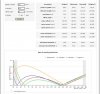
Here is the result using the comparator from VE - note it is worse than the 230 arc but

If you play with the offset angle you will get different results & possibly improvement
 

Attachments

  • Nines TD160 Gauged.jpg
    Nines TD160 Gauged.jpg
    78.4 KB · Views: 37
It might be early yet guys but I am lost here. I'll try to figure out what you are showing here.
Thanks for all the support.
 
Ron
The tables & graph are from the Tonearm comparator on Vinyl Engine
http://www.vinylengine.com/tonearm_alignment_comparator.php

Input the data for your alignment & compare to Baerwald / Stevenson/ Loefgren

play with tweaking the data and you will get different results - this is what I used to produce my own TD160 protractor when I found I couldn't use the Baerwald.

The graph above shows the difference between Nines Gauge method & Baerwald performance so a difference of 1mm setback from the original thorens effective length of 230mm standard arc gives a much poorer performance & more distortion. By playing with the offset angle you could improve on this.
 
Last edited:
twist the cart & you can alter the setting - this is the problem some people get with VE protractor in that the twist is too much & the slide forward is too little

Some can do it & others can't - I get partial success, but can't use the baerwald setting so devised my own
 
Isn't the offset angle permanently built into the tonearm's design and therefore non-adjustable?

Yes it is and if you have the alignment gauge to set the overhang you are all set. Simply set the overhang and square the cartridge. Done.

But, there are so few gauges (if any) that people have to use a protractor as best they can to align to some geometry not knowing the overhang or even in some cases not knowing what geometry the arm was designed to. The Thorens is rumored to have been Baerwald. Others from Japan have been rumored as Stevenson. I used the recommended Thorens protractor from VE and I am way off apparantly from the gauge overhang setting.

If the stylus on the TP-16 headshell is to be 10mm from the front edge of the headshell that's all the gauge we need. I am at 5mm.
I wish I knew what protractor I am supposed to use given such a huge discrepancy.
 
Last edited:
Ron The original setting for the Thorens was not baerwald it was their own.

The VE Thorens protractor was aftermarket designed to Baerwald by SEB

You can use a variety of settings of setback within the headshell (altering the effective length) but each will then have its own unique offset angle to get optimum performance. The Baerwald is the better protractor if you can (a) get the effective length & (b) twist the cart in the headshell to align to the offset angle
 
Back
Top Bottom