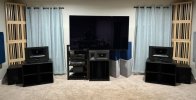
Do you have two tapped horns per side? Or two in total?I hear you! And I hear what you mean. I don’t have my Fh-1 in the stack yet but I did add the woofer section of my Belle Klipsch to the mix. Horns top to bottom! Wow! And these Anarchy subs are wild!
View attachment 3376315
I just joined the Lansing Makers Network. I now have access to tools and warm dry space. I am going to build new Fh-1 bottoms from scratch as a project with my nephew. He recently started a career as a cabinet maker and is excited to do something with me. He is very talented. The Belles will be refurbished when I can.


You are using an out of date browser. It may not display this or other websites correctly.
You should upgrade or use an alternative browser.
You should upgrade or use an alternative browser.
Three-Way Horn System w/ PRV D2200Ph Midrange & ZXPC 18x10 Horn
- Thread starter THD+N
- Start date

Cask05
Active Member
When you can instantly switch from corrected phase to the uncorrected phase response that a speaker like the La Scala or Klipschorn presents, yes it’s like night and day; once you’ve heard it, you can’t unhear it. That said, most Klipsch-heads and horn aficionados have no idea how bad their speakers truly are. They’re truly awful.
It used to be that hi-fi enthusiasts would try new things and techniques, then report subjectively and others would try out those new things and then add their opinions...because no one could afford acoustic measurement gear back then.
Over time, the available fidelity that hi-fi enthusiasts* could achieve in their listening rooms began to improve to the point that the limitations of their listening room acoustics themselves started to become a real limiting factor**. About this same time, shareware room acoustic measurement apps and inexpensive measurement microphones appeared, and DSP crossovers improved in quality and affordability to be true game-changers. Now real hi-fi measurement capabilities can now be easily accomplished, and for next to nothing. In my view, it is foolish to try to pass up these sort of capabilities. If someone is initially intimidated by their inexperience and won't do anything to educate themselves to use these game-changing capabilities, their response is eventually extremely self-destructive.
Having said that, I can say that I've personally witnessed full rooms of people (supposed hi-fi enthusiasts) that couldn't consistently hear the difference in largely blind tests. I don't consider my hearing abilities to be "golden ear" by any means...but I also find that I'm not "tone deaf" either to these sort of large differences in hi-fi reproduction capability. I was astonished to the point of disbelief. It took a long time to muster the presence of mind to mention this experience to anyone else. It shook my confidence in believing virtually any "audiophile" subjective hearing abilities. This includes (especially) audio magazine or reviewers of any sort.
I now can't help but question others' hearing abilities: and many times, they tend to present themselves like someone sitting on a busy street corner with a sign that says "I've got a hearing disability" but then take umbrage to anyone coming up referring to the subject of their sign.
What I find that begins to occur is that people stop making any sort of comments at all to that person sitting on the corner holding that sign--and actually start avoiding walking by that street corner altogether.
Chris
* Here defined as those enthusiasts that use both in-room measurements and subjective listening to assess hi-fi performance...and not those that cannot, will not, or haven't yet taken and interpreted in-room acoustic measurements (like REW provides) to help inform them of verifiable progress toward actual hi-fi.
** If you're unsure of room acoustic problems that are being referred to above, that list includes problems like:
- canted ceilings due to roof-top contours (that usually end up requiring almost total absorption on all of the canted ceiling/side-wall surfaces to control early reflections, and this isn't usually enough to make the room sound "good")
- acoustic reflections between the loudspeakers because of "stuff" between the loudspeakers (which compromise phantom center imaging severely and also mask phase flattening performance of loudspeakers)
- pulling the loudspeakers out away from the room's boundaries because the owners won't put down effective absorption to control early midrange reflections on the front and side walls (and sometimes the ceiling, too if it is low enough)--which all compromise phantom center imaging and soundstaging, and add significant bass modulation distortion artifacts to realistic listening levels.
- things like coffee tables and other chairs between your listening position(s) and the loudspeakers, and acoustically reflective high-back listening chairs that reflect sound near the listener's ears, etc.
- (If you're the type of person that never shows a picture of their listening room with loudspeakers and listening positions--ostensibly because you're afraid people will see that you've got some real issues--you're likely someone that's in denial as to the source of "not being able to hear the differences" of things like subtle-but-strong performance enhancements in flattened loudspeaker phase response.)

babadono
Active Member
I know nothing.......but human perception of absolute phase of soundwaves is one thing, the relationship of phase(i.e. time alignment) between signals coming out of different portions of a 2,3 or even 4 way speaker system is another. Like gigantic said you can't un hear it.

What Chris said is analogous to DIY amps/preamps too. It drives me crazy. There is inexpensive computer based test equipment and/or other means to measure and document amplifier performance, but hardly anyone does it. They post a DIY amp or preamp and say it sounds great but there is no objective documentation to prove that the device actually performs at a level of what would be considered Hi-Fi.
When questioned about the lack of documentation, the offensive response is usually, I don't need any test equipment to tell me it sounds good, I trust my ears.
When questioned about the lack of documentation, the offensive response is usually, I don't need any test equipment to tell me it sounds good, I trust my ears.

Two tapped horns per side…Do you have two tapped horns per side? Or two in total?

DirtyErnie
Well-Known Member
Why do I feel like this after calling Chris to this thread?

…I can say that I've personally witnessed full rooms of people (supposed hi-fi enthusiasts) that couldn't consistently hear the difference in largely blind tests.
Maybe blind listening tests are flawed.
Cask05
Active Member
I typically don't try to upset rice bowls here...since many of the participants clearly enjoy what they are doing.Why do I feel like this after calling Chris to this thread?
However, you might have noticed that I don't spend much time here. This is probably due to my complete lack of interest in passive crossovers and in multiple aperture loudspeakers (i.e., non-MEH designs) that Klipsch still seems to be imprinted on. MEH designs are frankly superior performing loudspeaker designs (IMO)--even when the MEH design is fairly poorly executed.
I'm also a big fan of dual diaphragm compression drivers to replace separate midrange and tweeter drivers (typically eliminating polar lobing between midrange and tweeters, especially if time alignment using DSP/multi-amping is also brought to bear on the design). These type of compression drivers seem to work the best of all and at the lowest overall cost to achieve very high acoustic performance of higher frequency reproduction, IME.
I also like to see acoustic measurements (very much so over the typical electrical/electronic measurements which do not show audio system end-to-end performance) and a tendency of the participants to try to correlate measurements to what they are hearing. I notice a lot of online reviews using only simple harmonic distortion figures. I think it's a lot better to focus on subjects like acoustic group delay, phase, and modulation distortion (as well as thermal compression distortion, etc.) that are really what we hear as "not sounding very good".
[I find that pure harmonic distortion without accompanying modulation distortion is almost impossible to detect in many cases--so using harmonic distortion data only as the basis of arguments is usually a notoriously poor place to start audio equipment review discussions. This is why data from sources like Klippel NFS systems is so important, IMO, even if the accompanying "spinorama" data is vastly overplayed in the discussion. (Again...IMO.) Simple polar spectrograms compiled from a series of measurements taken at 10 degree increments off-axis in horizontal and vertical directions usually tell me a great deal more than any of the spinorama composite amplitude response plots (themselves that suffer from usually poor assumptions about the room acoustics and loudspeaker placement in-room).]
Chris
Last edited:
DirtyErnie
Well-Known Member
Mmm, yeah. I hear all that. Sadly I don't have room for the MEH in my house, so we're going to attempt a Pocket JubScala 2-way. The coaxial mid/high driver will be kept as a back-up. Probably simple LR2 crossover and let the marantz receiver handle EQ an' stuffs. upper horns will be separate units for aiming and front/back time alignment.
Thanks for coming out, Chris (and not biting!)
Thanks for coming out, Chris (and not biting!)

TheAbide
Active Member
I'm also a big fan of dual diaphragm compression drivers to replace separate midrange and tweeter drivers (typically eliminating polar lobing between midrange and tweeters, especially if time alignment using DSP/multi-amping is also brought to bear on the design). These type of compression drivers seem to work the best of all and at the lowest overall cost to achieve very high acoustic performance of higher frequency reproduction, IME.
This is my current plan way down the road, swap the PRV/lavoce out for b&cs. MEHs are definitely on the list too but i can understand why you dont see a folks DIYing(or purchasing SHs) them as much. But knowing the performance level of those designs in no way takes away from whats going on here with some $60 compression drivers and $50 horns either imo.
While most of us here know you are very knowledgeable in these areas and we respect your opinions, some of us may eventually end up in the MEH camp. Some of us are perhaps on the journey already (to MEH camp) and we don't know it yet.I typically don't try to upset rice bowls here...since many of the participants clearly enjoy what they are doing.
However, you might have noticed that I don't spend much time here. This is probably due to my complete lack of interest in passive crossovers and in multiple aperture loudspeakers (i.e., non-MEH designs) that Klipsch still seems to be imprinted on. MEH designs are frankly superior performing loudspeaker designs (IMO)--even when the MEH design is fairly poorly executed.
I'm also a big fan of dual diaphragm compression drivers to replace separate midrange and tweeter drivers (typically eliminating polar lobing between midrange and tweeters, especially if time alignment using DSP/multi-amping is also brought to bear on the design). These type of compression drivers seem to work the best of all and at the lowest overall cost to achieve very high acoustic performance of higher frequency reproduction, IME.
I also like to see acoustic measurements (very much so over the typical electrical/electronic measurements which do not show audio system end-to-end performance) and a tendency of the participants to try to correlate measurements to what they are hearing. I notice a lot of online reviews using only simple harmonic distortion figures. I think it's a lot better to focus on subjects like acoustic group delay, phase, and modulation distortion (as well as thermal compression distortion, etc.) that are really what we hear as "not sounding very good".
[I find that pure harmonic distortion without accompanying modulation distortion is almost impossible to detect in many cases--so using harmonic distortion data only as the basis of arguments is usually a notoriously poor place to start audio equipment review discussions. This is why data from sources like Klippel NFS systems is so important, IMO, even if the accompanying "spinorama" data is vastly overplayed in the discussion. (Again...IMO.) Simple polar spectrograms compiled from a series of measurements taken at 10 degree increments off-axis in horizontal and vertical directions usually tell me a great deal more than any of the spinorama composite amplitude response plots (themselves that suffer from usually poor assumptions about the room acoustics and loudspeaker placement in-room).]
Chris
In some cases (probably a lot of cases), MEH's may not be practical due to room size or other factors.
I too have a complete lack of interest in a lot of posts I see, and I have learned you can't change their mind unless they come to you looking for advice first, then they seem more open to your knowledge/opinions/advice.
Some people just like to listen to their music in an imperfect way whether it be through passive crossover loudspeakers or preamps/amps that fall well below HiFi standards.

ProHornResto
Active Member
Hey fellas, back from the dead with a question.
Context: I finally brought my Peavey/PRV/MAHL speaker back into my room after months of enjoying my kpt-904’s. (Why I suddenly stopped posting) This was my first time playing them with d2200ph mids as well as seeing what Crites universal crossovers would sound like. My first few listening sessions were at low volume but gave me the chance to dial in the driver balance (just by ear at this point). That plus audyssey yielded smoother and more enjoyable listening than my 904’s, so I sold the 904’s.
The problem: The next day, I listened for hours, under reference level, and suddenly heard crazy distortion on a piano track on b flat 5 (mid 900hz). By crazy, it was so pronounced, squawking, and had decay, it sounded digital. I bought these drivers a year ago and just now ran them. (K69a’s before that) So before I just buy another identical driver or look for another model, I wanted to get any input I could. Thanks guys
Context: I finally brought my Peavey/PRV/MAHL speaker back into my room after months of enjoying my kpt-904’s. (Why I suddenly stopped posting) This was my first time playing them with d2200ph mids as well as seeing what Crites universal crossovers would sound like. My first few listening sessions were at low volume but gave me the chance to dial in the driver balance (just by ear at this point). That plus audyssey yielded smoother and more enjoyable listening than my 904’s, so I sold the 904’s.
The problem: The next day, I listened for hours, under reference level, and suddenly heard crazy distortion on a piano track on b flat 5 (mid 900hz). By crazy, it was so pronounced, squawking, and had decay, it sounded digital. I bought these drivers a year ago and just now ran them. (K69a’s before that) So before I just buy another identical driver or look for another model, I wanted to get any input I could. Thanks guys
Attachments

Invidiosulus
Well-Known Member
If you swap the inputs left/right/middle etc, does the noise stay with a specific driver?
ProHornResto
Active Member
Yes I just tried swapping the amps and the sound stays in the right speaker. I can get it to distort on other songs but this one just hits the nail on the head. I just tried the song on my headphones and it’s just a harsh master that makes it stand out. “Field of Tears” by Natural Beat Records if anyone wants to follow along.If you swap the inputs left/right/middle etc, does the noise stay with a specific driver?
Invidiosulus
Well-Known Member
Is that with Audyssey enabled?Yes I just tried swapping the amps and the sound stays in the right speaker. I can get it to distort on other songs but this one just hits the nail on the head. I just tried the song on my headphones and it’s just a harsh master that makes it stand out. “Field of Tears” by Natural Beat Records if anyone wants to follow along.
Are you sure it’s not something from the input/processing side?
You would know pretty well if you swapped the driver and the noise followed.
My kids and I have been beating on my D2200ph daily for two years without any issue.
TheAbide
Active Member
Hoping these fellas are right and its something else but if it is busted a new diaphragm is $25. not too bad

PRV Audio RPD2200Ph Replacement Diaphragm for D2200Ph
PRV Audio RPD2200Ph Replacement Diaphragm for D2200PhRestore your drivers to their optimal quality with this genuine PRV replacement diaphragm. Genuine PRV diaphragms come with an engraved logo, so you know you're getting the genuine article. Make your compression driver sound as good as the day...
www.parts-express.com
ProHornResto
Active Member
THD - it did not follow when I swapped the signal. I haven’t tried swapping the amps. Good thought.
In. - Thanks for the thoughts. I’ll try with audyssey off too. Should have a chance this weekend.
hadn’t thought about just replacing the diaphragm. Definitely worth trying before buying new drivers. I would have been tempted to upgrade to the 4500ph which is considerably more.
In. - Thanks for the thoughts. I’ll try with audyssey off too. Should have a chance this weekend.
hadn’t thought about just replacing the diaphragm. Definitely worth trying before buying new drivers. I would have been tempted to upgrade to the 4500ph which is considerably more.

Dave MacKay
Active Member
That’s the way this addiction (to audio) works …hadn’t thought about just replacing the diaphragm. Definitely worth trying before buying new drivers. I would have been tempted to upgrade to the 4500ph which is considerably more.
