I don't think that Ojas will be at the next Axpona in Chicago. All those speakers are more about the LOOKS rather than the Sound.Probably the rage due more in part by the retro look than by the performance.


I don't think that Ojas will be at the next Axpona in Chicago. All those speakers are more about the LOOKS rather than the Sound.Probably the rage due more in part by the retro look than by the performance.

You mean it is just a front Snoop?I don't think that Ojas will be at the next Axpona in Chicago. All those speakers are more about the LOOKS rather than the Sound.
I can relate... I know we beat it to death in another thread, but I'll never miss my turntable or vinyl. I do have a few cassette decks but only to play old archive tapes of a radio show I recorded off-air from Orlando called Sunday Night Vinyl. It was 80 & 90's alternative and progressive. It was awesome. Of all the "old technology" the transducers have/had to be the weakest link in the chain. That's the main reason I sold my JBL D130's and bought modern Celestion 15 " woofers. They do everything the D130 can do, but better by a few magnitudes.I don’t doubt that at all. Frankly, (I may get into trouble here for saying this,) I don’t understand the current craze for vintage gear, nor do I get the orthodoxy and pedantry that vintage speakers in particular, should remain unmolested museum pieces; my experience with 70’s Klipsch is that they’re not particularly good, largely due to the limitations of their vintage components. Why people insist that boxy, shouty and sibilant are desirable characteristics in a loudspeaker is beyond me.

Photos please.Normally, I have the top hat flush with the front of the horn like a normal LaScala. I was then letting the Pioneer home theater receiver correct for room anomalies, etc and it sounded great. However, today, I moved the open top hat back as far as it would go to physically align the midrange more with the woofer for better time-alignment.

As indicated in many postings and opinions, we appear to be more sensitive to phase changes than frequency response aberrations. This little experiment has proven it to me.

That’s what I thought too.I must have missed that. It has been over a decade, so I doubt I will find the study, but most people don’t really notice phase changes at all
When you can instantly switch from corrected phase to the uncorrected phase response that a speaker like the LaScala or Klipschorn presents, yes it’s like night and day; once you’ve heard it, you can’t unhear it. That said, most Klipsch-heads and horn aficionados have no idea how bad their speakers truly are. They’re truly awful.I have my Pioneer home theater receiver (using it for it's DSP functions mainly) in the tape loop of my preamp so I can switch it "in & out" at the push of a button and it makes a dramatic difference in the imaging and focus. The speakers literally disappear. Simple frequency response changes won't do that (IMO).

Yes.ChrisA? He's here... occasionally.

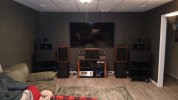
With a passive it’s hard to get the driver center distance close and be time aligned.Here is my current home theater / 2 channel set-up in the basement;
View attachment 3417491
Open top-hat flush with front of bass horn
View attachment 3417492
Moved back to be more physically aligned (in time) relative with woofer
View attachment 3417493