• The move to the new server is done. There are some software and database maintenance updates in process. This has us passing the hat around to help out. We appreciate any donations. Seriously, even a dollar helps. The payment page may be found here - https://www.audiokarma.org/support.html

TL vs Overdamped BR - Opinions?

@Ken Kantor:______________________________________________________
"Why would the amplifier see a more resistive load? That sounds incorrect to me. Any data or documentation on this phenomenon?"

I don't claim to know, but from what I've read here & elsewhere, I took it
to mean that the load was not more resistive as such, but more purely resistive
and less reactive. Again, I don't claim to know, as I don't have the
science down like most others here, but that was how it read to me.
 
There are 4 issues here:

1. Frequency response. (How low does it go?)
2. "Q"
3. Woofer excursion.
4. Electrical phase / impedance
EDIT Forgot
5. group delay/acoustic phase

Get Martin King's worksheets (or other modelling software) and simulate both types. See what the models predict. That won't be definitive, obviously, but at least we'll have something to talk about besides our opinions.... :D

PS: My guess is that 1-3 may be a toss-up, but that #4 will will favor the t-line. Not sure about #5.
 
Last edited:
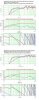
Been there done that. I have had people run the program. Not sure which one is easier to read. I stated earlier why some drivers were crossed over very low. The graph shows why.
 

Attachments

  • tn.jpg
    tn.jpg
    19.5 KB · Views: 16
  • Dalesford 10 TL comparison..jpg
    Dalesford 10 TL comparison..jpg
    72.1 KB · Views: 19
Last edited:
sreten, thanks for the observations on damping/stuffing, etc.
More food for thought. I have read that 'glass is better for
some things and dacron for others, that HF attenuation
increases as as fiber diameter decreases, etc. 'mojo had an interesting
link on that that he sent me in another thread. Solen now carries
a product by Teijin called Twaron that is carded into different
products, such as one called "Angel Hair". Twaron is supposed to be
super fine. It is a bit pricey, but interesting. Here's a data sheet
on it, if the link pans out: http://www.solen.ca/pdf/twaron/TWARON Angel Hair.pdf
 
Outside of wool the foam is more expenxive then the Acoust stuf. I would like to see some testing of the Ange Hair for comparisons with the other damping materials.

The first time I ever heard a t-line were the Fried O1 through a Thorens turntable, Dynaco Pat-4 and Dynaco St-400 built from kit. 200 watts was a big amp in 1979.

Check out the video of world reknown tube amp designer listening to one of her speakers.

http://www.youtube.com/watch?v=6UQfa0z2x_s

http://www.dehavillandhifi.com/Q&Akara_chaffee.htm
 
Last edited:
FWIW, Here's one that goes to Teijin's Twaron site directly:

http://www.twaron-angelhair.com/index.php?item=twaron-angel-hair&action=page&group_id=9&lang=EN
Be warned, the English is a bit "interesting".

That stuff does look mighty fine, but I do wish they'd come out and state
just how thick their fibers are, and use 'glass or dacron rather than a human hair
for comparison in that micro-photograph they use in all their lit.
*
Anybody got any science OR opinions on kapok? I read of someone who
modded the midrange sub-enclosure (the tear-drop shaped style) on their
B&W's by swapping out the stock damping material with kapok, and was impressed
with the results.
 
Been there done that. I have had people run the program. Not sure which one is easier to read. I stated earlier why some drivers were crossed over very low. The graph shows why.

Thanks for posting - that's the sort of comparison I was looking for. But .. could you make them a little larger?
 
"Thanks for posting - that's the sort of comparison I was looking for. But .. could you make them a little larger? "

Yes, cool to have the comparisons - and larger would be good.
I'm going to try to download and blow it up in print mode. Don't hold your
breath, folks - I AM technically challenged.
 
Frperdurabo thats the best I can do. It was from an email. I see you have a set of IMF. Did you ever listen to any of the Fried t-lines? The whole point of my postings that there are many ways to design accurate t-lines. It's just a hobby to me.

I was waiting for someone to ask for a computer design compared to Fried's design for the same drivers. The Fried line length is 9.4 " and 4..25 cubic feet line volume. If you divide 1.25 Sd. into Vb. Good listening
 
Comes out pretty pixellated on print-out, even with a good printer, but I see you can get the
thumbnail on the right to blow up with a second left click, then it's not too bad.
 
I did not intend for the thread to become such off topic. I doubt I have given the thread starter any help. I apologize to Hannibal.
 
@sm19422:_______________________________________________________
"I did not intend for the thread to become such off topic. I doubt I have given the thread starter any help. I apologize to Hannibal."
*
For what?? This is all good stuff. I asked about TL's and how they compare
to other cabs, and you've provided a lot of data, graphs and
observations about just that. Works for me. Oh, BTW, I did just now
get registered at the yahoo group. Finally. I will be reading and rereading a
lot of posts here (many of them yours), scoping and rescoping all kinds of links
(many of them yours). Pretty soon I'll register over @ King's site too. I'm half tempted
to print out this whole thread and make a book out of it. :D
Big grats in fact to everyone who has chimed in.
 
Wow, sm, I just took a quick look at that last link. You can keep "victimizing" me like that all you want. :D
Now that's something I probably WILL print out.
 
In fact I just DID print it out. Yep, that's going in my binder.
If anybody wants to just read it on-screen, click to print anyway -
the PDF shows up real nice on screen.
----------------------------------------------------------------
"The problem was there was only one speaker and it broke one day while I was using it while they were in school."
*
Sounds like you first got into speaker building and repair as a survival
mechanism.:D:lmao::D
 
OK, I see your point. I can think of at least two ways to overcome it, but they take a fair amount of work, and so probably would only be used by a manufacturer. One would be to build an isolating fixture, perhaps putting the terminus into an anechoic chamber or outside a building wall. The other would be using two microphones and applying nearfield theory, (such as Keele's) to determine the relative contribution of each source. This is done routinely in large vented systems and multi-source arrays, and isn't that difficult.

So, let me think of the various TL's, (accepting the common usage of the term). No rankings or ratings here.

Fried's stuff. I had listened to it at many shows, but also, Bud became a casual friend at one point. He played several things for me, and I used one of his smaller designs at a trade show demo I was doing.

IMF stuff, but long ago.

PMC stuff. And I have had some discussions/debates with Loader.

Numerous smaller manufactuers and serious hobbyist designs heard over the years at trade shows, audio club lecture tours, client visits, etc.

My own efforts in the area, including a large TL done in college with friends, and the NHT VT-1, which used a small line terminated in a Helmholtz resonantor to allow one of the first videocentric, small column systems.

/k/


Getting an accurate measuement using a spl meter when the line terminus is 26" below the voice coil center on the sub. How do I know the woofer's sound isn't affecting the reading from line terminus.. They both measure the same spl. The spl coming from line terminus at the rear of the C3L enclosures is = to measurements from the front. All the damping placement in my first O4 enclosure were designed by the company. I am well from a very easily pleased listener. You listened to the Acoustic Research sound when you got interested in loudspeaker design. I was exposed to Fried's aperiodic loading in the B2 and C satellites and t-line of the model O. The t-line was not yet used for the midbass driver this was around 1986 Listening to the C3l and O4 enclosures is like now hear this. Do you recall which models of Fried-lines you have listened to over the years? I have not heard of the new owners desings. I dont' claim to be a genius designer. I can't claim to create the designs. Bud created his designs by expanding on other people's work. I understand what the designer achieved by comparing different designs. I have used this to create my own designs as have many former Fried kit owners. The best t-line designs I have heard are the C3L and O 4 enclosures with the various drivers Bud designed for their use.. The 2 way flat baffle on the Fried Studio IV does not have the off axis respone of the tweeter and mid range compared to the sloped front C3L. I have not heard other companies t-lines except the B&W Nautilus 801. Very few companies offer t-lines commercially. I prefer the Fried C6 and O6. The Fried lines sound more like real music then other companies speaker designs. I know I am being subjective You have probably heard more t-lines then I ever will being in the industry. What t-lines have you listened to over the years and your opinions of them?

 
@Ken Kantor:______________________________________________________
"Why would the amplifier see a more resistive load? That sounds incorrect to me. Any data or documentation on this phenomenon?"

I don't claim to know, but from what I've read here & elsewhere, I took it
to mean that the load was not more resistive as such, but more purely resistive
and less reactive. Again, I don't claim to know, as I don't have the
science down like most others here, but that was how it read to me.

I would ignore this claim, because it makes no sense.

/k/
 
Back
Top Bottom