• The move to the new server is done. There are some software and database maintenance updates in process. This has us passing the hat around to help out. We appreciate any donations. Seriously, even a dollar helps. The payment page may be found here - https://www.audiokarma.org/support.html

TL vs Overdamped BR - Opinions?

Frperdurabo thats the best I can do. It was from an email. I see you have a set of IMF. Did you ever listen to any of the Fried t-lines? The whole point of my postings that there are many ways to design accurate t-lines. It's just a hobby to me.

I only heard the smaller, bookshelf-sized Frieds, back in the 80s. I'd love to hear the bigg'uns. :D

I didn't realize there were other software-based t-line design tools (besides the MJ King worksheets). My mistake; I haven't been an active speaker builder since the early 2000s.
 
There is not other software based design tools that I am aware of. I never stated that.

I am not sure how much of the thread you read.
.
In giving advice many design parameters discussued pertaining to drivers and common denominators in many commercial designs,

Observations made by diiferent designs in t-line evolution.

Getting into more detail about the Kevin Blair article He came up with a 1/8 wavelength design for driver Fb and 1/4 wavelength for driver Fh.

Back in 1994 I did not have a computer. Info was more limited compared to today. I used the public library.

In order to learn more about t-line speaker design I subscribed to Speaker Builder

Many of the designs were using Acousta Stuf in the 90's. In 2-82 Speaker Builder Gary Galo used wool like Bailey.

Kevin Blair explained the foam being waved in a matrix. and R.Wright of TDL

I finally found another design using the foam like the Fried lines and the same terminology used. Free flow of air.

Roger Sanders and Robert Spear both wrote a response to the article before it was published that is also included.

On page 4 of the issue under Good News was a picture of the new Fried Signature Series of speakers. Now isnt that ironic. Coincidence maybe or maybe not.
 
Last edited:
Another driver parameter is voice coil inductance. It is not mentioned often in choosing a driver for t-lines. The lower the inductance the faster the transient response.

Yes and no. The transient response is completely determined by the bandwidth of the driver. In some woofers, this is dominated by the inductance, in most, it is dominated by the mass.

-k
 
Moving mass has a small secondary effect. It's not only not the whole story, it's got comparatively little effect compared to inductance.

Really? A typical single-pole corner frequency formed by a driver inductance falls between about 2 KHz and 4 KHz. I would think that mass would have a large impact there. Am I wrong?

-k
 
Not sure how to answer this. There are many ways to reduce inductance, although a lot of them reduce sensitivity, too. Shorting rings >sometimes< lower it, but not always. (Their main function is to linearize the field.)Honestly, I rarely hear about inductance being a big issue in woofer design. For the most part, it only can be altered by about 2:1, maybe 3:1, anyway. Of course, some expensive drivers seek to minimize it simply as a point of differentiation to justify their price.

-k

I wish Ken would comment about driver design being a designer when he has the time.

I would like to know how one designer had the driver voice coil inductance lowered in his oem drivers compared to the stock models.

Dnewma04 is the Super Mod. And I bet everyone would enjoy reading this.

https://docs.google.com/viewer?a=v&...5d08hF&sig=AHIEtbT-ADWgCFdXTXY4V_h7AcVZiPmwAg
 
The question was about methods to reduce inductance from a post a few prior the one you quoted. It led to a quick discussion on the benefits of a faraday ring. It's my understanding that they can reduce inductance to some degree and also help to linearize the effective inductance as the coil travels through the gap. I figured that one of the experts may better explain how it works and in the meantime, found the link I posted because it seemed to do a decent job of explaining it.

There, now are you even more lost? :)

Well, to get the real scoop, I suggest you contact Queen Faraday....

The copper ring acts as a shorted turn. As the coil passes over it, an opposing circular current is induced in it. This current acts to support the static magnetic flux against modulation, and also can somewhat extend the fringe field. The result is increased Xlin and lower distortion. Induction may be modulated down slightly, as the ring pulls energy out of the dynamic magnetic field. I'm not sure about the exact conditions under which the ring influences inductance, but I can ask if you are really itching to know.

-k
 
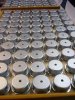
Of course, I know the ScanSpeak well. (Attached are a few pics of the ScanSpeak/Vifa production facility. I will post more, including several of the old Peerless factory, below.)

Certainly, inductance has nothing at all to do with bass performance. That's all about its low Fs. Sure, the inductance is low-ish, but nothing that unusual. And there are plenty of similar copperized drivers with double that inductance.

-k

I posted earlier about magnets being slightly offset. I would hate to take the drivers out of their cabinets to take a picture. You never know when a t-nut might come loose.

I originally thought they were defective when I purchased last set of replacments of NOS around 1993. I was educated on how this improved the sound.

I don't know how a person would be able to take off the shelf drivers and improve them so much. Larger diameter of the magnet and increasing the height of the magnet. Longer voice coils were probably used due to extended pole pieces.

Case examples in driver inductance, Look how low the voice coil inductance is on the Scan Speak Revelator. Well known for it's bass.

http://www.speakercity.com/Merchant...SC&Product_Code=18W-8531G&Category_Code=SSREV
 

Attachments

  • P1000385.jpg
    P1000385.jpg
    37.3 KB · Views: 15
  • P1000388.jpg
    P1000388.jpg
    33.3 KB · Views: 12
  • P1000390.jpg
    P1000390.jpg
    35.3 KB · Views: 11
  • P1000392.jpg
    P1000392.jpg
    33.1 KB · Views: 13
  • P1000393.jpg
    P1000393.jpg
    37 KB · Views: 9
  • P1000395.jpg
    P1000395.jpg
    33.9 KB · Views: 14
Offset magnets improve the sound?? This I gotta hear!

-k

I posted earlier about magnets being slightly offset. I would hate to take the drivers out of their cabinets to take a picture. You never know when a t-nut might come loose.

I originally thought they were defective when I purchased last set of replacments of NOS around 1993. I was educated on how this improved the sound.

I don't know how a person would be able to take off the shelf drivers and improve them so much. Larger diameter of the magnet and increasing the height of the magnet. Longer voice coils were probably used due to extended pole pieces.

Case examples in driver inductance, Look how low the voice coil inductance is on the Scan Speak Revelator. Well known for it's bass.

http://www.speakercity.com/Merchant...SC&Product_Code=18W-8531G&Category_Code=SSREV
 

Attachments

  • P1000381.jpg
    P1000381.jpg
    36.1 KB · Views: 9
  • P1000375.jpg
    P1000375.jpg
    38.6 KB · Views: 11
  • P1000373.jpg
    P1000373.jpg
    38.7 KB · Views: 7
  • P1000371.jpg
    P1000371.jpg
    28.4 KB · Views: 8
  • P1000368.jpg
    P1000368.jpg
    36.2 KB · Views: 6
  • P1000433.jpg
    P1000433.jpg
    39.8 KB · Views: 9
Last batch, mostly Peerless.

-k
 

Attachments

  • P1000438.jpg
    P1000438.jpg
    37.1 KB · Views: 8
  • P1000439.jpg
    P1000439.jpg
    38.6 KB · Views: 9
  • P1000443.jpg
    P1000443.jpg
    32.2 KB · Views: 6
  • P1000446.jpg
    P1000446.jpg
    26.1 KB · Views: 6
  • P1000468.jpg
    P1000468.jpg
    35.6 KB · Views: 6
Really? A typical single-pole corner frequency formed by a driver inductance falls between about 2 KHz and 4 KHz. I would think that mass would have a large impact there. Am I wrong?

-k

The only data I've seen is Dan Wiggins' test where inductance seemed to dominate. Mass killed sensitivity but didn't seem to impair the drivers ability to react to a signal change.
 
Yes and no. The transient response is completely determined by the bandwidth of the driver. In some woofers, this is dominated by the inductance, in most, it is dominated by the mass.

-k

A woofer with a wider bandwith will have a faster transient response.

Then a woofer that goes higher in frequency has a faster response time compared to a woofer that does not reach as high a frequency doing a comparison of two 6.5" woofers.

I think we have started a new topic Dnewma04
 
A woofer with a wider bandwith will have a faster transient response.

Then a woofer that goes higher in frequency has a faster response time compared to a woofer that does not reach as high a frequency doing a comparison of two 6.5" woofers.

I think we have started a new topic Dnewma04

Yes, exactly!

Makes sense, doesn't it?

To follow the rapid back and forth oscillations of a high frequency wave requires.... wait for it.... speed.... transient response! This is the same for any mechanical or electronic system. Wider bandwidth equals lower risetime.

-k

Not sure there is a new topic's worth to say on this. It's pretty cut and dry. 99.9% of audio and hearing researchers don't believe transient response is particularly audible, in any event. I feel it can be heard under overload conditions, but not readily below.
 
Last edited:
Two things I don't have much experience with; and I'd like to hear
any opinions on their general similarities and differences as far as
their actual sound goes. Subjective and un-scientific as this is,
I'd love to hear from anybody that has listened to both. (Or be
steered to a thread on it that I've missed.)

What I'm out to build is a nice, no-subs-needed, 2 channel, music-
only home system with something like a single 12" or twin 10's @
side, most likely 3-way & tri-amped. Driver selection is pretty well
covered - what I need to decide is if it's worth the extra work to
scare up a TL design when I already have a nice design in hand for
overdamped BR. (The extra fab difficulty would not be an issue.)
I don't need stupid-deep subsonic HT rumble, just effortless, musical
bass. Any feedback is greatly appreciated.

Just wondering, I'd like to know what woofers you have in mind, or even just the T&S parameters.
How would you tune them (Fb) in the vented box, how large of a box did you have in mind?

Box size and where did you plan to tune the TL, basically l/4 freq?

Is there a commercial speaker that you particularly like?
 
As to your experience, well you might be a genius designer or a easy pleased listener.

Ken do you think I am an easily pleased listener or a genius, ha ha.

Yes it does make sense. One reason why I prefer t-lines and large bandwith drivers in the critical midrange.

The Scan Speak 5" split cone in the Totem Hawk are very musical.
I wish they were not so expensive but you have to earn a living.

I really appreciate the forum users who are true gentleman like Ken. The ones who are not have issues I expect in every day life. Many people asking advice that are new to this hobby deserve to be treated respectfully.

No more then I wouldn't expect a mechanic to make fun of a customer that doesn't understand why their vehicle broke down.

For some reason I have yet to master the quote function.
 
Last edited by a moderator:
The magnets on a pair of 6.5" are offset about 1-2mm just enough to notice.

I have discussed the defunct company with Jerry at Falcon Acoustics .

I also asked him if they were under hung or over hung voice coils?

He though it was beyond the capabilities of the company to produce underhang.

They were custom built to Fried specs by Dalesford.

Another woofer repair technician the owner of the company was impressed with their design.

Milersound repaired a lot of overdriven Kef woofers.

102mm magnet by 18mm magnet height.

The distance from top plate to back plate 38 mm compared to 33m with Gefco composite cones.

The driver depth is 93mm a lot for a 6.5"
.
They also us nomex voice coil formers with copper wire.

One of the many Fried drivers I have purchased over the years.

I like them better in the C3L t-line then the Carboneau polpropylene .

The Gefco cones are the most accurate of any Fried woofers I have used.

The cone mass was also stated to be less mass then the stock units of 17 grams. Fried claimed they had thinner cones?

From what I have seen nothing would surprise me.
http://www.millersound.net/about.htm
 
When you say offset, I think you are throwing me off like the magnet is offset from center. Do you mean offset as in there is a thicker top plate?
 
@Pete B:________________________________________________________
Just wondering, I'd like to know what woofers you have in mind, or even just the T&S parameters.
:smoke:
This all stems from the original idea of making a clone of the
AMT 3 Rock Monitor to feed my Heil jones. A good bass driver for the job seems
to be the Eminence 1040 SF 10", available at OCS. Mms is 45.79 gm, 2" VC,
sheet says "VC winding .750" - which I assume means it's inductance, at .750
mH.
VAS: 3.38 cu. ft.
QTS, FWIW: .38
FS: 29.88 Hz
XMAX: 9.1 mm

________________________________________________________________
How would you tune them (Fb) in the vented box, how large of a box did you have in mind?
:smoke:
I'd had in mind just duping the original cab & port dimensions, as everything
was well scienced out by OCS and other AMT 3 owners.
That was the original idea. I since got to wondering if it would be
worth the effort to go instead to a TL cab/mid-bass/Heil combo, as I want
to frame the Heils in the best possible way.
_______________________________________________________
Box size and where did you plan to tune the TL, basically l/4 freq?
:smoke:
Whatever box size works - WAF not an issue. It could have a footprint
like an AMT 3 and be even taller yet. I'd prefer it be not crazy big like
the largest Polk SDA's. Other than that, I'm easy (or so they tell me).
Where tune it? 25, 30 Hz I imagine would be fine, if that's what you
mean. Tuning lower would be OK if critical to the design. Whatever
makes the driver I go with happy & accurate/articulate enough to
blend well w. AMT's.
I just don't want to have to add subs.
_______________________________________________
Is there a commercial speaker that you particularly like?
:smoke:
Sorry if I'm being obtuse here, you mean drivers or built speakers?
If drivers you mean pro-line (JBL/EAW) or home market OEM/DIY
like Audax/Scanspeak & so on?

FWIW, in general I usually prefer a good BR cab
to sealed, hate horn-loaded anything or band-pass, and have never actually listened
to any TL's, but they look good on paper. Nicest (if not fastest)
mid-bass to my ears is probably the 8" JBL L116-A they used to put
in the L-19 & such. I owned some modded JBL 4311's that I quite liked
for their bass. Most of my life I never had time and/or money to
listen to home stuff too much more up-market than that. But since
'80, '81, I've loved the idea of mixing Heils with quality bass & lo-mid
drivers. Now I do have more time & money to go for that plan.

 
If you can over come the cabinet complexity of the TL vs the PR then you are well onyour way to having an excellent potential for a bass platform. It may also a bit fickle with placement if you rear slot your design.

Local speaker mfg here in Ft Worth Tx, "Toby" built TL for years and I consider them standards of the design. Never heard one I did not like for their ultra smooth bass reproduction. Never boomy or weak and easily blending with upper drivers.

As for PR designs, I think Klipsch came as close as anyone getting that done well. The Forte and others are good examples.

If you get the chance do put an ear or two on a Toby design, even their older 6"x9" cone design was pretty good!
DC

Yay Forte!:banana:
 
Hmmm, nope, no desire to rear slot. I don't even like rear-firing ports.
Been there/done that/don't see the point. What I'd like is to not only
have it front, but as close to the drivers as possible, which would likely
require a lot of deviousness on my part, but I'm good at that. :D Seems to
me that all sources ought to be grouped together as closely as possible
 
Back
Top Bottom