• The move to the new server is done. There are some software and database maintenance updates in process. This has us passing the hat around to help out. We appreciate any donations. Seriously, even a dollar helps. The payment page may be found here - https://www.audiokarma.org/support.html

Transistor Substitutions

Is there a modern replacement for a 2SC644(T)?

I agree with @rcs16 in that KSC1845 is a good replacement for the 2SC644. I've used exactly that many, many times and been very satisfied with the resulting performance.

2SC644
Silicon NPN in TO-92 package

Vcbo: 25 V
Vceo: 25 V
Vebo: 5 V
Ic max: 0.05 A
ft: 75 MHz
hFE MIN: 350
Pc: 0.15 W​

KSC1845
Silicon NPN in TO-92 package
Audio Frequency (very, very) Low-Noise Amplifier

Vcbo: 120 V
Vceo: 120 V
Vebo: 5 V
Ic max: 0.05 A
ft: 75 MHz
hFE MIN: 300-600 (you'll need a "F" gain code)
Pc: 0.500 W​
 
What would be a good replacement for Sanyo D313E?

The 2SD313 is pretty common in some of the vintage receivers as power supply transistors and in other places (I think) as low wattage output transistors. I think your question can't be answered properly without an idea of how the 2SD313 is used in the circuit.

2SD313
Silicon NPN in TO-220 package
general purpose amplifier and switching applications

Vcbo: 60 V
Vceo: 60 V
Vebo: 5 V
Ic max: 3 A
ft: 8 MHz
hFE (for the E code): 100-200
Pc: 1.75 W​

In general, you've got quite a few modern, inexpensive choices... which ones are best, though, will depend on how the transistor is used in your circuit. Is it doing amplification duty in the audio signal path? Or is it just performing voltage regulation or switching in the power supply?

TIP31, TIP41, KSC2334, KSD526, KSD880, KSD363, KSD1408, KSD1588, KSD2012, BD241, BD243, BD809, MJE15028, MJE15030, MJE15032, MJE15034

(edited to remove the TO-247 devices as they are not the same dimensions)
 
Last edited:
The 2SD313 is pretty common in some of the vintage receivers as power supply transistors and in other places (I think) as low wattage output transistors. I think your question can't be answered properly without an idea of how the 2SD313 is used in the circuit.

2SD313
Silicon NPN in TO-220 package
general purpose amplifier and switching applications

Vcbo: 60 V
Vceo: 60 V
Vebo: 5 V
Ic max: 3 A
ft: 8 MHz
hFE (for the E code): 100-200
Pc: 1.75 W​

In general, you've got quite a few modern, inexpensive choices... which ones are best, though, will depend on how the transistor is used in your circuit. Is it doing amplification duty in the audio signal path? Or is it just performing voltage regulation or switching in the power supply?

TIP31, TIP41, KSC2334, KSD526, KSD880, KSD363, KSD1408, KSD1588, KSD2012, BD241, BD243, BD809, MJE15028, MJE15030, MJE15032, MJE15034

(edited to remove the TO-247 devices as they are not the same dimensions)

I'd be using it to replace the output transistors in a Realistic STA-47 receiver. TIP31 or 41 would work? I have some laying around.
 
I'd be using it to replace the output transistors in a Realistic STA-47 receiver. TIP31 or 41 would work? I have some laying around.

The MJEs are great for low wattage (50 watts or less) outputs.
 
I agree with @rcs16 in that KSC1845 is a good replacement for the 2SC644. I've used exactly that many, many times and been very satisfied with the resulting performance.

2SC644
Silicon NPN in TO-92 package

Vcbo: 25 V
Vceo: 25 V
Vebo: 5 V
Ic max: 0.05 A
ft: 75 MHz
hFE MIN: 350
Pc: 0.15 W​
KSC1845
Silicon NPN in TO-92 package
Audio Frequency (very, very) Low-Noise Amplifier

Vcbo: 120 V
Vceo: 120 V
Vebo: 5 V
Ic max: 0.05 A
ft: 75 MHz
hFE MIN: 300-600 (you'll need a "F" gain code)
Pc: 0.500 W​
thanks Dlucy, I amended the main list.

I have a curve ball for you and everyone else:

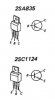
Sony 2SA835 / 2SC1124
Vcb: 190 V
Vce: 140 V
Veb: 5 V
Ic: 1A
Ff: 140MHz

Used in many Sony products, such as my beloved TAN-8550. Vcb, Vce are not critical in the Sony application, None of them see more than 70v.

The catch is the center Base
upload_2018-12-5_3-38-20.png

Without having to twist legs, are there replacements anyone is aware of?

the modern ksa/ksc TO-126 are all center Collector
 
The BD series of TO-220/126 is center collector, aren't they?

Just checked at Mouser and devices like BD-139 is center collector. The BD-5xx are also good center collector TO-92 devices, in case anyone needs something like a center collector 1845 (which would be BD560 or such).
 
The BD series of TO-220/126 is center collector, aren't they?

Just checked at Mouser and devices like BD-139 is center collector. The BD-5xx are also good center collector TO-92 devices, in case anyone needs something like a center collector 1845 (which would be BD560 or such).
Center Base / EBC what I need,
Otherwise, ksc2690 and it's pair would be a good sub, but it requires leg twisting.
 
Hello again,

I'm repairing a NAD model 90. A leaky cap destroyed a resistor and a glass diode and those took out the whole channel power transistors included.
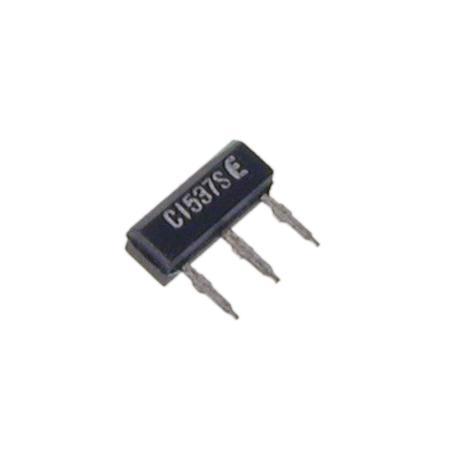
I found replacements for all of the transistors (MJ21193 instead of the 2SD426 outputs and KSA1220/KSC2690 for the drivers) but I'm having some trouble with the temperature compensation transistor mounted in a little slot in the heatsink. It's a 2SC1537s and it's hard to find info on it (no datasheet and some contradictory specs on different sites). It has a quite odd case :
127369_1380532522.jpg

I can drill out the slot a little to fit a regular to-92 transistor and it would seem that a regular BC546 is pretty close in spec, can anyone confirm this or is there a better sub out there ?

Thanks
 
Hello again,

I'm repairing a NAD model 90. A leaky cap destroyed a resistor and a glass diode and those took out the whole channel power transistors included.
I found replacements for all of the transistors (MJ21193 instead of the 2SD426 outputs and KSA1220/KSC2690 for the drivers) but I'm having some trouble with the temperature compensation transistor mounted in a little slot in the heatsink. It's a 2SC1537s and it's hard to find info on it (no datasheet and some contradictory specs on different sites). It has a quite odd case :
127369_1380532522.jpg

I can drill out the slot a little to fit a regular to-92 transistor and it would seem that a regular BC546 is pretty close in spec, can anyone confirm this or is there a better sub out there ?

Thanks

So that would be functioning as a thermally-controlled bias voltage.

The BC546 has very similar specs and the C hfe gain code version should meet or exceed that of the 1537.
 
Id like to add 2SC1570 for posterity h...I am doing an LXI (yes sears) 15wpc unit using SKT459 and it is peppered with 2SC1570 all over.

Im doing a couple 'just because' replacements and I have located that KSC1845 or KSC1815 has been specced.

The 2SC1570 has 100ma Ic and is overall fairly low in Vce at 50c (1571 is even lower) so either KSC works for voltage, but everyone's fav KSC1845 could be touch and go at on collector current so you have to path trace a wee bit and look for some meatier resistors hanging off the either the collector or emitter. And the 2SC1570 has some serious high gain options, I am not sure if what I found is an F or G (it says G9F on it so I lean G) so a KSC1845F or better should work here, the 1815 is a bit lower gain wise.
 
Id like to add 2SC1570 for posterity h...I am doing an LXI (yes sears) 15wpc unit using SKT459 and it is peppered with 2SC1570 all over.

Im doing a couple 'just because' replacements and I have located that KSC1845 or KSC1815 has been specced.

The 2SC1570 has 100ma Ic and is overall fairly low in Vce at 50c (1571 is even lower) so either KSC works for voltage, but everyone's fav KSC1845 could be touch and go at on collector current so you have to path trace a wee bit and look for some meatier resistors hanging off the either the collector or emitter. And the 2SC1570 has some serious high gain options, I am not sure if what I found is an F or G (it says G9F on it so I lean G) so a KSC1845F or better should work here, the 1815 is a bit lower gain wise.
Replacement and equivalent transistor for the 2SC1570
You can replace the 2SC1570 with the 2SC3916, 2SC3917, 2SC3918, 2SC3919, 2SC3920, 2SC3921, 2SC3922, 2SC3923, BC182LB or KTC1006
The complementary p-n-p transistor to the 2SC1570 is the 2SA929.
https://www.el-component.com/bipolar-transistors/2sc1570
 
Hello again,

I'm working on a luxman LV-104U that someone used and abused by leaving the pre-heat on way too long. The 2sa1006 and 2sc2336 voltage stabilizer transistors are totally cooked. I wanted to simply mount them to the chassis with silicone pads but the legs were very brittle and broke so I now need to replace them. They are 180V 25W at 80mHz, I think MJE15034G/MJE15035G could probably work but I'm not sure how important frequency transition and dc gain are in the particular spot (both are lower on the MJE parts).
 
Hello again,

I'm working on a luxman LV-104U that someone used and abused by leaving the pre-heat on way too long. The 2sa1006 and 2sc2336 voltage stabilizer transistors are totally cooked. I wanted to simply mount them to the chassis with silicone pads but the legs were very brittle and broke so I now need to replace them. They are 180V 25W at 80mHz, I think MJE15034G/MJE15035G could probably work but I'm not sure how important frequency transition and dc gain are in the particular spot (both are lower on the MJE parts).
Looking at the data sheets from ON and SavantIC, the Hfe and Ft are actually very similar under similar operating conditions, but many relevant device parameters are not specified fully or at all. I would suggest trying it out but checking for HF oscillations using a scope with at least a 70MHz bandwidth.
 
I realize this probably sounds like anathema to many here. I just replace any bad transistors with my stock of generics. I keep a lot of high current transistors around in different forms. I accidentally replaced a higher wattage transistor on a board with a 2N2222. It worked fine until I started looking at the at the power being dissipated in circuit . That little transistor was running too hot. However, the frequency response from my audio sweep generator was flat up to 40 khz. I replaced it with a TIP41. It ran cool again. I do not own an audio distortion analyzer. All I can do is look at the waveform and listen to the music. I can tell you that just because you have a great looking sine wave does not mean that the amplifier will sound good when stressed with something like Purple Haze. These generics all have FTs over 5 mhz. Some go up to 100 mhz. I have never replaced a transistor with a generic that lowered the high end amplifier gain. 2N2907s 2N2222s TIP41s TIP42s 2N3055 MJ2955s MJE3055s MJE2955s seem to cover just about eveyrthing I need. I use 741s to replace op amps. I have a few high frequency generics for tuners. The question you need to ask yourself is, can you really hear the difference between using an exact replacement or a generic. Using generics allows me to stock all the transistors I need to fix stereo receivers. No one has to wait for a part to be shipped in. The TIP41s and TIP42s, are really amazing little creatures. They can easily be used to replace a small signal transistor and they work like a charm.My customers are always thrilled at the performance of their repaired equipment and of course the new LED lighting to make their receiver pretty again. The few amps that come in that use himics for an output are SOL if that part is bad. Those little things fail too often. And of course they are mostly proprietary parts. So, my method of repair is to look at the circuit, and see how much current is being drawn, how much voltage is applied, and how much heat is being dissipated. A simple glance at the schematic and maybe a voltage measurement or two does it. I don't look for anything else. Yes, I realize many here would consider this terrible. However, my method works very well. I do not hesitate to use transistors that are overkill. They work just fine.
 
I realize this probably sounds like anathema to many here. I just replace any bad transistors with my stock of generics. I keep a lot of high current transistors around in different forms. I accidentally replaced a higher wattage transistor on a board with a 2N2222. It worked fine until I started looking at the at the power being dissipated in circuit . That little transistor was running too hot. However, the frequency response from my audio sweep generator was flat up to 40 khz. I replaced it with a TIP41. It ran cool again. I do not own an audio distortion analyzer. All I can do is look at the waveform and listen to the music. I can tell you that just because you have a great looking sine wave does not mean that the amplifier will sound good when stressed with something like Purple Haze. These generics all have FTs over 5 mhz. Some go up to 100 mhz. I have never replaced a transistor with a generic that lowered the high end amplifier gain. 2N2907s 2N2222s TIP41s TIP42s 2N3055 MJ2955s MJE3055s MJE2955s seem to cover just about eveyrthing I need. I use 741s to replace op amps. I have a few high frequency generics for tuners. The question you need to ask yourself is, can you really hear the difference between using an exact replacement or a generic. Using generics allows me to stock all the transistors I need to fix stereo receivers. No one has to wait for a part to be shipped in. The TIP41s and TIP42s, are really amazing little creatures. They can easily be used to replace a small signal transistor and they work like a charm.My customers are always thrilled at the performance of their repaired equipment and of course the new LED lighting to make their receiver pretty again. The few amps that come in that use himics for an output are SOL if that part is bad. Those little things fail too often. And of course they are mostly proprietary parts. So, my method of repair is to look at the circuit, and see how much current is being drawn, how much voltage is applied, and how much heat is being dissipated. A simple glance at the schematic and maybe a voltage measurement or two does it. I don't look for anything else. Yes, I realize many here would consider this terrible. However, my method works very well. I do not hesitate to use transistors that are overkill. They work just fine.
Well, there you have it. It seems that the years spent in undergraduate and graduate school and in industry learning how transistors etc work and understanding how to design circuits were just a waste of time.
In all seriousness, if you think that you can simply replace devices with "generics" and guarantee correct operation to spec and reliable performance then you are utterly delusional, and if you think that you can just replace any opamp with a 741 and get identical or even, for that matter, acceptable, results across a multiplicity of performance dimensions then you are worse than delusional, you are, well, ridiculous.
Whatever your ears may or may not tell you, this is not good practice and should be actively discouraged, and the fact that your customers may find this acceptable just indicates that there are a great many uninformed, or indeed, misinformed, people out there who really ought to know better...
So yes, it is, and darn well should be, anathema.
I generally make a point of avoiding personal insults, even mild ones, so if I crossed the line, my apologies.
 
Back
Top Bottom