No two WAFs are exactly the same. I think we can say that with some confidence. I mean if any two of us have exactly the same WAF, we probably have problems far bigger than turntable isolation.



Really no need to be rude. What I said is correct, reasoning is this. Any flat surface in the audio room WILL pick up vibrations from the speakers this cant be avoided. The larger the flat surface the more energy it will gather this is simple physics. Energy can not be created or destroyed this is the first law of thermodynamics If we put a turntable on a wooden shelf the shelf itself WILL store lots of vibration energy which we then have to isolate the turntable from. Sorbothane is good at this as vibrations are converted to heat and reduced (back to our law).
Now the frame support I mentioned has limited surface area so it will by design collect less energy from the music in the room (this is fact again refer to the law).

 Of course this doesn't happen. (This is not just semantics!) The inertial mass of the heavy wooden shelf will resist motion, the motion from vibrations transmitted through the air and into the walls, and even into the shelf directly. You seem to confuse "sail area" of the shelf and its potential to absorb vibrations, with its mass (inertial mass).

Not mixing anything up, I am trying to simplify. In simple terms the shelf acts like a sail on a boat as the sail collects the wind the shelf collects the vibrations from the room. Terms people understand. Place a hand on the shelf or my glass of water and you can feel and see these vibrations. Use the metal frame with the smaller area you cant feel or see the vibrations. Even with a massive board vibrations can be felt. Yes true the brick wall (mine is concrete) mass loads the metal shelf as the two couple together very well. The wood on the other hand does not couple well to the frame or the wall so it has more vibrations so in a nut shell we are better off without it.You've got many mixed "metaphors" here for energy. You corrupt energy "storage" and energy "transfer."
Vibrations that affect a turntable come from several sources; you have them mixed up all together. How these vibrations reach the turntable are also varied, and you again have these all mixed up. "Collecting" this energy, and "storing" this energy, are concepts that again, you have mixed up.
The vibrations that affect a turntable come from 2 sources: Human mass moving through the room, causing the floor to flex; Sound vibrations emanating from the loudspeakers and being transmitted through the air and then transmitted through the solids of the room construction materials, and finally turned into heat.
BTW, these are not just "semantics."
Wall stud mounting of the turntable helps to isolate the turntable from moving human mass on the floor, as the wall studs move less than the floor supports. That portion of floor movement that IS transmitted into the wall studs can be damped by a heavy mass; that's why the heavy mass of the shelving system and wood block are effective. The mass of the shelving system does not "store" energy, rather it absorbs/dissipates energy. It takes more force to move a heavy mass than it does to move a light mass. Physics.
Vibrations transmitted through the air are in turn, transmitted into and absorbed by the solids in the room. The shelf itself will not "store lots of vibration energy", as you say. That would be potential energy, and would keep building inside the shelf until one day the shelf just exploded.
Additionally, you seem to forget coupling. Mass is vitally important here; When you screw the heavy wooden shelf, or even the light metal tube shelf, to the wall studs, you MASS COUPLE the shelf to the mass of the wall. That makes for some heavy duty, leveraged, inertial mass isolation of your turntable. THAT'S why even light, or small, metal tubing works to isolate your turntable. It has nothing to do with "sail area", or exposure to the sound waves, or how many sound waves your shelf "catches."
Everything in the room will be bombarded with sound waves; the heavier an object's mass, the less it will be moved by those sound vibrations. The fact that you use thin metal framing for your shelf has very little to do with its ability to "absorb" those vibrations and isolate the turntable, nor does its "exposure" to sound waves in the room decrease and improve its isolation. It is MASS COUPLED to the wall mass! Mass is critical. This is, after all, physics.
The metal frame is very well coupled to the concrete wall. The wood is not.. Adding the wood you have something that sings along on to the music. Adding a shelf is a bad plan as the wood wont couple to the frame well and it will vibrate as not mass damped by the wall.Exposed area of the shelf has nothing to do with anything. MASS has everything to do with how well, or not, vibration is transmitted to the turntable.
And, your entire premise is incorrect about wood vs metal shelving. Wood dampens vibrations much better than metal. Want an example even you can understand? Ok. When was the last time you saw a wooden tuning fork?
Nice plinth err shelf, plinth.. Nice anywayFor my SP-25, I decided to 'eliminate the middle-man', so to speak.

I missed you post earlier, sorry.Same here. My listening room is built on a poured concrete slab and there are no ill effects from environmental vibrations. My normal listening level isn't that loud though. Well actually what my wife will allow.
What is the OP trying to isolate his deck from; environmental vibrations like footfalls or system/speaker vibration? I would think that the wood shelf solutions described above would work for the former. Man, what volume level are you cranked to when the water starts to ripple. I think my neighbors would step in if my wife hadn't already.
I'm not a physicist, but have 48 years experience in WAF. No offense but a metal shelf?.
Unless it looked something like this:
View attachment 1784365
The shelf in post #6
The system in post #4because it looks good and it's from a thrift store.

I missed you post earlier, sorry.
My listening room is 9mx8m and door is soundproof so I can go as loud as I like. It does not take much volume to see need to look carefully but with wooden shelves you can feel the vibrations with your hand and the water shows this up easily. As I said later metal is mass loaded to the wall, but the wood is not as the wood does not couple very well to anything. So in a nut shell the wall is helping the metal fame but not the wood on top of the frame. Also remember most shelves have metal frames, we are not adding anything just taking away what might vibrate.
This conversation made me think about how we could further improve even a metal frame design, and I posted this thought further on in the thread ie the shot blasting sand inside. This makes a massive difference to speaker stands, it could only improve a metal frame IMO, one thing to try for sure.
Chris

“The most amazing thing about this test is that my wife hasn't complained about how loud it is”
Vibrations from a HiFi source are measured in frequencies that only wives can discern. They alone can determine the metrics by which a shout of “Turn it Down!” can be justified. Any attempt to counter the requirement for an amplitude reduction could potentially result in adverse conditions that would negate any further discussion regarding vibration traveling from here to there and henceforth.
You need to tell her everything is a testI just did the glass of water 'test' in different spots around the room. I'm listening to the Who - Who's Next. Volume at a level that I'm not even comfortable with.
Granted my turntable is not on a wall shelf, sits on one of those Gusdorf stereo cabinets. I set the glass of water on the plinth. Not a ripple. Set it on a knick-knack shelf on the adjacent wall, not a ripple. Set it on an oak folding tray stand, approximate surface area of some of the TT wood shelves, not a ripple. Interesting though, that the only place I do feel vibration with my hand is the wall opposite my speakers.
Maybe I'm just blessed with a dead room. It's a family room addition we did 30 years ago 23' x 16'. Poured Concrete slab 4 to 6 inches thick on poured concrete 42" footers. Carpeted floors, upholstered seating, heavy drapes on 2 windows and French doors. The system sounds better with the drapes drawn across the glass French doors. But sounds it's best in warm weather when I can open the French doors to the outdoors.
The most amazing thing about this test is that my wife hasn't complained about how loud it is - well not yet.


You need to tell her everything is a test
It might be bass dependant too or maybe glass might make a difference as mine was quite thin.
Chris
You reminded me of my good friend who passed away a couple of years ago. He used to say about listening to hifi about sitting there like the Memorex manYes, it was a thick piece of glassware. Wife wouldn't trust me with one of her fine pieces of delicate crystal.
That reminds me of the 'Is it live or is it Memorex?' commercials.
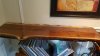
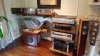
I have a longer shelf in the listening room which was vibrating badly with the music due to its length (very thick too) which is why I started experimenting with frames. Nice wood though what is it?I did a solid walnut live edge slab. Used iron pipes as fixture hardware. A wall shelf makes a world of difference for vibration isolation, absolutely the best audio upgrade I have made for my tts.View attachment 1785963View attachment 1785964
View attachment 1785966