• The move to the new server is done. There are some software and database maintenance updates in process. This has us passing the hat around to help out. We appreciate any donations. Seriously, even a dollar helps. The payment page may be found here - https://www.audiokarma.org/support.html

Unique & Distinctive Speakers

The thing about a looong horn where the backwave is output, the ear hears a lag. Between the frontwave and the delayed backwave.

The beauty of the design is one driver, no crossover between the amp and driver. Great acoustic efficiency.
 
Last edited:
The thing about a looong horn where the backwave is output, the ear hears a lag. Betwee the frontwave and the delayed backwave.

The beauty of the design is one driver, no crossover between the amp and driver. Great acoustic efficiency.

That slight delay from the back wave is one reason open baffles are becoming so popular. Very seductive.
 
Magnepan, open baffle(specifically dipole output) and the Pass horn are not all on a par.

Dipole with a specific baffle dimension creates nulls where bass cancellation occurs. This can be utilised to modify room nodes if positioned correctly. I'd rather experiment with multiple true dipole subwoofers in preference to digital room correction.

The Pass horn does none of that.
 
I've read that open baffles ( the name implies cone drivers ) date back to the 1920's. The old juke boxes and consoles of the 40's and 50's were often open backed.

yes, they have been around forever. In fact weren't most early speakers not OB before Acoustic suspension speakers came about? Seems all consoles and even the very early transistor radios all had perforated backs.

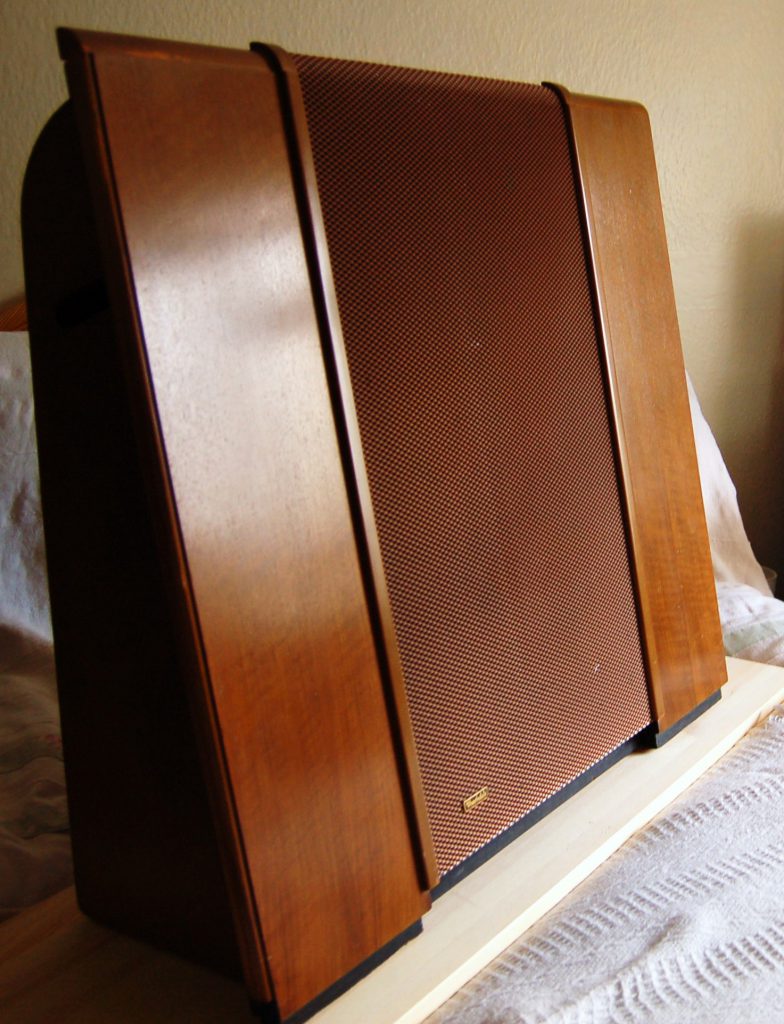
I regrettably passed on a set of these 1957 Wharfedale SFBs which are open baffle.

https://www.inner-magazines.com/audiophilia/wharfedale-sfb3/

WHAFERDALE-SFB-4-784x1024.jpg
 
I've read that open baffles ( the name implies cone drivers )

How so?

An open baffle speaker uses a board to mount the loudspeaker to keep the soundwaves from the front and back apart. It's one of the simplest, most straightforward ways to enhance this technology's performance. An open baffle speaker is sometimes called a doublet.

Magnapans are boards mounting a loudspeaker dividing the front and back wave. I don't think I have ever read where the driver has to be a cone.

Yamaha made the NS line of OB with a really odd shaped driver. I'd not call that a cone.

upload_2022-1-7_9-25-21.png

Also what about the foam board / exciter speakers? No cone. I guess these would be more no baffle speakers.

upload_2022-1-7_9-31-21.png
 
Do any of you old timers recall a 70's era sub speaker device that was basically a heavy plate that attached to the wall or large table and converted the surface into an almost subsonic subwoofer - kind of a 'sensuround' effect?

I can't find anything about them. It seems they needed large amounts of power and were known to crack plaster walls. Never actually saw one, only magazine advertisements and reviews.
 
An open baffle speaker:
  • Uses cone drivers that emit acoustic radiation without the aid of a conventional (sealed, ported, bandpass, aperiodic, horn, ...) enclosure.
  • Uses drivers as above for a substantial portion of the frequency range, and at least in the bass/modal regions.
  • Aims to accomplish a dipole radiation pattern over a significant portion of the frequency range.
  • Are intended for home/domestic use.
 
An open baffle speaker:
  • Uses cone drivers that emit acoustic radiation without the aid of a conventional (sealed, ported, bandpass, aperiodic, horn, ...) enclosure.
  • Uses drivers as above for a substantial portion of the frequency range, and at least in the bass/modal regions.
  • Aims to accomplish a dipole radiation pattern over a significant portion of the frequency range.
  • Are intended for home/domestic use.

Not trying to be argumentative but where did this info come from and how is it the law of the OB? OB literally stands for Open Baffle. Says nothing of the driver it is a configuration spec, not a driver. Everything you posted above fits but the cone part.
 
Electrostatics and Magnepan speakers DO have woofer-panels designed specifically for open baffle use and have overcome the majority of engineering challenges that a conventional cone woofer on an open baffle must face. But both types are still prone to bass wave cancellation. Bipolar box speakers (think of Definitive Technology’s BP series speakers) also have significantly more flexibility than true open-baffle speakers and can deliver an enhanced soundstage without loss of bass performance.

https://hometheaterhifi.com/editorial/oped/are-open-baffle-speakers-a-flawed-technology/

upload_2022-1-7_16-37-43.png
 
Electrostatics and Magnepan speakers DO have woofer-panels designed specifically for open baffle use and have overcome the majority of engineering challenges that a conventional cone woofer on an open baffle must face. But both types are still prone to bass wave cancellation. Bipolar box speakers (think of Definitive Technology’s BP series speakers) also have significantly more flexibility than true open-baffle speakers and can deliver an enhanced soundstage without loss of bass performance.

https://hometheaterhifi.com/editorial/oped/are-open-baffle-speakers-a-flawed-technology/

View attachment 2445478
.
That's why we got 3.2kw of subwoofer and crossover work behind mine, to more than totally compensate for the lack there of.

In terms of soundfield capabilities, instrumental seperation, depth , the airiness these speakers can produce. I yet have to find a cone to do that. These days subs are lot better accommodated even in the mid budget ranges. If you can accomodate all that , mind-blowing how a magnepan Tympani I can sound . .

What people often forget that dipole is not the only thing that makes them sound the way they do. The drivers are linesource. That makes a huge impact, cones radiate completely different from how maggies do. They don't have issues with side wall , floor, ceiling reflection. Imagine a figure 8 through the speakers seen from ontop. Walk up to one stand beside it , a huge spl drop ..

That's the secret sauce right there

IMG_20211207_040720385.jpg
 
Not trying to be argumentative but where did this info come from and how is it the law of the OB? OB literally stands for Open Baffle. Says nothing of the driver it is a configuration spec, not a driver. Everything you posted above fits but the cone part.

Linkwitz clearly makes the distinction between OB's which use cone drivers and panels which do not. There are audio forums devoted to open baffle speakers and also to panels and most people know which is which. But by all means call them whatever you want.

https://www.linkwitzlab.com/conclusions.htm
 
Linkwitz clearly makes the distinction between OB's which use cone drivers and panels which do not. There are audio forums devoted to open baffle speakers and also to panels and most people know which is which. But by all means call them whatever you want.

https://www.linkwitzlab.com/conclusions.htm

No he doesn't, open baffle is just open baffle regardless of what methodology/ideology is being used in the design of a open baffle.

That they make a entire story about drive behavior differences, doesn't negate the fact magnepans are open baffle speakers. Matter in fact I would prefer line source drivers over any cone driven open baffle anyday of the week.

But that's a whole different discussion
 
No he doesn't, open baffle is just open baffle regardless of what methodology/ideology is being used in the design of a open baffle.

That they make a entire story about drive behavior differences, doesn't negate the fact magnepans are open baffle speakers. Matter in fact I would prefer line source drivers over any cone driven open baffle anyday of the week.

But that's a whole different discussion

Then you need to read it again.
 
No he doesn't, open baffle is just open baffle regardless of what methodology/ideology is being used in the design of a open baffle.

I for one would not lump an open baffle dynamic(cone) speaker in the same category as say a di-pole stat, but whatever......... I also couldn't care less to get in a pissing match over it either !
 
I for one would not lump an open baffle dynamic(cone) speaker in the same category as say a di-pole stat, but whatever......... I also couldn't care less to get in a pissing match over it either !

All dipolar speakers have a rear wave that's 180 degrees out of phase with the front. That includes OB's.

They are not nearly as different as you suggest. They are both dipole radiators. What is used to generate the sound is immaterial. A dipole radiator is just that regardless of whether it's an esl, planar magnetic or a cone.
 
I can overlook it as he's new here.

Wow. What bearing does that have on anything? Just seems rude, condescending and dismissive. I mean just look at his room, amazing speakers, well sorted, room treatments, tons of material to listen to... does not seem like his first rodeo.

I really did not want to start a pissing match I just dont see how Open Baffle has anything to do with driver type as we are talking about the type of structure drivers are attached to and the effects of deferent driver structures. The reason I brought up Magnepan is I see them mentioned in several OB posts like I linked. Seems many seem they are Open Baffle, which in design they sure seem to be. The baffle is indeed open. I dont understand the need to such tight classification as for cones drivers only. And what about the examples like the Yamaha which are kinda not cones but for sure OB.

I just hope I have been here long enough to have an opinion.
 
Last edited:
Back
Top Bottom