• The move to the new server is done. There are some software and database maintenance updates in process. This has us passing the hat around to help out. We appreciate any donations. Seriously, even a dollar helps. The payment page may be found here - https://www.audiokarma.org/support.html

Update on new EMIT/EMIM Diaphragms

Status
Not open for further replies.
Yes you do but bear in mind these things crossover at 300Hz so there is still plenty of scope to check what is happening way below that.

regards

Interesting, is that where you cross your 4.5s over Rabbit? The passive crossover in the 4.5 is set at around 150 Hz or so and I have used that and 220 Hz as crossover points when biamping. With 24 db/octave crossover slopes there isn't much overlap between the frequency ranges covered by the woofers and EMIMs but using the Infinity recommended 6 db/octave slope, there is and this would complicate the testing

You are right in that assuming we are interested in the range from 70-220 Hz, it should largely be covered by the woofer if we use a crossover well above 220 Hz. Consequently, nearfield testing the woofer should show if there is a trough there. Of course, there are 2 woofers per side......
 
The biggest thing here is the variability of the units I have tested. I actually like the stock EMIM sound (no tape on the panel). when they are "right". that is, no wrinkles, and all close on tension. And I like my current version as an expression of "how I would do it", and more so as they are all identical (like lego bricks!). What's my opinion worth - i'm biased (really!)? The taped EMIM's aren't even in the running for comparative measurement. They are a tad "low res". Their damping is achieved in a different way to what I have done with these late- stage-proto/early-production run. Speakers are very subjective, and I know whatever I make some will dislike the product vs stock, even if they were (their not!) stock clones!!!

I have tape on some of the EMIMs in my 4.5 and I thought someone had done a patch job on them. Why did Infinity do that? Production variation? That would mean they made the better ones worse to match the ones that didn't produce.
 
I believe it was their attempt at damping the resonances produced by the EMIM film. Later versions used a different method to do that, instead of strips of tape.
 
I have tape on some of the EMIMs in my 4.5 and I thought someone had done a patch job on them. Why did Infinity do that? Production variation? That would mean they made the better ones worse to match the ones that didn't produce.

Maybe the tape is used to stop the diaphragms from wrinkling up.

I believe the latter versions use stronger neodymium magnets and Kapton diaphragms so maybe they need more mass or damping.

regards
 
Interesting, is that where you cross your 4.5s over Rabbit? The passive crossover in the 4.5 is set at around 150 Hz or so and I have used that and 220 Hz as crossover points when biamping. With 24 db/octave crossover slopes there isn't much overlap between the frequency ranges covered by the woofers and EMIMs but using the Infinity recommended 6 db/octave slope, there is and this would complicate the testing

You are right in that assuming we are interested in the range from 70-220 Hz, it should largely be covered by the woofer if we use a crossover well above 220 Hz. Consequently, nearfield testing the woofer should show if there is a trough there. Of course, there are 2 woofers per side......

In bi-amp mode the crossover frequency to the EMIM is lower than it is with single amp mode. I'm not really sure if the stated Xover frequency is for single amp mode or biamp mode. I'm assuming it is for bi-amp mode and it is much higher for single amp mode.

Also both woofers are driven identically so it's only necessary to mic one woofer.

regards
 
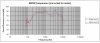
OK, here's a preliminary frequency response plot for you all. If it looks a little fuzzy hover your cursor over the plot and click to expand it. This is a comparison of the overall EMIM response for my two RSIIb speakers, one containing 3 Graz EMIMs, and the other containing 3 stock EMIMs. Low and high Midrange crossovers are in line. Woofers and tweeters were disconnected, and no LF equalizer was used. Readings were taken with a Radio Shack analog SPL meter at 1 meter from the center of the center EMIM, C weighted, slow response. All readings were corrected for the known response variations of the RS analog meter. These were taken in my family room, with lots of other stuff around, so beware of over-interpretation of all the deviations from ideal behavior.

Looks like the Graz-ed units do go a bit lower before dropping off, and the overall response may be a bit smoother. The difference at the high end should be well within the range of adjustment for the high mid pot.


.
 

Attachments

  • Graz EMIM Response.jpg
    Graz EMIM Response.jpg
    48 KB · Views: 54
Last edited:
With 3 EMIMs and the 3rd placed lower in the crossover network, is this a fair representation for general application?

Do the EMIMs look better to you guys than I think they look? It's great that they produce sharper transients... but the overall frequency response? Graz's certainly looks much better than the stock EMIMs.

What do you do with the 8db valley before before the EMITs take over?

What are the steps in Hz on the graph between 100 and 1k, and 10k?

I'm sorry, fellas. Discovering the apparent weaknesses of the EMIM after all this time is a little disheartening. I'll mention again that I played my RS 4.5 against my dual sets of 8 Kappas and the Kappas sounded much flatter and better balanced overall with much sharper transients. (The 4.5 had MUCH better bass response.) I've been blaming it on weaknesses due to antiquated electronics in the wiring and crossover but now I'm not so sure. Some of the EMIMs in my 4.5 have tape dampening. - All that aside, it's apparent that Graz's diaphragms must be considered a necessary upgrade for anyone that wants clearly sharper transients (yeah!) and better frequency response.
 
Last edited:
I'm sorry, fellas. Discovering the apparent weaknesses of the EMIM after all this time is a little disheartening.

i dunno. i'm fairly certain that i now remember my pair of RS1b's having what looked like tape down the center. with the right electronics, they were certainly capable of excellent dynamics and realism, the only limitations apparent being the woofers. i'd be more than happy if the only improvement was uniformity. also, like it or not, i think we have to consider the fact that Max can't exactly do a blind test of these EMIMs. he's even admitted that the improvements he thinks he hears aren't exactly measurable. i'm not trying to throw him under the bus here, just trying to keep our minds open.
 
OK, here's a frequency response plot for you all. This is a comparison of the overall EMIM response for my two RSIIb speakers, one containing 3 Graz EMIMs, and the other containing 3 stock EMIMs. Low and high Midrange crossovers are in line. Woofers and tweeters were disconnected, and no LF equalizer was used. Readings were taken with a Radio Shack analog SPL meter at 1 meter from the center of the center EMIM, C weighted, slow response. All readings were corrected for the known response variations of the RS analog meter.

Looks like the Graz-ed units do go a bit lower before dropping off, and the overall response may be a bit smoother. The difference at the high end should be well within the range of adjustment for the high mid pot.

Is it possible to do a nearfield test of one EMIM with the mike about 5 cm away from the diaphragm and the driver being directly driven by the amp and the crossover bypassed. You'll only need a watt or so to drive it.

regards
 
Is it possible to do a nearfield test of one EMIM with the mike about 5 cm away from the diaphragm and the driver being directly driven by the amp and the crossover bypassed. You'll only need a watt or so to drive it.

regards

Max, why not disconnect an EMIM from the wiring harness and drive it directly as Rabbit suggests?
 
In bi-amp mode the crossover frequency to the EMIM is lower than it is with single amp mode. I'm not really sure if the stated Xover frequency is for single amp mode or biamp mode. I'm assuming it is for bi-amp mode and it is much higher for single amp mode.

Also both woofers are driven identically so it's only necessary to mic one woofer.

regards

Hi Rabbit, yes the passive crossover in single amp mode is set around 150 Hz if that is what you are asking. In biamp mode the passive crossover is moved much lower using the switch on the speaker to allow the crossover between the EMIM and woofer to be set using an external active crossover. The lowest crossover on the Infinity-supplied active crossover is 110 Hz and I would not go below this point when biamping the 4.5 using an active crossover.

In my room, the speaker sounds best in biamp mode crossing over the woofers to EMIMs at either 150 Hz or 220 Hz using an electronic crossover. I have settled for the time being on 220 Hz.

All I am saying is that we cannot discount the affect of the EMIMs on the composite low frequency response of the 4.5 unless we make sure the crossover between the EMIMs and woofers is set high enough (using the active crossover). As you had indicated setting this crossover at 300 Hz (and using a sharp slope) should enable one to test the response of the speaker from 70-200 Hz by just testing the woofer in the nearfield.
 
Hi Rabbit, yes the passive crossover in single amp mode is set around 150 Hz if that is what you are asking. In biamp mode the passive crossover is moved much lower using the switch on the speaker to allow the crossover between the EMIM and woofer to be set using an external active crossover. The lowest crossover on the Infinity-supplied active crossover is 110 Hz and I would not go below this point when biamping the 4.5 using an active crossover.

In my room, the speaker sounds best in biamp mode crossing over the woofers to EMIMs at either 150 Hz or 220 Hz using an electronic crossover. I have settled for the time being on 220 Hz.

All I am saying is that we cannot discount the affect of the EMIMs on the composite low frequency response of the 4.5 unless we make sure the crossover between the EMIMs and woofers is set high enough (using the active crossover). As you had indicated setting this crossover at 300 Hz (and using a sharp slope) should enable one to test the response of the speaker from 70-200 Hz by just testing the woofer in the nearfield.

I should have said the crossover frequency was 150Hz not 300Hz. I was confusing it with the caps in the crossover for the EMIM's which is 300uF for biamp and 150uF for single amp mode.

regards
 
With 3 EMIMs and the 3rd placed lower in the crossover network, is this a fair representation for general application?

Do the EMIMs look better to you guys than I think they look? It's great that they produce sharper transients... but the overall frequency response? Graz's certainly looks much better than the stock EMIMs.

What do you do with the 8db valley before before the EMITs take over?

What are the steps in Hz on the graph between 100 and 1k, and 10k?

The way it works with the 3 EMIMs in the RSIIb, the top and bottom are lower in the network (150 to 800Hz) and the middle is higher (800 to 4000Hz). Kind of a D'appolito array setup.

As far as the area of the graph from 1000Hz on up, a little tweak of the High Mid adjustment pot will bring the stock up (or the Graz down) so that they overlay more closely. I didn't think it was necessary to re-do the graph to show that.

The peak at 3500Hz may be due to a cavity resonance in the EMIM - the area all around the magnets to the edge of the shell is wide open in all my EMIMs. There is a piece of fabric across the back set of magnets, but nothing in the cavities around the magnets. I have some SAE grade F10 wool felt (excellent midrange absorber) on the way to my house today - I plan to install the Graz diaphragms in the other speaker tonight, and stuff the inside of the cavity with the felt; then I'll compare the response of the felted EMIMs to the unfelted. If it is a cavity resonance the wool felt should take care of that. Someone who is adept at crossover design could also probably work up a notch filter to take that peak out as well.

The x-axis of the graph is logarithmic, so they are 100, 200, 300...1000, 2000, 3000...etc...

Remember that the crossovers have adjustment pots on the high mids, tweeter and high tweeter, so I can tweak the tweeters and mids up and down to get the best transition - I'm not worried about the area between the high mids and the tweeters for that reason. The tweeters roll in at 4000Hz, as the high mids roll off.

.
 
Last edited:
Maybe the tape is used to stop the diaphragms from wrinkling up.

I believe the latter versions use stronger neodymium magnets and Kapton diaphragms so maybe they need more mass or damping.

regards

The later versions with the Neo magnets (which I have) still use mylar. I have never seen a stock Kapton EMIM, nor has Graz. The EMITs are Kapton. It's easy to tell - Kapton is yellow.
 
i dunno. i'm fairly certain that i now remember my pair of RS1b's having what looked like tape down the center. with the right electronics, they were certainly capable of excellent dynamics and realism, the only limitations apparent being the woofers. i'd be more than happy if the only improvement was uniformity. also, like it or not, i think we have to consider the fact that Max can't exactly do a blind test of these EMIMs. he's even admitted that the improvements he thinks he hears aren't exactly measurable. i'm not trying to throw him under the bus here, just trying to keep our minds open.

To help clear the tape thing up, it's not just the tape strip down the center. Those EMIMs have vertical strips of "scotch" tape across the entire diaphragm, from one side to the other. It was their means of damping resonances. Later EMIMs do not have tape strips, but have a layer of another material sprayed on them to do the same thing. I had to remove the layer/tape in order to do the analysis of the films themselves. In either case, it adds mass, which slows the diaphragms down. For what it's worth, Graz uses a completely different means of damping, which I think is quite clever.

I'm not claiming to be a blind tester, and I'm just giving my impressions, take them or leave them as you wish, no offense taken either way. I'm sure the transient response could be measured by someone with the right equipment to take time domain measurements, but that's not me. I'm already spending way too much time on this at the expense of work and family. My goal was to get someone to make us replacement diaphragms; we are there now, so the goal has been reached. I feel they are also an improvement, but the only way for you to know is to try them out yourself, on your systems.
 
To help clear the tape thing up, it's not just the tape strip down the center. Those EMIMs have vertical strips of "scotch" tape across the entire diaphragm, from one side to the other. It was their means of damping resonances. Later EMIMs do not have tape strips, but have a layer of another material sprayed on them to do the same thing.

Hm. Perhaps there was no damping at all then. I just remember that the center portion of the diaphragm had a duller look to the racetrack, not unlike the appearance of scotch tape. I probably didn't understand what I was looking at, as I never took an EMIM apart then.

And my other comment was more for the people who might be reading this and starting to question whether the original EMIM is even a good driver and now wondering what they've been missing out on all this time. I'm just uncomfortable at this point giving the average owner the impression that this upgrade is a "must" as opposed to a great idea - know what I mean? [my order for 6 diaphragms is as good as made, just so you know I'm not hating on this project one bit ;)]
 
Here's a pretty clear picture of what the tape strips look like. You can see the vertical stripes where they overlap on the film.
 

Attachments

  • RSIIb EMIM Rebuild 004.jpg
    RSIIb EMIM Rebuild 004.jpg
    28.5 KB · Views: 79
Status
Not open for further replies.
Back
Top Bottom