• The move to the new server is done. There are some software and database maintenance updates in process. This has us passing the hat around to help out. We appreciate any donations. Seriously, even a dollar helps. The payment page may be found here - https://www.audiokarma.org/support.html

Vacuum record cleaning machine

I don't feel your statement is accurate-correct. You can scrub the bejesus out of a record all day long, but no brush's bristles get into the groove. Sorry, but that's a fact.

Again, the machine being used is only part of actually getting records "properly" and fully cleaned. The rest is dependent upon the cleaners and rinse waters. And this is where variables step in.
Cavitation bubbles don't get into the groove either, not the 40khz ones. It's not important to get *into* the groove so much as having the agitation disturb the fluid vigorously around the soils, replacing spent fluid with fresh.

Sure, the surfactants used can make a difference, but you'd be surprised how effective plain tap water is when it's forced against the record at high pressure. Cavitation also works well in plain water.
 
I respectfully differ.
Most ‘tap’ water contains too many contaminants to use for disk cleaning. Well-water is even worse. Wouldn’t that come under the heading of penny wise and dollar foolish? It reminds me of going to a cheap restaurant and asking for water and receiving tap water, you know immediately just by the taste of it you’re drinking city-gin.

Besides one gallon of distilled water is less than two dollars a gallon and it’s been documented and proven by the audio industry and by owners of mega-buck systems and components that distilled water is highly recommended. I'm certain that if you ask around here, the cognoscenti would agree.

After all my years of system building since 1967 and of dedication and expense in putting together my final ultimate system, I refuse to cheap-out on ingredients as common as water. I’ve spent many hours reading, experimenting, and understanding qualified opinions to take such a chance. But, as the expression goes; to each his own.
In the end it all depends on one's level of discretion and desire to achieve the best listening quality they possibly can get. My most expensive cartridge costs at near $4000. why would I second guess the best methods proven by the ‘High-End’ audio community?
Ultra-Sonic methods have been around for some time now and I have not have I heard of good results in using ’tap’ water.
FM

Below from the Web:
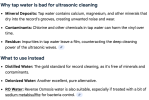
Screen Shot 2026-01-06 at 4.38.37 PM.png


Record pressing:


FM
 
No, but yes.
You do have the potential to transfer dust to the clean side when you flip, but probably just surface dust, easily removed when you brush before each play.
You should not transfer dust back into the grooves that your liquid/brush/vacuum just removed.

I got a VPI vacuum cleaner. I try to preclean any really dirty records prior to placement on VPI platter, to keep platter clean & reduce potential for flip contamination.
I also like the discussions re: ultrasonic cleaners. I will probably get an inexpensive system to add to my quiver.
With the VPI I own, I used 2 of their cork mats. Clean 1 side, remove the record, change the mat and then do side 2. Pain in the ass, but it did work. I no longer do that because after cleaning both sides, the record is cleaned a second time with an us cleaner.
 
I respectfully differ.
Most ‘tap’ water contains too many contaminants to use for disk cleaning. Well-water is even worse. Wouldn’t that come under the heading of penny wise and dollar foolish? It reminds me of going to a cheap restaurant and asking for water and receiving tap water, you know immediately just by the taste of it you’re drinking city-gin.

Besides one gallon of distilled water is less than two dollars a gallon and it’s been documented and proven by the audio industry and by owners of mega-buck systems and components that distilled water is highly recommended. I'm certain that if you ask around here, the cognoscenti would agree.

After all my years of system building since 1967 and of dedication and expense in putting together my final ultimate system, I refuse to cheap-out on ingredients as common as water. I’ve spent many hours reading, experimenting, and understanding qualified opinions to take such a chance. But, as the expression goes; to each his own.
In the end it all depends on one's level of discretion and desire to achieve the best listening quality they possibly can get. My most expensive cartridge costs at near $4000. why would I second guess the best methods proven by the ‘High-End’ audio community?
Ultra-Sonic methods have been around for some time now and I have not have I heard of good results in using ’tap’ water.
FM

Below from the Web:
View attachment 3670376


Record pressing:


FM
I fully agree. Years ago as a kid I read in an electronics or audio magazine that you could clean your records effectively in the kitchen sink with dish soap. The record that I tried it on was unlistenable after that. If your city water supply is very soft perhaps sourced from from a clean lake you might get away with it. I had used rather hard well water. After that experiment I would not think of using anything but distilled water! Why risk ruining your records to save the slight added cost?
 
It's fine to use tap water as long as you don't let it evaporate off the record. When got back to vinyl in 2010 I used a fine paint brush and Dawn in the sink with warm well water. Dried them with clean microfiber towels and those records sound fine today.
 
It's fine to use tap water as long as you don't let it evaporate off the record. When got back to vinyl in 2010 I used a fine paint brush and Dawn in the sink with warm well water. Dried them with clean microfiber towels and those records sound fine today.
Not if it comes from a well!
 
I respectfully differ.
Most ‘tap’ water contains too many contaminants to use for disk cleaning. Well-water is even worse. Wouldn’t that come under the heading of penny wise and dollar foolish? It reminds me of going to a cheap restaurant and asking for water and receiving tap water, you know immediately just by the taste of it you’re drinking city-gin.

Besides one gallon of distilled water is less than two dollars a gallon and it’s been documented and proven by the audio industry and by owners of mega-buck systems and components that distilled water is highly recommended. I'm certain that if you ask around here, the cognoscenti would agree.

After all my years of system building since 1967 and of dedication and expense in putting together my final ultimate system, I refuse to cheap-out on ingredients as common as water. I’ve spent many hours reading, experimenting, and understanding qualified opinions to take such a chance. But, as the expression goes; to each his own.
In the end it all depends on one's level of discretion and desire to achieve the best listening quality they possibly can get. My most expensive cartridge costs at near $4000. why would I second guess the best methods proven by the ‘High-End’ audio community?
Ultra-Sonic methods have been around for some time now and I have not have I heard of good results in using ’tap’ water.
FM

Below from the Web:
View attachment 3670376


Record pressing:


FM
My definition of tap water is municipally treated, safe to drink and cook with. It is absolutely fine for cleaning records provided the water is rinsed with something purer like distilled, or at least dried immediately with a pva sponge to draw up the minerals and chlorine. If I had nothing else, I wouldn't hesitate to use clean tap water.

Anyway, my post was not about the water, it was about fluid agitation being more important than the choice of surfactant. Like doing laundry: we can debate forever which soap is best but none of them will do very well if the machine's drum doesn't turn to agitate the water.
 
With the VPI I own, I used 2 of their cork mats. Clean 1 side, remove the record, change the mat and then do side 2. Pain in the ass, but it did work. I no longer do that because after cleaning both sides, the record is cleaned a second time with an us cleaner.
I'm unsure with VPI RCMs and others today, what material is used for the RCM Platters? I know the 16 and 16.5 used MDF. I believe the model 17 and 17F came with an Acrylic Platter. Perhaps others as well did? Not sure?

Of course one important precaution is while cleaning, you don't turn the top of the machine into a fish tank, as liquids and MDF don't go well together. And that was usually the main causes of damage to their RCMs, water damage to the case-platter, or water intrusion into the Vacuum Motor.

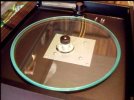
I mentioned earlier, the use of a Neoprene Rubber Mat replacing the cork mat for good, I went one step further. Had an acrylic Platter machined.

The Green Edge Acrylic Sheet was given to me free, the machining labor costs of one hour by a friend were $40 at the time. He also enlarged and re-tapped the attachment holes on the Motor-Platter Arbor to accept 8-32 Flat Head Screws, the original screws were quite small 6-32.

The new Platter was an exact copy of the MDF Platter.

I felt with the better acrylic Platter, no warping of the platter could ever occur, nor the platter coming loose and damaged due to holes in the Platter itself becoming enlarged-elongated over time.

At first I had thought of running just the bare Acrylic Platter, but then decided to permanently attach a Neoprene Rubber Mat. This Mat will likely never wear out, degrade.
 

Attachments

  • Mark_VPI_16.5_Photo_1.jpg
    Mark_VPI_16.5_Photo_1.jpg
    29.3 KB · Views: 7
Last edited:
I've said this before, so this is me being a "broken record" again.

With either machine type, they're doing maybe 50% of the heavy lifting. The rest relies on the cleaners and their abilities to loosen and lift-detach contaminants from the groove. I'll omit going through lengthy details.
thanks for the input but your statement is not correct. I work in big pharma so had access to all the lab microscopes to look at 2000x views of grooves before and after cleaning with a vac machine, an US machine and a few other treatments. US is really the only method that will get 90%+ of the particles out of the groove. VAC machines will remove maybe 5% but not much more.
 
Some Cleaning Machines like a Nitty Gritty have no Platter. But because of that, they are a bit more difficult to apply and spread solutions.

As for machines like VPI, and those that do have a platter, the surface of the Platter can be Cork. You can wipe it and keep it as clean as you can, but eventually in time they get old, dirty and should be replaced. Or, changed to a different material.

And that's what I did with my VPI 16.5 RCM, I went with a 1/8" thick Neoprene Sheet, shore hardness 60 to replace the Cork Mat. Custom cut, and permanently bonded to the Platter. Problem solved.

Non Porous, Chemical resistant, easy to clean and easy to see anything such as dusts on the surface. You can wipe to your heart's content with no harm done, and in between each and every record you clean if you wish to.

View attachment 3668859
My nitty gritty applies the fluid to both sides the lp at once then cleans and vacuums it.
 
thanks for the input but your statement is not correct. I work in big pharma so had access to all the lab microscopes to look at 2000x views of grooves before and after cleaning with a vac machine, an US machine and a few other treatments. US is really the only method that will get 90%+ of the particles out of the groove. VAC machines will remove maybe 5% but not much more.
So I've been listening to my records (cleaned with an RCM since 1986) with 95% of the dirt still in the grooves?
 
thanks for the input but your statement is not correct. I work in big pharma so had access to all the lab microscopes to look at 2000x views of grooves before and after cleaning with a vac machine, an US machine and a few other treatments. US is really the only method that will get 90%+ of the particles out of the groove. VAC machines will remove maybe 5% but not much more.
How effective is US cleaning using only water?
I think all will agree on the importance of the cleaners themselves. Otherwise, wouldn't everyone be using only water?
 
"So I've been listening to my records (cleaned with an RCM since 1986) with 95% of the dirt still in the grooves?"

More than likely so. Ultra-Sonic machines were not commercially available for the consumer market forty years ago in terms of record care. that I'm aware of much less the practice.
More likely, a good jeweler probably had one to clean jewelry and U.S. was certainly used in scientific circles and other industrial areas.

Regarding FLUIDS. I experimented with a few, "MoFi", VPI, and a couple of the fancy ones from abroad, etc. I have been using set amounts of the 91% alcohol versus 60-70%. Tried numerous different temperatures within reason also.
In a 6 liter vat and found it was best to clean 5 or 7 at one time for decent condition disks or could I clean 10-12 lesser condition disks as my tests have shown. The best number of rotations while submerged, fast or slow speeds ere tested also.
For me, I find slow speeds work best as it gives more bubbles more time to bounce off the vinyl's surface.
And while difficult to evaluate due to the premise of different records having different amounts of debris and age I determined that generally speaking a disk that received
adequate/normal handling and care throughout its prior lifetime, I was able to generalized my settings.

Second rinses had minimum advantages for me, as did using exotic fluids or mixtures thereof. In general I found while using a 6 liter vat, 7 disks, 1.5oz. 91% alcohol, 1.5 Ilford ILFOSOL as a wetting agent at around 75 F degrees for about 7 minutes. I use the small 4" fan offered by the same company that made my U.S. set-up for drying though, the U.S. method allows for fast self-drying.

Just for argument's sake I have posts here on this forum and other forums regarding this topic and I have listening results that can defend my beliefs.

I find one of the problems being that many individuals refusing to read posts from the last 10 to12 years or more when the audio industry was going hog-wild with cleaning experimentation across the board. Repeating words and findings/results has become more than boring for those who have accepted tried and proven results. Though mankind is a 'let me see for myself' sort of animal is understandable but, tolerating repetitive statements of non-recommended methods and new-comers claiming their methods are ground-breaking is unnecessary and certainly misleading. Brings to mind an old expression: "Those who refuse to know history, are condemned to relive it."

If I were asked, I'd suggest reading methods that have been posted on the sites of the two major USA Hi-Fi publications. You know who they are.

To date, I have cleaned about 1000+ disks with my bought in 2009 VPI 16.5 machine with decent results and about 2500+ disks with my U.S. set-up. I still have about 3500+ disks to clean. I thought about it and decided it's best to enjoy all the disks I processed already and that in of itself takes time. I can also look around my home and easily see I have definitely gone hog-wild wildly thinking that I could have all the music I thought I needed to collect. I probably won't sell these disks, I simple need the determination to clear out one room and simply build or purchase proper shelving and figure out what will work best for me as far as categorizing my collection of disks.

FM

P.S. Refer to page one of this thread, look at my 2 posted fotos, don't I look serious enough?


632
 
Last edited:
"So I've been listening to my records (cleaned with an RCM since 1986) with 95% of the dirt still in the grooves?"

More than likely so.

I'm sorry, but that is just nonsense.

Repeating words and findings/results has become more than boring for those who have accepted tried and proven results.
67
What proof is there that US machines extract so much more dirt from the grooves?
Why then do I hear no improvement listening to records cleaned with my US machine than those cleaned with my RCM?
 
So I've been listening to my records (cleaned with an RCM since 1986) with 95% of the dirt still in the grooves?
I think that figure is an exaggeration but quantifying it depends on unknown particulars. For example, if one were to drop a dusty record onto the platter, squirt some fluid on and swish it around, then vacuum it and call it a day, then yes, much dirt will still be left behind. This is because the vacuum process is very inefficient at removing anything more than liquid: warps in the vinyl cause vacuum leaks where there will little suction; gaskets block airflow and trap dust and moisture which is then redeposited on the next record, etc. String wands address some of these issues but they only directly contact the record at widely spaced intervals, so again, removal of soils is incomplete.

The issues given above can all be mitigated somewhat by applying several rinses and changing wands in between but this is a tedious, iterative processing with each repetition removing slightly more than the previous. This is why I prefer to use a jet of tap water to blast any and all soils down the drain as it's a once and done process. A second, light rinse using distilled from a spray bottle displaces the minerals and chlorine in the tap water. Only then is the record vacuumed dry as the only thing remaining is pure, harmless water.

A US tank doesn't have the vacuum wand issues but any soils pulled off the record through cavitation remain in suspension in the tank, some of which is redeposited on the record when it's lifted out. Once again, a rinse in pure water is essential to ensure that all soils are removed before drying or vacuuming.
 
I think that figure is an exaggeration but quantifying it depends on unknown particulars. For example, if one were to drop a dusty record onto the platter, squirt some fluid on and swish it around, then vacuum it and call it a day, then yes, much dirt will still be left behind. This is because the vacuum process is very inefficient at removing anything more than liquid: warps in the vinyl cause vacuum leaks where there will little suction; gaskets block airflow and trap dust and moisture which is then redeposited on the next record, etc. String wands address some of these issues but they only directly contact the record at widely spaced intervals, so again, removal of soils is incomplete.

The issues given above can all be mitigated somewhat by applying several rinses and changing wands in between but this is a tedious, iterative processing with each repetition removing slightly more than the previous. This is why I prefer to use a jet of tap water to blast any and all soils down the drain as it's a once and done process. A second, light rinse using distilled from a spray bottle displaces the minerals and chlorine in the tap water. Only then is the record vacuumed dry as the only thing remaining is pure, harmless water.

A US tank doesn't have the vacuum wand issues but any soils pulled off the record through cavitation remain in suspension in the tank, some of which is redeposited on the record when it's lifted out. Once again, a rinse in pure water is essential to ensure that all soils are removed before drying or vacuuming.
I agree one can get not great results with an RCM using poor methods.

I do not apply fluids to records on the machine, I lay the records on clean towel over my workspace and by so doing can apply a lot pressure with the brushes using first distilled water (scrub, scrub) then cleaning fluid (more scrubbing) and finally more distilled water followed by final scrub with the brush. Then the record is dried on the RCM.
 
Why then do I hear no improvement listening to records cleaned with my US machine than those cleaned with my RCM?
My guess is, partly because the stylus doesn't ride on the bottom of the groove, but on its side walls, so the tip of the stylus doesn't always touch the dirt that's deep inside the groove. Partly because not all kinds of dirt affect the sound (for instance, the stylus can pick up a minute piece of lint and drag it along the groove without a change in sound). And partly because the record often has other imperfections that can cause pops and crackles, and it's impossible to tell which of those crackles are coming from vinyl imperfections and which from dirt, or to figure out by ear only if the amount of pops and crackles has decreased by 5% after having washed the record in a US machine. If the vacuum RCM has done a reasonably good job, then the US won't make a night-and-day difference.

I also can't say I hear a difference in sound after having US-cleaned all my records, which had been previously cleaned with a vacuum RCM. But what I do notice is that the stylus stays clean noticeably longer. I use a 40x loupe to inspect the stylus after every LP I play. The difference is clearly visible, even though I can't detect it in the sound.
 
How effective is US cleaning using only water?
I think all will agree on the importance of the cleaners themselves. Otherwise, wouldn't everyone be using only water?

Yes completely agree on the importance of the cleaner solution.


Never had much luck with plain water, distilled or tap, so quickly removed it from the trials. Some claim US works with distilled but could not visually prove a significant amount of particles were removed. US with some sort of surfactant really cleans the groove.

Not sure if there is any interest but here is some additional detail on the size of particles in the grooves.

The particles a vinyl collector is trying to remove range in size from 2-5 um (microns) at the bottom of the groove (under a high powered scope almost looks like gravel at the bottom of the groove). The groove walls have much smaller particles in the 50-200 nm (nanometer) range coating them. Could not find any evidence these particles were bonded to the PVC groove wall. US cleaning with a bit of surfactant will remove 95% of them.

US pressings from the 1980s and earlier usually have the highest particle load. Could not distinguish a major difference in particle loads between US pressing plants.

Japan pressings from King Record, Victor Music, Toshiba-EMI, RVC corp, and others usually have much less of a particle load than US pressings.

Of the Japan pressing plants, King Record Japan pressings were observed to have the fewest number of particles among the Japan pressing plants. All Japan pressings had particles that were smaller in size and less in quantity than those observed and measured in the US, UK, or the few Germany pressing observed (i.e. much easier to clean than typical US pressings).

As a side note, under high power, you can actually see the detrimental effects of the stamper polishing process some plants used to use on some of their tooling to reduce the number of pops and clicks; you can see it in the top edge of the groove walls.

With the help of several scientist friends, a series of cleaning experiments were run over a 6 month period trying to remove the particles intact. Several regular cleaning solutions were tried, experimental mixes were tried, and differences in times were tried. VAC machines and US machines were both used. I was really hoping a VAC machine would pull out the majority of particles since it would save me the costs of an US machine. That hope did not materialize. Each record was labeled with the experimental treatment, date and time. Would then take the records into the lab at work and look at the grooves pre and post cleaning treatments after work hours.

If a collector only has a vac machine all is not lost though. A collector can use a 10 min soak treatment with a surfactant solution keeping it wet for all 10 min (need to really level the surface the record sits on first in both X and Y planes). Then use the VAC machine to suck off the solution and the particles that have been removed from the groove and are floating in suspension in the cleaning solution.

 
So I've been listening to my records (cleaned with an RCM since 1986) with 95% of the dirt still in the grooves?

Join the club. I did the exact same thing for many years. Cleaning all my vinyl with a VAC machine then place them into a MOFI sleeve.

Its usually not dirt. Dirt particles would normally be too large to reach the bottom of the groove. There may be dirt particles, hair, lint etc on the surface of the record. A VAC machine will remove most of that debris. The particles down in the grooves are almost always release agents, and processing agents that come out of suspension from the PVC formula. If you want an easy test to see how much is in the grooves of your vinyl, remove your cartridge from the arm, flip it upside down and look at the stylus with a decent magnifying glass. If you see the area surrounding the stylus is coated with while particles, then yes your stylus is sort of snow plowing the particles out of your record.
 
Yes completely agree on the importance of the cleaner solution.


Never had much luck with plain water, distilled or tap, so quickly removed it from the trials. Some claim US works with distilled but could not visually prove a significant amount of particles were removed. US with some sort of surfactant really cleans the groove.

Not sure if there is any interest but here is some additional detail on the size of particles in the grooves.

The particles a vinyl collector is trying to remove range in size from 2-5 um (microns) at the bottom of the groove (under a high powered scope almost looks like gravel at the bottom of the groove). The groove walls have much smaller particles in the 50-200 nm (nanometer) range coating them. Could not find any evidence these particles were bonded to the PVC groove wall. US cleaning with a bit of surfactant will remove 95% of them.

US pressings from the 1980s and earlier usually have the highest particle load. Could not distinguish a major difference in particle loads between US pressing plants.

Japan pressings from King Record, Victor Music, Toshiba-EMI, RVC corp, and others usually have much less of a particle load than US pressings.

Of the Japan pressing plants, King Record Japan pressings were observed to have the fewest number of particles among the Japan pressing plants. All Japan pressings had particles that were smaller in size and less in quantity than those observed and measured in the US, UK, or the few Germany pressing observed (i.e. much easier to clean than typical US pressings).

As a side note, under high power, you can actually see the detrimental effects of the stamper polishing process some plants used to use on some of their tooling to reduce the number of pops and clicks; you can see it in the top edge of the groove walls.

With the help of several scientist friends, a series of cleaning experiments were run over a 6 month period trying to remove the particles intact. Several regular cleaning solutions were tried, experimental mixes were tried, and differences in times were tried. VAC machines and US machines were both used. I was really hoping a VAC machine would pull out the majority of particles since it would save me the costs of an US machine. That hope did not materialize. Each record was labeled with the experimental treatment, date and time. Would then take the records into the lab at work and look at the grooves pre and post cleaning treatments after work hours.

If a collector only has a vac machine all is not lost though. A collector can use a 10 min soak treatment with a surfactant solution keeping it wet for all 10 min (need to really level the surface the record sits on first in both X and Y planes). Then use the VAC machine to suck off the solution and the particles that have been removed from the groove and are floating in suspension in the cleaning solution.
One factor that will effect the degree of any cleaning process be it US, or RCM, is time.

I'm sure many of us has watched videos of a variety of RCM cleaning processes, and voila, the record start to finish is now cleaned in a matter of just a minute or two. So, many who might watch these vids will say,, "Wow, that was quick, I like that, because I don't want to spend lots of time to clean one record.

But, IMO, even the very best engineered record cleaners-solutions with either method cannot, and will not properly perform its task in such a short time. It's a process that requires patience and time to get the best results attainable with whatever products-methods a user chooses to use.

I'd imagine most if not all of these videos are purposely kept short to just show the operation and process is all. And how I myself sure wished it was just that simple and quick.

One might think "Well, why should such take so long to loosen-dislodge such microscopic-tiny dirts?" Well, there's more than just dirt and particulate matter on a record surface.

While some believe that if a little is good, then more is better, and let's "Super Concentrate" and fortifya cleaner to work faster-better often will cause other damages and creates a host of negative effects of their own.

I don't think any will disagree with my above statements.
 
Last edited:
Back
Top Bottom