• The move to the new server is done. There are some software and database maintenance updates in process. This has us passing the hat around to help out. We appreciate any donations. Seriously, even a dollar helps. The payment page may be found here - https://www.audiokarma.org/support.html

Virtual Device of Noise Reduction Systems

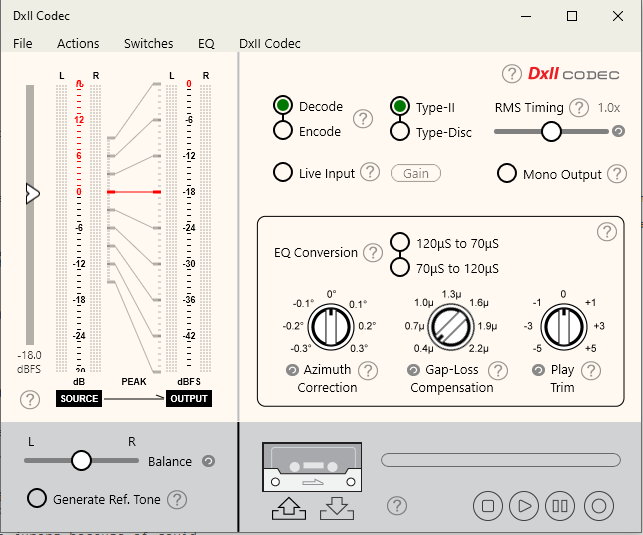
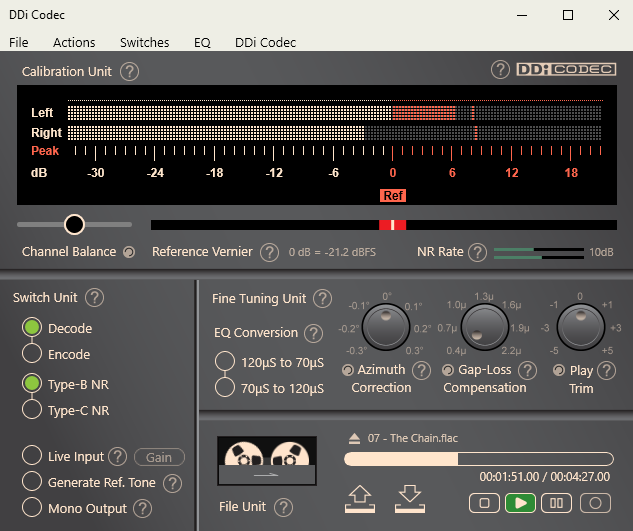
I have DDi Codec and it's brother DXII Codec for dbx II.
nhmk1mt9.png
zexx15ti.png


Both do a more than adequate job in dealing with the noise reduction. Results with DDi depend if you can get a good reference level set; dbx is a little less sensitive to this. I was actually able to get Dolby C to work *really* well with my Integra TA-207. I tried DxII on a real dbx unit...but that thing is in need of a major overhaul. It mostly worked...but I'm assuming any "errors" I heard were more due to the age of the components in that wood-sided box.

The EQ conversion options are interesting. You can either fix tapes recorded with the "wrong" curve; or modify the sound to virtually force a curve.

As far as the idea of dynamic noise reduction; I never looked at how they did that in the analog world in stuff like DNR. Digitally it's not very reliable; it's gotten better, but you can still tell it's having to guess at what the noise level is.

Hello, I have all Anaxwaves apps, it seems DxII gave me good results. They are good to have, but I am looking for any alternatives.
 
I had one of the Phase Linear autocorrelator units. Worked pretty well, except when on an LP there were song to song differences in how they were mixed and/or differences in overall levels, then readjustment would be necessary. But the biggest elephant in that room was the audible effects due to its inability to process recordings well when gain riding had been employed in a recording. The effects ran sonically from slightly weird to bizarre and occasionally even grotesque.
 
Hello,

I am working on digitizing of old recorded tape project, but the main problem here is hiss sound and echo. I suppose these tapes is not recorded in any noise reduction encode. I have tried to reduce hiss with dolby B and dbx 1, and I am planning to use the Super D noise reduction system if possible (but I think, without the encoding option, it is not meant to use).

So,

I use a couple of software-related solutions to reduce hiss effects on old tape records, but it reduces original sound quality and creates metallic noises.

As for the hardware solutions on the forums, people sometimes say Super D best, or dbx 224, etc.

If I record the playback of the sound of tapes to the computer, is there any plugin or virtual device that simulates these noise reduction systems generally used in hi-fi systems (like Super D or others)?

Dolby and dbx are Encode first, Decode to play back. Hardware necessary to do this correct. Facts: dbx Type 1, is for 7 1/2 IPS/15 IPS/30 IPS use in professional studio machines. Needs dbx Type 1 to decode properly. Intended for 1/2 track Stereo/Full track mono and professional multi-track use only. Dolby B is consumer slow speed machines like open reel home machines, at 3 3/4 and 7 1/2 IPS, and 1/4 track, 1/4" tape, can also be used with cassettes and even 8 track cartridge machine. Encode to record, decode to play back. In Studios, and like dbx Type 1, Dolby for that job is called Dolby A or Dolby SR, Dolby S for cassettes by the way if encoded with Dolby S NR.
 
Dolby and dbx are Encode first, Decode to play back. Hardware necessary to do this correct. Facts: dbx Type 1, is for 7 1/2 IPS/15 IPS/30 IPS use in professional studio machines. Needs dbx Type 1 to decode properly. Intended for 1/2 track Stereo/Full track mono and professional multi-track use only. Dolby B is consumer slow speed machines like open reel home machines, at 3 3/4 and 7 1/2 IPS, and 1/4 track, 1/4" tape, can also be used with cassettes and even 8 track cartridge machine. Encode to record, decode to play back. In Studios, and like dbx Type 1, Dolby for that job is called Dolby A or Dolby SR, Dolby S for cassettes by the way if encoded with Dolby S NR.

Thank you for the answer. Then what do you suggest for denoising of digitized old reel to reel tapes? I need software that must not affect audio to create artificial or metallic noises.
 
The tapes I am working with are recorded mono records, generally not for direct music, only speech

Speech is likely to be lower in frequency than tape hiss, so you might be able to use a simple low pass filter to remove the worst of the noise.
 
Speech is likely to be lower in frequency than tape hiss, so you might be able to use a simple low pass filter to remove the worst of the noise.

I have used low pass band pass. Problem here is the noise that stocked at 150-5000hz frequency under the speech.
 
What is the origin of these tapes? How old? How were they recorded? What size and type of tape? Was a noise reduction system (pre-emphasis, dbx, Dolby?) applied when recording? Was the matching system used on playback?

Have you read the Audition help on noise reduction?

https://helpx.adobe.com/audition/using/noise-reduction-restoration-effects.html

Do you understand the different noise reduction systems?

https://www.soundonsound.com/techniques/tape-noise-reduction?amp

Do you understand the origin and nature of tape noise? And the difficulty (impossibility) of perfectly removing random noise from a signal?
 
What is the origin of these tapes? How old? How were they recorded? What size and type of tape? Was a noise reduction system (pre-emphasis, dbx, Dolby?) applied when recording? Was the matching system used on playback?

Have you read the Audition help on noise reduction?

https://helpx.adobe.com/audition/using/noise-reduction-restoration-effects.html

Do you understand the different noise reduction systems?

https://www.soundonsound.com/techniques/tape-noise-reduction?amp

Do you understand the origin and nature of tape noise? And the difficulty (impossibility) of perfectly removing random noise from a signal?

The only info is they are recorded between 1950-1968 on the10.5 inches reels. I do understand the importance of the recorder device, recorded tape brand ( in terms of nWb/m), or if the noise reduction system is applied or not. But, I do not have this informations. I use the noise reduction plugins and features of Audition and other daw applications. Also, I do aware of "In the audio world you never get something for nothing, and all noise reduction systems have side‑effects that compromise the audio quality to some extent". I am just trying to learn if there is any better solution that I do not know from people like you who like working with this kind of stuff.
 
Last edited:
Thank you for the answer. Then what do you suggest for denoising of digitized old reel to reel tapes? I need software that must not affect audio to create artificial or metallic noises.

Software isn't enough. Do you know how to use it, is your sound card sufficiently good on input/output or your USB audio interface? Are either clean and transparent sounding. Food for thought.
 
Software isn't enough. Do you know how to use it, is your sound card sufficiently good on input/output or your USB audio interface? Are either clean and transparent sounding. Food for thought.

I can use the software (filter, EQ, noise reduction, etc.), no problem with that. Let me tell you about my setup, I do use 2 decks (Akai Gx-600DB and Teac X-2000M) for digitization. I have a Motu M2 sound card that supports 32-bit depth with 192-kHz sampling that has a nice low noise preamp. I do prefer high-quality cables to avoid any EM interference (supported silent jacks).

I am just looking for a way to improve the quality of what I do. Actually, hiss reduction of Audition does the job that I want but it brings some metallic noise. Today, I have tested Brusfri of Klevgrand. It seems to do a good job without messing with the phase of audio. I could not hear any metallic noise in the sound. I will try it with other tapes to decide it works or not.
 
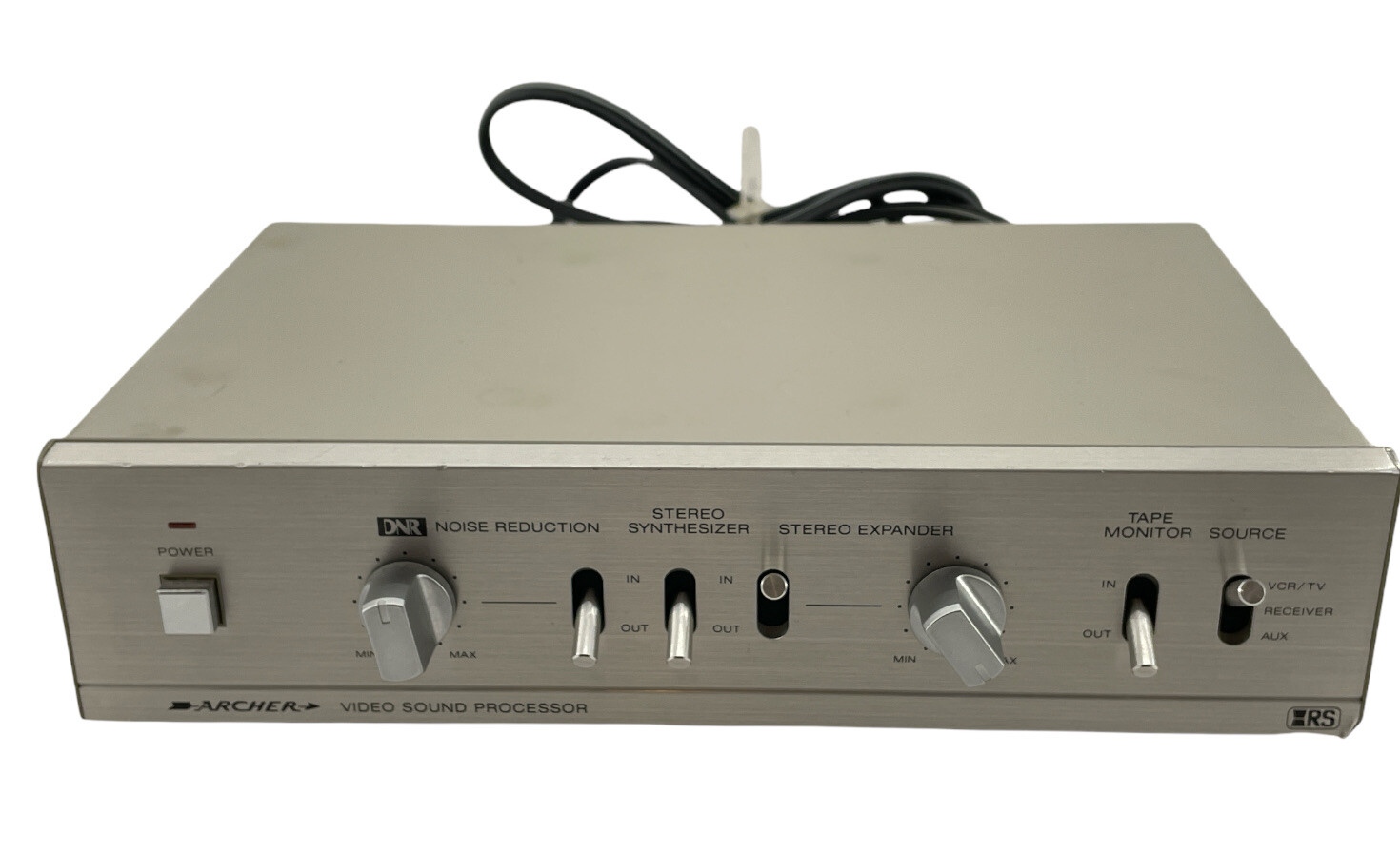
These Archer Video Sound Processors are an inexpensive way to acquire Dynamic Noise Reduction (DNR). They often show up on eBay for as low as $10.
s-l1600.jpg

I could not find a good demo video, but now I am looking for options that I can buy... thank you for the advice.
 
I'm not an audio engineer, and I don't use a DAW. But I am an electronic engineer, so I understand the basics of signal processing and noise. And the impossibility of perfectly separating two unknown, random signals once they have been added together.

But it has got me thinking about the origin of tape noise (magnetic grains on the tape, but Google is doing a poor job of finding good, detailed scientific discussion of the problem: old tech doesn't make it to the internet...?), the fact that it is random, but essentially repeatable (because grain distribution on the tape doesn't change), and the consequences for the accumulation of tape hiss when doing multi-pass recordings between different tapes, or 'bounce-down' on systems like the PortaSound; is the noise uncorrelated or correlated.

It has also made me ponder the possibility of recovering the 'unknown' tape noise (at least, that noise on the tape holding the recording, not any previous tapes used during multi-pass recordings, or duplication). It would be destructive to the recording, though... It would need better understanding of the science (cause/properties) of tape hiss, and experimentation with sacrificial recordings, plus some interesting maths/DSP to correlate to find and track the position of the recovered 'unknown' noise in the sampled recording. I don't know of any existing system to do this, and the destructive nature of my idea may not be appealing...
 
I'm not an audio engineer, and I don't use a DAW. But I am an electronic engineer, so I understand the basics of signal processing and noise. And the impossibility of perfectly separating two unknown, random signals once they have been added together.

But it has got me thinking about the origin of tape noise (magnetic grains on the tape, but Google is doing a poor job of finding good, detailed scientific discussion of the problem: old tech doesn't make it to the internet...?), the fact that it is random, but essentially repeatable (because grain distribution on the tape doesn't change), and the consequences for the accumulation of tape hiss when doing multi-pass recordings between different tapes, or 'bounce-down' on systems like the PortaSound; is the noise uncorrelated or correlated.

It has also made me ponder the possibility of recovering the 'unknown' tape noise (at least, that noise on the tape holding the recording, not any previous tapes used during multi-pass recordings, or duplication). It would be destructive to the recording, though... It would need better understanding of the science (cause/properties) of tape hiss, and experimentation with sacrificial recordings, plus some interesting maths/DSP to correlate to find and track the position of the recovered 'unknown' noise in the sampled recording. I don't know of any existing system to do this, and the destructive nature of my idea may not be appealing...

I am not audio engineer too, but communication engineer. It is not a problem to work with these electronics or materials. I have completely serviced the deck, but the problem with tapes remained... So I need to make sure that no improvement can be made to eliminate tape hiss when digitizing to leave asking about it. otherwise I will keep looking.. This is my hobby, somehow I could not get away from it :) It is interesting area which is nice to play with it. I hope someone who is the best about this kind of stuff, can touch on this topic to help us out. I don't think that random noise can not be eliminated. There is always a solution, but we need to figure it out.
 
I don't think that random noise can not be eliminated. There is always a solution, but we need to figure it out.
What can be done? Cutting high frequencies makes the hiss less obvious, but has an obvious effect on the audio. Turning down the overall level reduces hiss too, but obviously affects the audio. Any software can only be effective by combining those two techniques while attempting to minimise the negative effects on the audio. Turning down the level during silences can be done - it's known as noise gating - but is really only effective on individual instruments on a multitrack recording. It can actually make the noise worse by drawing attention to it as the noise goes up and down.
Software could perhaps turn down the high frequencies when the audio doesn't contain high frequencies, but it's all just messing about with EQ and volume. Yes, software can do these things on-the-fly at tremendous speed, but how effective can it be really?
It would make sense that some software would be more successful than others, so it might be worthwhile checking out recording studio forums to see what they recommend.
 
I can use the software (filter, EQ, noise reduction, etc.), no problem with that. Let me tell you about my setup, I do use 2 decks (Akai Gx-600DB and Teac X-2000M) for digitization. I have a Motu M2 sound card that supports 32-bit depth with 192-kHz sampling that has a nice low noise preamp. I do prefer high-quality cables to avoid any EM interference (supported silent jacks).

I am just looking for a way to improve the quality of what I do. Actually, hiss reduction of Audition does the job that I want but it brings some metallic noise. Today, I have tested Brusfri of Klevgrand. It seems to do a good job without messing with the phase of audio. I could not hear any metallic noise in the sound. I will try it with other tapes to decide it works or not.

Are the tapes encoded with NR to begin with? If so, what kind of NR. Are they slow speed or high speed. 1/4 track or 1/2 track Stereo. IMPORTANT. Do they have labels which say they were recorded with Dolby or dbx? If so, which Dolby or dbx system?
 
Are the tapes encoded with NR to begin with? If so, what kind of NR. Are they slow speed or high speed. 1/4 track or 1/2 track Stereo. IMPORTANT. Do they have labels which say they were recorded with Dolby or dbx? If so, which Dolby or dbx system?

No Information is available about NR applied or not.
They are generally slow speed (7.5 ips or 3.75 ips)
1/4 track and each one recorded as mono track.
No information is available about dolby or dbx.

So what should be done in case of this situation?
 
No Information is available about NR applied or not.
They are generally slow speed (7.5 ips or 3.75 ips)
1/4 track and each one recorded as mono track.
No information is available about dolby or dbx.

So what should be done in case of this situation?
You can hear dbx encoding quite clearly.
Best just use your ears.
 
You can hear dbx encoding quite clearly.
Best just use your ears.

They are not dbx encoded. No extra noise due to encoding of dbx existed. In my opinion, it is just recorded without any noise reduction or dolby or dbx.. We are talking about tapes that are recorded between 1950-1968.
 
Back
Top Bottom