• The move to the new server is done. There are some software and database maintenance updates in process. This has us passing the hat around to help out. We appreciate any donations. Seriously, even a dollar helps. The payment page may be found here - https://www.audiokarma.org/support.html

VTA method???

rodman101

Active Member
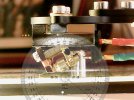
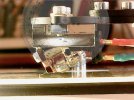
Was just shown another way to do VTA, I agree for what I heard works. Inexpensive USB microscope and focus such that when the base of the cartridge is "parallel" to the record you have reached nirvana... I'm not sold on this as, technically, it ultimately comes down to SRA angle. Perhaps there is a phono cartridge design secret/given along the lines that assumably the highest crest of a warp that does not overcome the cartridge base will allow "accurate" tracking, which mean the highest point is parallel. I get all this but this method is the first I ever heard of and I'm totally skeptical, comments please!
 
Register to hide this ad
The best way is to use the Analogue Productions test record made by Acoustic Sounds and an oscilloscope. You can't really set VTA via looking at anything, because the correct VTA is the setting that puts the stylus in the groove (while in motion) with the contact surface at the same angle as the mastering labs" cutter head when they cut the album. Of course, that angle isn't always exactly the same, so .... all you can do is use the test record to get it really really close for most albums. Other than that you can use a fairly high powered loop (or USB microscope) to view the stylus from the side and attempt to get the contact surface (if you can see it) (easier with LC styli) 2-3 degrees forward of perpendicular to the surface. And then make tiny adjustments by ear. Generally, the cymbals and high strings will snap into focus and sound very "airy" with little to no "edge" when VTA is spot on - of course, that will be for that album (and any albums cut with a cutter head installed at the same angle) only - but .... it'll be close enough for it to sound great on most all of your albums at that point. Remember though, that your tangency, VTF and Azimuth all need to be spot on for VTA adjustments to be reasonably "audible". Analog is such fun!!!!
 
Tonearms do not need to be parallels to the LP surface to give the correct tracking angle. It depends how the manufacturer has mounted
a) the cantilever to the cart, this can vary between manufactures by as much as 17 degrees.
b) How much bend, if any the cantilever has.
c) how the stylus is fixed to the cantilever

For Conical & Elliptical carts you do not need to worry about VTA set up, because the stylus shape has a comparatively large contact area.

All other more exotic styli however do slightly give a better performance when aligned to -92 degrees to the LP.

Cheers
 
There is THE dedicated and officially recommended test record for VTA determination and adjustment:
But if you are on a conical/elliptical needle, - the VTA does not matter, especially when such a cartridge is on a pivoted tonearm. Other sources of distortions will prevail.
 
The best way is to use the Analogue Productions test record made by Acoustic Sounds and an oscilloscope. You can't really set VTA via looking at anything, because the correct VTA is the setting that puts the stylus in the groove (while in motion) with the contact surface at the same angle as the mastering labs" cutter head when they cut the album. Of course, that angle isn't always exactly the same, so .... all you can do is use the test record to get it really really close for most albums. Other than that you can use a fairly high powered loop (or USB microscope) to view the stylus from the side and attempt to get the contact surface (if you can see it) (easier with LC styli) 2-3 degrees forward of perpendicular to the surface. And then make tiny adjustments by ear. Generally, the cymbals and high strings will snap into focus and sound very "airy" with little to no "edge" when VTA is spot on - of course, that will be for that album (and any albums cut with a cutter head installed at the same angle) only - but .... it'll be close enough for it to sound great on most all of your albums at that point. Remember though, that your tangency, VTF and Azimuth all need to be spot on for VTA adjustments to be reasonably "audible". Analog is such fun!!!!
The AP record test track is wrong. Laterally cut and not vertically as is needed for VTA check

That said, VTA applies all types of stylii whereas SRA applies mostly to line contacts diamonds. Also, adjusting tonearm height also affects warp wow.

Basic rules are
- set the tracking weight in the middle of the recommended range
- set the tonerm/cartridge upper plate parallel to the record
- check stylus in a USB microscope on a stationary record
—> if SRA is 92-94 degrees let it be
—> if not adjust VTF and check again

Leave VTA as is. It varies between 20-30 degrees among cartridges.

Advanced setting,
- use a test record and adjust azimuth for even crosstalk*
- adjust VTF for lowest crosstalk
*Do not exceed +/- 2 degree tilt
 
Last edited:
You can not reliably measure either of them - with your naked eye.
If you set up the VTA correctly - by means of the proper test record, - you are guaranteed to have the SRA correct too. Automagically.
No. For example the boron-based stylii like the JICO SAS have around 28 degree VTA at the correct SRA. It has been measured with test records. Other stylli have around 20-22 degree at correct SRA. It is a fact that VTA varies betwen 20-30 degree between different cartridges at correct SRA.
 
When I got my new Dynavector I asked them directly how to set VTA/SRA since the cartridge manual is silent on the issue. They said to set the top of the cartridge parallel to a static record surface. I used a USB microscope, a protractor overlay and a flat grooveless record side to do as recommended.

Screenshot 2024-11-23 at 3.03.00 PM.jpeg
Screenshot 2024-11-23 at 3.02.48 PM.jpeg

The above method will still have some variability given the microscope angle, manufacturing tolerances, etc. so I adjusted VTA (very little in this case) by ear to get rid of some minor harshness on cymbals and vocals using a record I know well.

If you set VTA/SRA by viewing the stylus (e.g. the cartridge has been retipped) a high power usb microscope is needed to see the facets or line contact points. Also, if a non-grooved and static record is used the stylus angle will reduce about 1° when the record is spinning and in a groove (according to Peter Lederman at Soundsmith).

IMO all this does is get you toward the center of the swings in SRA since most records are not flat so adjusting to "higher accuracy" will not yield better overall results.

Note: Photos taken with an inexpensive USB microscope off Amazon and viewed via Apple QuickTime Player. The protractor overlay was from the Apple apps store.
 
This may help:


I found VTA/SRA fine adjustment for particular record is necessary if you have good stylus like micro ridge or VDH. It can be done by ear simply playing inner track and adjusting tonearm high for best high frequency response. There is no much difference if you play records from 80s, but when you put on something from 60s difference is audible. So you can set initial position with test record and then make fine adjustment "on the fly". Simply mark nominal position to return when necessary. My ET has indicator.
Dragon_CT_Eminent_VDH-2.jpg
 
This may help:


I found VTA/SRA fine adjustment for particular record is necessary if you have good stylus like micro ridge or VDH. It can be done by ear simply playing inner track and adjusting tonearm high for best high frequency response. There is no much difference if you play records from 80s, but when you put on something from 60s difference is audible. So you can set initial position with test record and then make fine adjustment "on the fly". Simply mark nominal position to return when necessary. My ET has indicator.
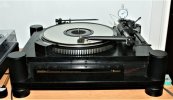
View attachment 3380049

Nice TT. Do you find it tedious to check the VTA of most records before you play them? The other thing is might you be hearing the effect of the Dragon's centering ability?
 
Nice TT. Do you find it tedious to check the VTA of most records before you play them? The other thing is might you be hearing the effect of the Dragon's centering ability?
About VTA - commonly I make fine adjustment when digitize records. At playback sometimes when I hear something is wrong or when I am in the mood. And really there are differences - record thickness, cutting angle. But centering is a must! Even for my ELP laser player I made custom centering device. Most records (except maybe Polydor) are far more away from standard 0,05mm off center or hole is larger. I have records where A side is absolute center, B side 0,4mm off center. If record is 0,1mm off center this is the border when you start to hear detonation of piano on inner track. Dragon and TX-1000 (now I started restoration of this one) center records to 0,02mm. And Audio Technica vacuum platter helps a lot for warped records - they are perfectly flat.

Here you can download Dragon brochure (file is too large to upload there):

All what is written in this brochure is truth.

Oh, no doubts about the Dragon's capabilities. I have a few records that the spindle hole is quite a bit larger than the spindle plus, as you note, the pressing is often off. It is one of the vagaries of vinyl that most don't have the ability to address. One thing that can be done is use a cartridge and counterweight that allows a pivoted tonearm's counterweight to be positioned closer to the pivot thereby reducing the lateral forces caused by eccentricities as the stylus follows the groove.

The question for most TT owners is whether fussing over VTA/SRA is worth the effort. Yes, dial in the TT settings as best as possible but getting too precise might not yield corresponding improvements in part because of the variable nature of records. That Dynavector didn't suggest a more precise method tells me they see no or diminishing returns by trying to set SRA/VTA to exceptionally close tolerances.
 
The question for most TT owners is whether fussing over VTA/SRA is worth the effort. Yes, dial in the TT settings as best as possible but getting too precise might not yield corresponding improvements in part because of the variable nature of records. That Dynavector didn't suggest a more precise method tells me they see no or diminishing returns by trying to set SRA/VTA to exceptionally close tolerances.

Yes, you can set nominal VTA with test record, but when you reproduce particular records, this setting does not match. But anyway nominal adjustment should be made as close as possible. It is about the same as with playback head azimuth. Nominal alignment should be made with test tape, but for particular records should be adjusted. Like on Nakamichi CR7. And I have azimuth knobs installed on all my Studer A80 and A820.
 
No. For example the boron-based stylii like the JICO SAS have around 28 degree VTA at the correct SRA
Do you understand that the test record (LB208) is NOT a protractor?! It does not tell you to set the VTA to exactly 20°.
All it does - it generates a signal to measure the level of the IMD (intermodulation distortion) with a spectroscope.
You adjust the cartridge so that the IMD minimum is obtained at the "20°" track of the record. Then you get the optimum SRA.
Whichever VTA you finally get - is irrelevant.
Different VTAs on the LB208 are there to help you to clearly see in what direction you should move, and how far.

Do you realise that the adjustment goal is not an angle in itself, but the distortion-free playback?
Yes I know of the IMD test record for VTA. But again, VTA is not the same as SRA. If you set cartridge for minimum IMD at 20 degree cutting angle (i.e. 20 degree VMA) it means that cartriidge VTA is set to 20 degree. The cantilever follows the same arc as the cutting cantilever. SRA can still be way different from the optimum 92 degree.

 
Yes I know of the IMD test record for VTA. But again, VTA is not the same as SRA. If you set cartridge for minimum IMD at 20 degree cutting angle (i.e. 20 degree VMA) it means that cartriidge VTA is set to 20 degree. The cantilever follows the same arc as the cutting cantilever. SRA can still be way different from the optimum 92 degree.


I believe you are confused by VTA/SRA. Here is picture from pspatialaudio (see link above, I advise to read that article):

1735077542814.png
 
Back
Top Bottom