• The move to the new server is done. There are some software and database maintenance updates in process. This has us passing the hat around to help out. We appreciate any donations. Seriously, even a dollar helps. The payment page may be found here - https://www.audiokarma.org/support.html

VU meters on vintage amps

goldwax

dozy ming-mong
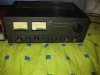
OK, this is really superficial, but I have no shame. I saw a pic of this Sansui 7070:

sansui%207070db.jpg


and noticed that it has some VU-looking meters at the bottom:

08cf_1.JPG


I mean, how frickin' cool is that? I love my Kenwood KR-7600, but the one thing it lacks is any sort of visual gizmo when the music's playing (apart from the Signal and Tuning meters when dialing in a station, of course).

So, what's the purpose of VU meters on amps, considering that not many seem to have them? What drives them and is it modifiable? Like, if you have a quiet passage on an LP playing, is there a control you could use to move the meters higher, like Recording Level on a tape player? Am I totally dumb and it's the volume control that's what does it?

Finally, what are some of the better receivers and amps that use VU meters? And since a pic of a Sansui 7070 started me off on this, how's that or one of its cousins as a piece of gear?
 
Register to hide this ad
I love VU meters. From a practical standpoint if the speakers you're driving with the amp are a difficult load VU meters are real nice to show how hard you're running your amp.
 
I don't know what it is, but since childhood, I've always been obsessed with analogue meters :screwy:
 
In that case you should love my Sansui quad receiver. 4 analog power meters and the standard tuning and signal strength meters, for a total of 6 analog meters on one unit!
 
Kenwood's KR-9600 has cool "dual mode" power meters. They have a switch to change from a (2 or 5 watt) setting to 200 watts. Very cool. It is the only Vintage machine I have ever seen to have this feature. All of Pioneers' SX-**80 series had power meters too:)
 
As far as I know, ALL these meters are actually just voltmeters with wattage scales. They do not measure power at all, but merely make the assumption that a specific load is in use. If the load is "difficult", they do not give an accurate measurement at all.

They give a vague indication of how close the amp is to its clipping limit.
And they do LOOK very pretty!

REALLY measuring the power delivered to a speaker is quite an involved electronic process (and quite expensive), requiring a measurement of the speaker current as well as voltage.
 
As far as I know, ALL these meters are actually just voltmeters with wattage scales. They do not measure power at all, but merely make the assumption that a specific load is in use. If the load is "difficult", they do not give an accurate measurement at all.

They give a vague indication of how close the amp is to its clipping limit.
And they do LOOK very pretty!

REALLY measuring the power delivered to a speaker is quite an involved electronic process (and quite expensive), requiring a measurement of the speaker current as well as voltage.

and you know because you designed all of them?
 
As far as I know, ALL these meters are actually just voltmeters with wattage scales. They do not measure power at all, but merely make the assumption that a specific load is in use. If the load is "difficult", they do not give an accurate measurement at all.

I will agree with you, because the meters on my 8080DB dance with no load.

Also most of the meters on my equipment say "@ 8 ohms".

I like them. If I ever finish my Sansui B-2102, I will have meters in my main system, just not analog. That is if I can bring myself to pull the AU-719 from service.

You asked about the 7070 and its cousin receivers. Great receivers if you ask me.

Rob
 
and you know because you designed all of them?

No. But I know how you measure electrical power. It takes a lot of complex analogue circuitry to do it, including log converters - which are notoriously prone to drift and temperature influence.
This is made even more complicated if you want a circuit that responds linearly over something like 10 octaves - its tricky enough doing it well at 60Hz mains frequency.
To correctly measure real power would require more circuitry than is already present in most amplifiers; and the result is of little use to the end user.

Now its more feasible with cheap microprocesors and A/D converters.
 
No. But I know how you measure electrical power. It takes a lot of complex analogue circuitry to do it, including log converters - which are notoriously prone to drift and temperature influence.
This is made even more complicated if you want a circuit that responds linearly over something like 10 octaves - its tricky enough doing it well at 60Hz mains frequency.
To correctly measure real power would require more circuitry than is already present in most amplifiers; and the result is of little use to the end user.

Now its more feasible with cheap microprocesors and A/D converters.
And NO meters is somehow better? :scratch2: The VU meters on Yamaha amps are a good indicator of load on the amp.
 
You asked about the 7070 and its cousin receivers. Great receivers if you ask me.

Good to know.

Kenwood's KR-9600 has cool "dual mode" power meters. They have a switch to change from a (2 or 5 watt) setting to 200 watts. Very cool. It is the only Vintage machine I have ever seen to have this feature. All of Pioneers' SX-**80 series had power meters too:)

Even better to know, since I'm already a fan of the 7600.

I'll keep an eye out for either the Sansui 7070 or higher or the KW 9600; maybe I'll get lucky and find one on the cheap!
 
And NO meters is somehow better?

I was just pointing out that they are not what they are usually promoted as being, or maybe not what most users believe them to be.

The VU meters on Yamaha amps are a good indicator of load on the amp.

Thats an interesting point. Suppose you severely loaded the amp, with say 3 pairs of speakers - pushing the load down to around 2½ ohms.... with such a heavy load, the voltage swing on the output would be more limited than the design intended, so the meters swing would be lower than "normal".
Without consiously noting the speaker load and doing a correction you might think the amp was happy, whereas it is severely overloaded. And because of the heavy load, it will go into clipping at a point somewhat short of what those meters indicate it ought to be able to swing to.

Interstingly too, you could get just as much of an 'estimate' of the power by measuring the current and using the equality P=I²R, rather than the usual way of these meters of measuring voltage and scaling the meter according to P=V²/R. That DOES give a much better indication of the load on the amplifier, since lower speaker impedance directly results in more current. The downside is the meters read zero if no speakers are connected (which is in fact quite accurate; no speaker = no power)
 
I was just pointing out that they are not what they are usually promoted as being, or maybe not what most users believe them to be.


Thats an interesting point. Suppose you severely loaded the amp, with say 3 pairs of speakers - pushing the load down to around 2½ ohms.... with such a heavy load, the voltage swing on the output would be more limited than the design intended, so the meters swing would be lower than "normal".
Without consiously noting the speaker load and doing a correction you might think the amp was happy, whereas it is severely overloaded. And because of the heavy load, it will go into clipping at a point somewhat short of what those meters indicate it ought to be able to swing to.

Interstingly too, you could get just as much of an 'estimate' of the power by measuring the current and using the equality P=I²R, rather than the usual way of these meters of measuring voltage and scaling the meter according to P=V²/R. That DOES give a much better indication of the load on the amplifier, since lower speaker impedance directly results in more current. The downside is the meters read zero if no speakers are connected (which is in fact quite accurate; no speaker = no power)
I have severely loaded my MX-10000 driving a pair of Infinity IRS Delta's that unknown to me had the woofers wired out of phase. My SPL meter registered peaks at ~ 80dB, but the meters on the MX-10000 were showing 200wpc continuous on the 4 ohm scale with 600 watt peaks. The meters on my PC5002M driving the top-end of the Delta's was showing 1/10 wpc continuous with 1 watt peaks. Those measurements convinced me that there was something seriously out of wack with the Delta's, which led me to test the phase of the woofers, and wire them correctly.
 
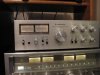
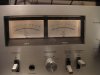
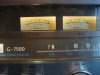
VU METERS are good for you!

We all like VU METERS..
 

Attachments

  • 6100_01.jpg
    6100_01.jpg
    50.8 KB · Views: 291
  • 6100_03.jpg
    6100_03.jpg
    41.4 KB · Views: 255
  • 6100-G7500_1.jpg
    6100-G7500_1.jpg
    22.9 KB · Views: 227
  • IMG_0090.jpg
    IMG_0090.jpg
    43.6 KB · Views: 244
  • IMG_0098.jpg
    IMG_0098.jpg
    49.3 KB · Views: 281
I feel this growing slowly into a pics of VU meters thread. How bout it?

drooling_homer.png


So anyway, do these power meters, as I've now learned what they are called, actually move back and forth in response to rising and falling of the volume of the music as it plays? Or do they remain fairly steady throughout playback?
 
drooling_homer.png


So anyway, do these power meters, as I've now learned what they are called, actually move back and forth in response to rising and falling of the volume of the music as it plays? Or do they remain fairly steady throughout playback?
The VU meters on my Yamaha amps move back and forth instantly to the slightest change in power. On very dynamic sources such as some classical music the movement can be dramatic.
 
Back
Top Bottom