

You are using an out of date browser. It may not display this or other websites correctly.
You should upgrade or use an alternative browser.
You should upgrade or use an alternative browser.
VU meters on vintage amps
- Thread starter goldwax
- Start date


I suspect very few amps have any real load measurement as related to VU or LED power meters. That's not to say they don't employ thermal or clip (distortion) limits. I know for certain from reading the schematics and service manuals that vintage Yamaha receiver's VU meter readings are taken from the preamp stages and have little to do with actual power output since they'll register with no load or speakers selected.
While it is a good indication of the status of things, good or bad, they are simply an "estimate" of the power output, but they are SO COOL...
While it is a good indication of the status of things, good or bad, they are simply an "estimate" of the power output, but they are SO COOL...


While that may be true for Yamaha receivers & some Yamaha amps, the meters of the MX-10000 & PC5002M show actual load.I suspect very few amps have any real load measurement as related to VU or LED power meters. That's not to say they don't employ thermal or clip (distortion) limits. I know for certain from reading the schematics and service manuals that vintage Yamaha receiver's VU meter readings are taken from the preamp stages and have little to do with actual power output since they'll register with no load or speakers selected.
While it is a good indication of the status of things, good or bad, they are simply an "estimate" of the power output, but they are SO COOL...

Coastsider
Curmudgeon
While that may be true for Yamaha receivers & some Yamaha amps, the meters of the MX-10000 & PC5002M show actual load.
You're right, as I understand the feedback/servo type detection in these registers actual load. Can't recall if the [EDIT] MX2000 does or not. (been up all night working a sick systems cluster)

Hokieman
Super Member
Interstingly too, you could get just as much of an 'estimate' of the power by measuring the current and using the equality P=I²R, rather than the usual way of these meters of measuring voltage and scaling the meter according to P=V²/R. That DOES give a much better indication of the load on the amplifier, since lower speaker impedance directly results in more current. The downside is the meters read zero if no speakers are connected (which is in fact quite accurate; no speaker = no power)
My understanding is that analog volt meters are a lot smaller and significantly less expensive than ammeters (current meters). Thus, this "indirect" measurement.

The big Sansui QRXxx00 quad receivers have four "level" meters as well as the two for signal and tuning for the tuner. these have a different function to the power meters fitted on other big Sansuis, These meters give an indication of the four output levels of the pre-amps before they are fed to the tone, volume and balance pots. There is a "level set" pot to adjust these outputs so as to not allow a distorted signal getting thru to the Tone and balance circuits. The meters also give an indication of what the decoders are doing? Because of where the meters are in the pre-amp circuits they "work" all the time, Nice if you like the visuals (I do!).
Only real problem is the lamps inside them! each meter has three so thats eighteen in all!! Nasty little sub-minature things and a pig to change! But its worth it to see these Monster sized receivers up and running
Only real problem is the lamps inside them! each meter has three so thats eighteen in all!! Nasty little sub-minature things and a pig to change! But its worth it to see these Monster sized receivers up and running
Last edited:

Fred Sanford
Addicted Member
When I moved to this beautiful valley in VA, I was going to get custom license plates saying "NICE VUS", figuring folks like AKers might get the double meaning...
Sadly, there's not a single power amp here with meters anymore...lots of clip indicators, though. Most of the mixers have analog VUs, and some of the tape decks.
je
Sadly, there's not a single power amp here with meters anymore...lots of clip indicators, though. Most of the mixers have analog VUs, and some of the tape decks.
je
Attachments


steerpike2
Super Member
My understanding is that analog volt meters are a lot smaller and significantly less expensive than ammeters (current meters).
From a technical pint, ALL moving coil meters are in fact current meters. The are specified with something like "150uA FSD", i.e., 150 microamps for full scale deflection.
If you put a large resistor (large relative to the meteres own coil resistance) in series with such a meter, the voltage across the resistor is predominantly going to determine the current through the combination, so you have a voltmeter.
This is typically how they are used in audio circuits - tape deck VU meters included.
To measure practical current (150uA is very small) you'd put a low value shunt resistor in parallel with the meter; then the current is shared between the meter and the shunt, in the ratio of their respective resistances.
But even so, that would involve putting a resistor of a few tenths of an ohm in series with the loudpeaker - not good for damping factor. (Unless the designer was going to put in a current transformer and meter amplifier circuit = up the cost).
So 'voltmeter' type displays are just the easiest and cheapest.
By definition, a "VU meter" is a voltmeter, with stringently specified mechanical characteristics.

Chazb11
Vintage Human
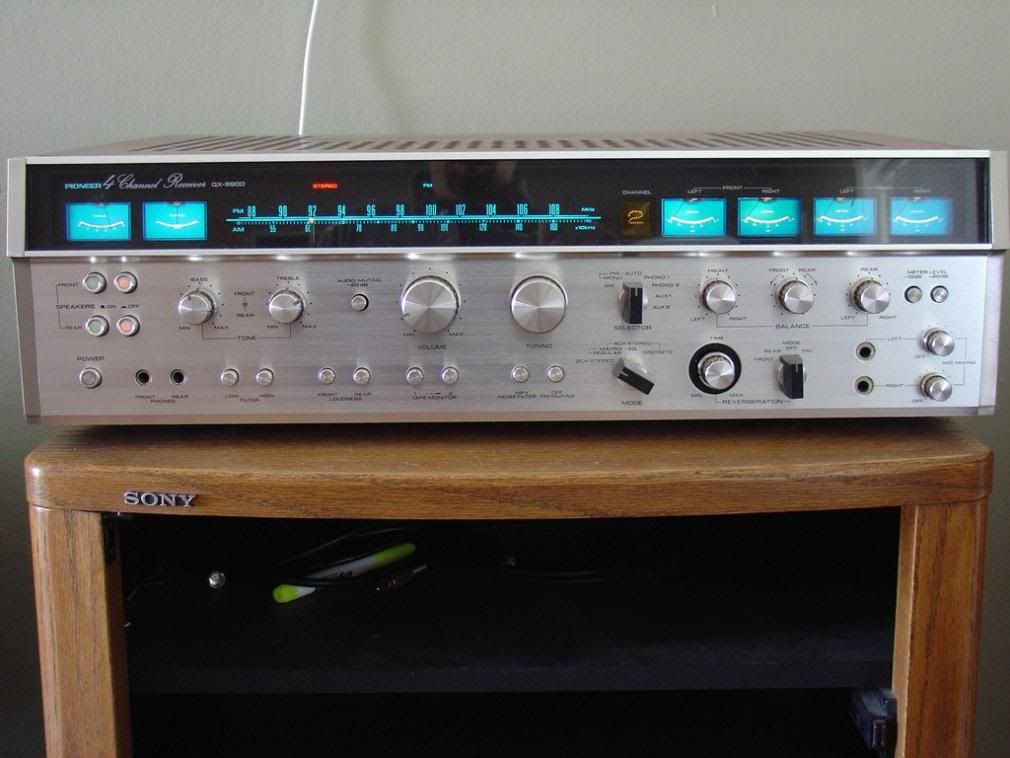
If you want to talk about unusual meters take a look at my Wintec receiver. It has a row of LED's with left channel reading to the left and right to the right. The switch to the right controls the sensitivity of the meters. It's rather hypnotic.

Picture is from the web but just like mine.
Picture is from the web but just like mine.




Old_Tech
Yer-isn't!
Volume Units
The "VU" meters actually measure "volume units" which can be interpreted in many ways. They are not precise however very beautiful to watch on well designed units. The thing to remember is that they are uaually "weighted" or damped. What this means is that their response is relatively slow and corresponds to a greater average of the music than an instantaneous value. This being said the meters will be slow to react to what is really being sent down the speaker wire. If they were not dampened they would be flicking up and down so fast they would be almost useless. So when you read them remember it is an average you are seeing and really not that far off from the true power. They are sampling the audio in the low level circuitry and usually designed into a precise voltage divider summing circuit.
Oh by the way, nice equipment fellas.
The "VU" meters actually measure "volume units" which can be interpreted in many ways. They are not precise however very beautiful to watch on well designed units. The thing to remember is that they are uaually "weighted" or damped. What this means is that their response is relatively slow and corresponds to a greater average of the music than an instantaneous value. This being said the meters will be slow to react to what is really being sent down the speaker wire. If they were not dampened they would be flicking up and down so fast they would be almost useless. So when you read them remember it is an average you are seeing and really not that far off from the true power. They are sampling the audio in the low level circuitry and usually designed into a precise voltage divider summing circuit.
Oh by the way, nice equipment fellas.


The VU meters on my Yamaha amps move back and forth instantly to the slightest change in power. On very dynamic sources such as some classical music the movement can be dramatic.
Yes indeed! :thmbsp:
Last edited:

goldwax
dozy ming-mong
If you want to talk about unusual meters take a look at my Wintec receiver. It has a row of LED's with left channel reading to the left and right to the right. The switch to the right controls the sensitivity of the meters. It's rather hypnotic.
Picture is from the web but just like mine.
Cissy Strut would look great on these funky meters!

