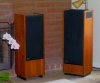
well, i finally own some walsh-equipped infinitys. i'm working on a monitor IIa project and just went through the walshes. this walsh rebuild thread proved quite helpful. since we never really got too deeply into the subject of the foam cap, i thought i'd resurrect this languishing thread and add this info, just to have all the walsh-rebuild stuff in one place for future reference.
i know a lot of people just use whatever foam is handy, and i see it frequently installed flat, but i wanted to try to duplicate what the factory was doing. my dialogs with walsh expert dale harder of HHR provided much good info that helped point me in the right direction, and saved me a lot of head scratching. of course, lincoln walsh's patent was consulted at length, and the writings of horn/waveguide guru dr. earl geddes were also instrumental in helping me wrap my brain around the wave propagation issues that need addressing as well as the characteristics of various foams. so, here is some droning about foaming...
the walsh tweeter was capped with a piece of foam sheet 1/2" thick, installed in a domed configuration. the original foam is kind of a mystery, since none of it has survived the years intact. crumbling remnants and gooey residue give only hints of what the foam was like in its pristine state, but in general we know that it was a gray, flexible foam, with many small cells of uniform size. not much to go on, and a description that belies the complexity of the foams task. to clarify the foam's task, i'll paraphrase dale again here:
"the open cell foam acted to damp the cone from ringing, provide structural support to the center tube and to help with the air/metal interface where the sound hopefully was absorbed at the annulus of the cone. if sound is not absorbed here, when it reaches the end of the cone and perceives the air/metal interface, physics demands that the propagating wave be reflected back down the cone 180 degrees out of phase. the foam plug at the top of the cone was to provide the damping and absorption of the wave at this interface and prevent reflection of the wave back into the cone. It was also a strengthening agent, fundamental in locating the cone in relation to the center support.
the density of the foam does play a role and this is why in our (HHR's) work with all walsh speakers we tell people, you can't just grab any old thing and throw it in. the foam that was used in the tweeters was an open cell foam, charcoal grey in color and the density of the foam was uniform. off the shelf foams do not work as well. some off the shelf foam has a very randomized cell structure with lots of air voids and this foam does not work as well. this leads to break-up and wave cancellation/reinforcement giving the speaker a very muffled or hollow sound. even muddy, or veiled".
so, for the tweeter application, a proper replacement foam needs to be an open cell type, so it is permeable to air (and sound). there are a lot of open cell foams out there. there are myriad materials – polyurethane, polyethylene, polyvinyl chloride, latex, melamine, polyimide, PVA, EVA, etc. based on intended use, and due to longevity concerns, polyurethane is the preferred material.
besides material, there are many physical attributes to consider. there are two types of open cell structure related to permeability – one being "reticulated" (cell walls completely gone leaving only an interconnecting skeletal structure), and the other being "non-reticulated" (cell walls partially intact). for the walsh tweeter application, the reticulated type has several distinct advantages.
a reticulated open cell foam is produced through an interesting process called zapping. this process involves placing a bun of foam in a large vacuum pressure vessel known as (drum roll, please)… a zapper. the vessel is evacuated and filled with an explosive gas mixture. the gas is ignited and a controlled flame front passes through the foam. this melts the cell window membranes, but leaves the skeletal structure intact. the benefit of the zapping process is it yields a smooth, polished skeletal structure, higher strength, and maximum permeability. polyurethane foam best lends itself to the zapping procedure.
the ideal foam for the walsh tweeter cap needs to be flexible enough to conform to a dome shape, yet resilient enough to hold the cone centered in-place without deforming it. it needs an open enough structure to be acoustically transparent, but dense enough to damp the sound waves at the top of the cone. a reticulated foam best meets these criteria. besides its role in supporting the fragile cone, the foam also needs to absorb any spurious wave reflections emanating from the cone edge that would otherwise cause unwanted sound quality issues. a reticulated foam is necessary to achieve a proper balance of absorption without too much attenuation when damping the reflected waves that geddes termed higher order modes (HOMs), and walsh called undesired delayed transient radiation.
the number of cells (pores) per inch, and the uniformity of cell size, are also key considerations.
i auditioned a lot of different foams for this project, but i didn't even come close to examining the literally thousands of variations out there that specialty foam manufacturers offer. in addition, i tested only gray colored foams, as i wanted an original look. i live in a rural area that is lacking in exotic foam dealers, and so was limited to purchasing online, and only from sources that would sell a reasonably small quantity (most specialty foam manufacturers seem to only want to sell you cargo container sized orders, and specialty foam is fairly expensive considering by volume it is mostly air).
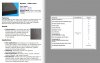
i confess, of the varieties i auditioned, none had all the exact attributes preferred, so i ended up compromising. in the end, i went with a 1/2" thick, reticulated polyurethane ester-type foam for speaker and filter applications, with 30 ppi (pores per inch). this ppi was bit of a trade-off. from a purely visual standpoint, i would have preferred a ppi of 45-65, but it was a little on the stiff side. the 30 ppi foam best met the physical criteria of density, elasticity, deflection, compression, permeability, etc. (and 30 ppi is what geddes swears is best suited to the purpose). it also has a rated life-span of 10+ years, an important consideration since we know our environmental ozone issues accelerate the demise of poly-based foams and plastics. i attached the spec's for the foam i used below. this foam was sourced from:
http://www.foambymail.com/SFF-/speaker-filter-foam-30-ppi.html
(no affiliation)
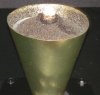
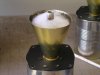
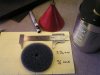
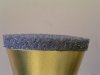
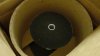
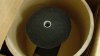
once in hand, fabrication of the foam caps for the tweeters was pretty straight-forward. i cut the disc with an exacto knife (using a conveniently-sized solvent can i had handy for a template), and punched the center hole with a gasket punch. through a process of trial and error, i determined the optimum diameter for the (30 ppi) foam disc was 3 7/16" for my gold coned walshes. this is slightly larger than the diameter of the top of the cone. a disc of this diameter with a square cut edge, will match the angle of the cone when installed in its "domed" position. this will give maximum edge contact, and will also provide the proper resistance to center, as well as damp, the cone. in this slightly-compressed installed state, no glue was necessary. a friction fit holds it securely in place. just as the outer diameter is slightly larger than the cone, the center hole is a slightly smaller diameter than the support tube. i found a 3/8" hole was optimum. i posted pics of the flat disc sitting on top of the cone, as well as it in it's installed (domed) state.
hope this typically long-winded esoteric discourse helps others traveling down this road.
.