

You are using an out of date browser. It may not display this or other websites correctly.
You should upgrade or use an alternative browser.
You should upgrade or use an alternative browser.
What are these Fried speakers?
- Thread starter dcsalling
- Start date

Register to hide this ad

 . Bud (Fried) made some great sounding speakers.


restorer-john
Addicted Member
What kind of potato did you use to take that pic? 
I agree the mids and treble units 'look' KEF-like.
I agree the mids and treble units 'look' KEF-like.
Last edited:
2ndtimelucky
Well-Known Member
I'm getting a Celestion vibe, particularly the Ditton series...
No, they are Fried - pronounced "Freed" as in Irving Bud Fried (IMF speakers) his own company, probably mid-late eighties - so little documentation on models on the net.. for such a
renowned guy and company, no body has a website documenting any model lineage or anything... unless I have missed it... these have 10" drivers, large cabinets, and massive foam
rot on the midrange which I can fix. No idea which line they are other than signature... Q? A? R?... I posted on a whim, and all I had was my phone in a darkish room.. thought it
was clearer than that, but when I looked at it full size, yes, it is awful.... Thanks for all the help so far...
renowned guy and company, no body has a website documenting any model lineage or anything... unless I have missed it... these have 10" drivers, large cabinets, and massive foam
rot on the midrange which I can fix. No idea which line they are other than signature... Q? A? R?... I posted on a whim, and all I had was my phone in a darkish room.. thought it
was clearer than that, but when I looked at it full size, yes, it is awful.... Thanks for all the help so far...

JimPA
Distinguished Member
It amazes me the number of people who make a post who do not read all the prior posts.
These are the Fried NAD 8200 speakers the 2 way model.
The model the OP has are the 3 way versions the NAD 8300.
The woofer uses Fried's line tunnel design.
The midrange probably use a tube enclosure.
I seriously doubt any of the drivers were made by Kef.
NAD tried to make the tweeter look like the Kef T27.
These are truly budget versions of the Fried R1 design.
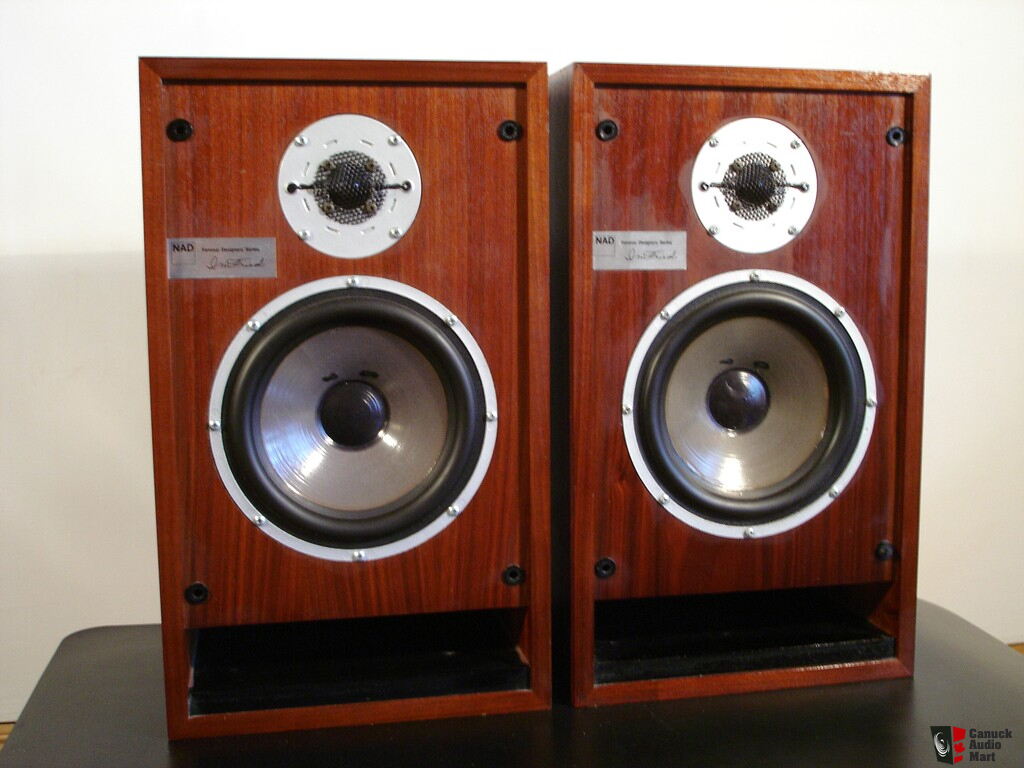
These are the Fried NAD 8200 speakers the 2 way model.
The model the OP has are the 3 way versions the NAD 8300.
The woofer uses Fried's line tunnel design.
The midrange probably use a tube enclosure.
I seriously doubt any of the drivers were made by Kef.
NAD tried to make the tweeter look like the Kef T27.
These are truly budget versions of the Fried R1 design.

Bud bought tweeters and drivers from all over the place .. once I get to repairing these I will investigate. These are not NAD, they are Fried signature series, but should be based on a regular model... Like an R3 or something. They made a sig beta a3 or similar... Interesting that they had a NAD three way, bet it was an eight inch woofer instead of a ten incher.


Not to get all obsessive or anything, but, to the degree that KEF tweeters have a look, that look is probably that of the T 27. I've never seen one that wasn't black, and didn't have the black plastic circle around the tweeter surround (I assume it is actually an extension of the dome/surround material, with lead wires running across, one of the blue. I've never seen one with a mesh cover, nor with with concentric ring segments, whereas many SEAS tweeters have both. I will admit I've never seen a bare metal SEAS.
Found another speaker that uses the same tweeter as the Fried signatures... the Acoustic Energy AE1 and AE2... this is the same tweeter.. still trying to figure out what brand though
it is a metal dome, hence the little screen.. AE used one too, it just set on top held on by the magnet, haven't tried to remove mine, I assumed they were screwed on.
I have a friend who used to sell Fried back in the late 70's / early 80's - he said that bud would come out with a new speaker, then 3 months later, he would have a different tweeter with a crossover mod, then six months later, he would have another update... this went on constantly, maddening and fun at the same time. He was always developing the models, which is good, but with 5 year warranty on speakers, keeping up with which drivers are in which models got to be a problem with servicing... and supply. This was a big reason why the company was not sustainable after Bud's death when someone else bought the company. is there not a Fried tribute website any where?
it is a metal dome, hence the little screen.. AE used one too, it just set on top held on by the magnet, haven't tried to remove mine, I assumed they were screwed on.
I have a friend who used to sell Fried back in the late 70's / early 80's - he said that bud would come out with a new speaker, then 3 months later, he would have a different tweeter with a crossover mod, then six months later, he would have another update... this went on constantly, maddening and fun at the same time. He was always developing the models, which is good, but with 5 year warranty on speakers, keeping up with which drivers are in which models got to be a problem with servicing... and supply. This was a big reason why the company was not sustainable after Bud's death when someone else bought the company. is there not a Fried tribute website any where?
Just a couple of late remarks on the speaker drive units:
The NAD 8200 looks absolutely identical to the Fried Signature Series Model A, with a Seas 21F-EWF woofer and a Seas H140 tweeter (customer-specified versions of the 21F-EW and H086, with silver finish instead of the standard black). The letter F added to the woofer name would be a reference to the customer, as per Seas' naming conventions; in this case Fried. Therefore, I'd bet rather confidently that the NAD speaker is a rebranding.
Although the image in the original post is a bit blurry, this large 3-way model seems to have the same H140 tweeter, possibly accompanied by versions of the Seas 25F-EW woofer and 13F-GMB midrange, the latter of which would have a foam surround. The drivers will usually have a sticker on the magnet, with model names and week/year of manufacture, and I would expect these to be from around 1978, give or take a year. The "tunnel loading" TL port, typical of Fried's speaker designs, is also visible at the bottom end of the front. Since the label reads "Fried Signature Series", it probably predates the NAD-branded speakers, if such a NAD model did exist (I haven't been able to find images of the 8300 anywhere, at least so far).
The H140 tweeter features Seas' characteristic punched-out circular pattern on the front plate, which constitute the actual centering mechanism for attaching the magnet system to the front plate/dome assembly (this was originally invented for the H086, and used on all 1" tweeters until the mid-80s). The domes are hand-coated textile, with a "catenary curve" profile (similar to the pointy end of an egg, if you like). The protective grid is held in place by 4 screws. These screws also hold the magnet system to the front plate, so never attempt to unscrew them while the tweeter is mounted in the enclosure!
Seas didn't start making their own metal dome tweeters until the late eighties. By this time, they had also mostly transitioned to molding their front plates/dome assemblies from fibreglass-reinforced plastic. Some OEM customers still needed the old units, though, so the old manufacturing tools were still kept busy. Seas did supply Acoustic Energy for a period too, and AE went with a slightly modified version of the older stamped-metal front plate design, presumably for better rigidity. I don't have a complete overview of AE speakers, nor their history, but some models - perhaps early ones - seem to be fitted with Elac tweeters instead. Those tweeters are recognized by a smooth front plate surface, with two small centering pins on the magnet protruding through it.
The Seas-made AE tweeters retained the classic centering mechanism (not particularly pretty, but it's there for a reason). A protective grid made from rather delicate mesh, not much larger than the dome itself, was added, just like on the Elac tweeters. This grid fit into a groove in the front plate, and was held in place by magnetism and a dab of glue. AE opted to leave the "phase plate" out, though. This was a 12 mm diameter transparent plastic disc, glued to the inside of the grid in front of the dome on standard models. While the characteristic metal dome peak above 20 kHz would be equalized by the phase plate, the technique possibly introduced other problems. Note that the assembly screws on the AE tweeters are located at a larger distance from the dome, compared to the older H140 tweeters. This is because Seas' magnet systems had to be redesigned for the introduction of molded plastic front plates/dome assemblies.
- H -
The NAD 8200 looks absolutely identical to the Fried Signature Series Model A, with a Seas 21F-EWF woofer and a Seas H140 tweeter (customer-specified versions of the 21F-EW and H086, with silver finish instead of the standard black). The letter F added to the woofer name would be a reference to the customer, as per Seas' naming conventions; in this case Fried. Therefore, I'd bet rather confidently that the NAD speaker is a rebranding.
Although the image in the original post is a bit blurry, this large 3-way model seems to have the same H140 tweeter, possibly accompanied by versions of the Seas 25F-EW woofer and 13F-GMB midrange, the latter of which would have a foam surround. The drivers will usually have a sticker on the magnet, with model names and week/year of manufacture, and I would expect these to be from around 1978, give or take a year. The "tunnel loading" TL port, typical of Fried's speaker designs, is also visible at the bottom end of the front. Since the label reads "Fried Signature Series", it probably predates the NAD-branded speakers, if such a NAD model did exist (I haven't been able to find images of the 8300 anywhere, at least so far).
The H140 tweeter features Seas' characteristic punched-out circular pattern on the front plate, which constitute the actual centering mechanism for attaching the magnet system to the front plate/dome assembly (this was originally invented for the H086, and used on all 1" tweeters until the mid-80s). The domes are hand-coated textile, with a "catenary curve" profile (similar to the pointy end of an egg, if you like). The protective grid is held in place by 4 screws. These screws also hold the magnet system to the front plate, so never attempt to unscrew them while the tweeter is mounted in the enclosure!
Seas didn't start making their own metal dome tweeters until the late eighties. By this time, they had also mostly transitioned to molding their front plates/dome assemblies from fibreglass-reinforced plastic. Some OEM customers still needed the old units, though, so the old manufacturing tools were still kept busy. Seas did supply Acoustic Energy for a period too, and AE went with a slightly modified version of the older stamped-metal front plate design, presumably for better rigidity. I don't have a complete overview of AE speakers, nor their history, but some models - perhaps early ones - seem to be fitted with Elac tweeters instead. Those tweeters are recognized by a smooth front plate surface, with two small centering pins on the magnet protruding through it.
The Seas-made AE tweeters retained the classic centering mechanism (not particularly pretty, but it's there for a reason). A protective grid made from rather delicate mesh, not much larger than the dome itself, was added, just like on the Elac tweeters. This grid fit into a groove in the front plate, and was held in place by magnetism and a dab of glue. AE opted to leave the "phase plate" out, though. This was a 12 mm diameter transparent plastic disc, glued to the inside of the grid in front of the dome on standard models. While the characteristic metal dome peak above 20 kHz would be equalized by the phase plate, the technique possibly introduced other problems. Note that the assembly screws on the AE tweeters are located at a larger distance from the dome, compared to the older H140 tweeters. This is because Seas' magnet systems had to be redesigned for the introduction of molded plastic front plates/dome assemblies.
- H -
Dannyboy311
Member
Wow, I have the ads made nad 20s, didn't know this happened...great another rabbit hole to go down...ughThose could be the NAD models that were designed by Fried.
I remember hearing the NAD designs and they were nothing like his satellite and subwoofer designs.
I found a photo of one of the Fried NAD designs.
74908


