• Please note that Audiokarma will be offline briefly for updates early on Monday morning, September 28th.

What are your "unexpectedly good" loudspeaker-amplifier combos?

Thanks.


Indeed. And my DM302s sound surprisingly good when driven by TPA3116.

I don't understand. I really don't understand. I thought low-impedance speakers like B&W DM302 need powerful, high current amplifiers to sound good. I have tried Yamaha RX-V663 AVR and Rotel RB-985 power amplifier to drive my DM302s, and both amps sound strained when played out loud (albeit the Rotel, being more powerful, is much less susceptible to strain than the Yamaha). And yet the DM302s are completely strain-free when driven by TPA3116. Okay, they are also strain-free when driven by Sansui AU-7900, but that's Sansui.

Why does TPA3116 drives B&W DM302 with such effortlessness? Perhaps chip amps are more powerful than I thought?

The 302's are fairly efficient at 91 dbs so the TPA3116 should have plenty of power for them.
 
Why does TPA3116 drives B&W DM302 with such effortlessness? Perhaps chip amps are more powerful than I thought?

There are several variables that could play in, but chip amps being more powerful than you thought is pretty unlike to be one of them. That's not to imply it doesn't work out for you because clearly it does; but some other reason is more likely the case.

Perhaps your expectation of how you can play the chip amp vs. the other amps you have is the big factor? Personally, I have a couple chip amps including a TPA3116. It sounds OK driving some low-ish impedance Thiel CS3.6, but it runs out of steam pretty quick if I try to push it louder like I can with most of my other amps.
 
Last edited:
Both the speakers and the amp are Marantz, no?

Yes, the 2325 drives the HD-880’s. Great combination!

Do you use current source or voltage source?

I tried both with the current source providing a more warm tube like sound and the voltage source a little brighter. I prefer the slightly brighter sound from the voltage source.
 
There are several variables that could play in, but chip amps being more powerful than you thought is pretty unlike to be one of them. That's not to imply it doesn't work out for you because clearly it does; but some other reason is more likely the case.

Perhaps your expectation of how you can play the chip amp vs. the other amps you have is the big factor? Personally, I have a couple chip amps including a TPA3116. It sounds OK driving some low-ish impedance Thiel CS3.6, but it runs out of steam pretty quick if I try to push it louder like I can with most of my other amps.

Expectations? His speakers are 91 dbs.
 
The context of my previous post should be clear to you, but I know you are sensitive of any comments about chip amps that you perceive as some sort of slight.

It's not rocket science that a TPA 3116 is quite comfortable driving 91 db speakers. My Volt+D with a 19v power supply does fairly well with 86 db speakers.
 
It's not rocket science that a TPA 3116 is quite comfortable driving 91 db speakers. My Volt+D with a 19v power supply does fairly well with 86 db speakers.

I don't presume to know or dictate the OP's volume requirements. But, that in itself, wasn't the point anyway.
 
1600820540648915936648747761708.jpg
Cleo and I were surprised that Reisong A10, 6 wpc set amp and ADS L880, 89db spl speakers play jazz well together, in 11'x12' room. I thought it would run out of gas.
 
Stromberg-Carlson ASR333 or ASR433, running JBL L77s. Holy cow, that just WORKS. Very good balance.

And, the most ridiculous combination I think I've ever heard of- and it was out of desperation (after a Hafler 500 amp blew up)- Harman-Kardon Award A300, running Apogee Scintillas. Not only did it have good balance, but decent dynamics. It actually sounded better than the Hafler, , even before the Hafler had issues.

15 watts per channel should NOT be able to drive a speaker that's only rated at about 80dB/1w... but somehow- it worked. Everybody was like "but- physics?!"... :crazy::idea::yikes:

Regards,
Gordon.
 
Not quite as "serious" as the rest of your systems -

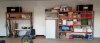
Never really cared for the sound of my Pioneer SX-737. When we bought a new home and moved into town, I needed a system for the garage. It wouldn't be used for "critical" listening, so the Pioneer got the job. Since I had them, and the garage is big enough, I drug the Electrovoice Dominators home, and put them up on some pallet rack shelving.

They actually sound fantastic. (just ask the neighbors) Waiting for a block party now.

garage system.jpg
 
The 302's are fairly efficient at 91 dbs so the TPA3116 should have plenty of power for them.
Expectations? His speakers are 91 dbs.
Indeed, but despite their high sensitivity, B&W DM302s are difficult load, with impedance dropping to 3 ohms in certain frequency ranges. Among the amps I own, and before I tried the TPA3116, only Sansui AU-7900 can drive the DM302s without strain nor distortion at all.

There are several variables that could play in, but chip amps being more powerful than you thought is pretty unlike to be one of them. That's not to imply it doesn't work out for you because clearly it does; but some other reason is more likely the case.

Perhaps your expectation of how you can play the chip amp vs. the other amps you have is the big factor? Personally, I have a couple chip amps including a TPA3116. It sounds OK driving some low-ish impedance Thiel CS3.6, but it runs out of steam pretty quick if I try to push it louder like I can with most of my other amps.
Indeed. I knew the TPA3116 is 100 wpc-rated, but my Yamaha RX-V663 AVR is also 100 wpc-rated, and the Yammie sometimes distorts when driving the B&Ws loudly, while the TPA doesn't. I wonder why.

Oh, and my 25 wpc Sansui A40 distorts all the time when driving the B&W DM302s, despite their high sensitivity (91 dBs).

While we are at it, is TPA3116 really supposed to sound like that?

The TPA3116 I own sounds really bright, with crisp, extended highs, subdued vocals yet more detailed mids, and no bass at all. When driving the brutally honest JBL L20Ts (titanium dome tweeter :eek: ), it becomes listening hell. However, such brightness work really well with the chocolatey-sounding B&W DM302s.
  1. The B&W's rolled highs become extended, cymbals become lucid. It's almost like listening to JBL titanium dome tweeter! :banana:
  2. The chocolatey, artificially organic-sounding mids are reduced to more natural level. The sweetness is still there, but not to sweet. The entire sound becomes more open, more airy, and less boxy.
  3. The rather obnoxious LF bump is reduced to more acceptable level.

It is almost like listening to JBL L20Ts driven by Sansui AU-7900, although with sweeter (but not overly sweet) midrange and deeper soundstage. Although the TPA3116 sounds noticeably grainier than the Sui.

I'm interested to DIY my own TPA3116 (have a good friend who would do that for me). It seems a properly-built DIY TPA3116 would sound less grainy, and much cleaner, than aforementioned TPA3116 on this thread (after all, it's a cheap twenty bucks amp made in China). However, will it have the similar brightness I desire?

 
Rotel Integrated Amplifier 960BX (60W/Channel, early 1990s) with Kef LS50's. I've typically use the LS50's with modern McIntosh solid state gear (so that's my baseline for the sound) and the Rotel sounds good!
 
Indeed, but despite their high sensitivity, B&W DM302s are difficult load, with impedance dropping to 3 ohms in certain frequency ranges. Among the amps I own, and before I tried the TPA3116, only Sansui AU-7900 can drive the DM302s without strain nor distortion at all.


Indeed. I knew the TPA3116 is 100 wpc-rated, but my Yamaha RX-V663 AVR is also 100 wpc-rated, and the Yammie sometimes distorts when driving the B&Ws loudly, while the TPA doesn't. I wonder why.

Oh, and my 25 wpc Sansui A40 distorts all the time when driving the B&W DM302s, despite their high sensitivity (91 dBs).

While we are at it, is TPA3116 really supposed to sound like that?

The TPA3116 I own sounds really bright, with crisp, extended highs, subdued vocals yet more detailed mids, and no bass at all. When driving the brutally honest JBL L20Ts (titanium dome tweeter :eek: ), it becomes listening hell. However, such brightness work really well with the chocolatey-sounding B&W DM302s.
  1. The B&W's rolled highs become extended, cymbals become lucid. It's almost like listening to JBL titanium dome tweeter! :banana:
  2. The chocolatey, artificially organic-sounding mids are reduced to more natural level. The sweetness is still there, but not to sweet. The entire sound becomes more open, more airy, and less boxy.
  3. The rather obnoxious LF bump is reduced to more acceptable level.

It is almost like listening to JBL L20Ts driven by Sansui AU-7900, although with sweeter (but not overly sweet) midrange and deeper soundstage. Although the TPA3116 sounds noticeably grainier than the Sui.

I'm interested to DIY my own TPA3116 (have a good friend who would do that for me). It seems a properly-built DIY TPA3116 would sound less grainy, and much cleaner, than aforementioned TPA3116 on this thread (after all, it's a cheap twenty bucks amp made in China). However, will it have the similar brightness I desire?

I have a mono TPA that handles 2 ohm loads. Before modding a generic TPA3116 you might consider a Volt+D TPA3118 which comes tricked out with dual mono's, all film caps, capacitance multipliers, high quality stepped pot, etc. The Volt+D recently received a very good review at Audio Science Review.
 
Superscope A-245 integrated amp at 10 whole watts driving a pair of big (but efficient) Cerwin Vega's. Sounds quite lovely at lower volumes.
 
...

Indeed. I knew the TPA3116 is 100 wpc-rated, but my Yamaha RX-V663 AVR is also 100 wpc-rated, and the Yammie sometimes distorts when driving the B&Ws loudly, while the TPA doesn't. I wonder why.
...

Hard to say why. There is a lot going with AVRs. The "sometimes" aspect is interesting too.

FWIW, the RX-V663, playing two channels @ 4 ohms measured 245.9 wpc at 1% distortion per a test review. The TP3116 output, using a 24V supply (which is toward the upper limit) gives around 60 wpc @ 4 ohms, 1% THD.

To me, anyway, that suggest power in itself isn't the likely reason and it might remain a mystery. That said, some AVRs have an impedance selector setting. Using the low impedance setting imposes more current and or voltage limiting of the amp. If you have it set to the lower impedance setting you might try the result set to the high impedance mode.
 
Last edited:
I have a mono TPA that handles 2 ohm loads. Before modding a generic TPA3116 you might consider a Volt+D TPA3118 which comes tricked out with dual mono's, all film caps, capacitance multipliers, high quality stepped pot, etc. The Volt+D recently received a very good review at Audio Science Review.
You mean like this? Very interesting, although I'm actually looking to build 3 channel amp.

Hard to say why. There is a lot going with AVRs. The "sometimes" aspect is interesting too.

FWIW, the RX-V663, playing two channels @ 4 ohms measured 245.9 wpc at 1% distortion per a test review. The TP3116 output, using a 24V supply (which is toward the upper limit) gives around 60 wpc @ 4 ohms, 1% THD.

To me, anyway, that suggest power in itself isn't the likely reason and it might remain a mystery. That said, some AVRs have an impedance selector setting. Using the low impedance setting imposes more current and or voltage limiting of the amp. If you have it set to the lower impedance setting you might try the result set to the high impedance mode.
I see. Well, the RX-V663-DM302s combo usually strains and distorts when I played it loud. When the RX-V663 drives easier load speakers, like JBL 120Ti, it never distorts no matter how loud I raise the volume. With the more powerful Rotel RB-985,

In any case, is TPA3116 (or 3118, for that matter) really supposed to sound like I describe? Bright, with detailed mids (but subdued vocals) and extended highs, and no bass at all? Such brightness is ear-hurting when the TPA drives JBL L20Ts, but works really well with the midrangey, chocolatey B&W DM302.

NHT SuperZero also sounds rather midrangey; I'm very interested to test the TPA3116 with the SuperZero, perhaps the combo will also sound great. The lack of bass shouldn't matter much, because the SuperZero already has no bass to begin with!

In any case, perhaps this is the reason why TPA is very popular among full range, single-driver enthusiast? Because single-driver speakers sound midrangey by nature, and the TPA's brightness work well to extend the highs?
 
Back
Top Bottom