• The move to the new server is done. There are some software and database maintenance updates in process. This has us passing the hat around to help out. We appreciate any donations. Seriously, even a dollar helps. The payment page may be found here - https://www.audiokarma.org/support.html

What test equipment should I use? What are you using?

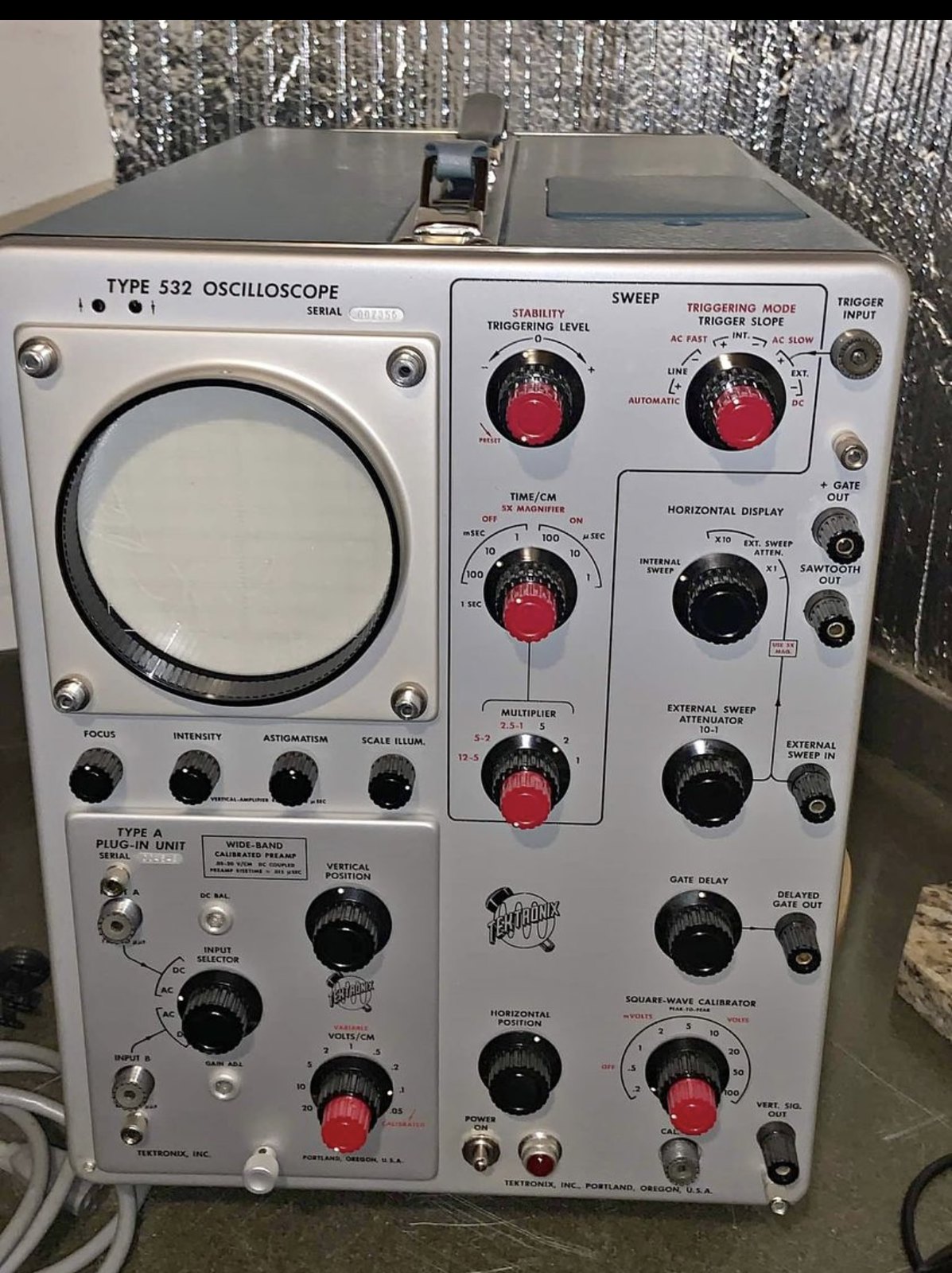
There is a NOS Type 535 I have been eying up. But shipping it would scare me.

Here are some pics of it

53951483617_45b3272c53_h.jpg


53952632268_0635005639_b.jpg

53952832510_48b42622d1_b.jpg

53951483612_d2b7a37166_b.jpg


But room is an issue for me. I have been looking where I could add more work space for this.

Unless one of you Vultures with more time to travel and money than I have scoop it up !!! :mad:;):rflmao:

Athanasios
 
It is a beauty indeed.
Worth a road trip, if that were a possibility.
Like a classic car, with all the correct numbers.

Looking at the date on the probe manual, I see May 1970 !
 
There is a NOS Type 535 I have been eying up. But shipping it would scare me.

Here are some pics of it

53951483617_45b3272c53_h.jpg


53952632268_0635005639_b.jpg

53952832510_48b42622d1_b.jpg

53951483612_d2b7a37166_b.jpg


But room is an issue for me. I have been looking where I could add more work space for this.

Unless one of you Vultures with more time to travel and money than I have scoop it up !!! :mad:;):rflmao:

Athanasios
Shipping? It’s in Syracuse… not far lol.

I talked to the guy about it a few weeks ago. The 532 is one of only 4 devices that uses the same crt as the 570 and 575 curve tracers I have. I would love a spare. I’d want to pay him less than half of his asking though.

It’s not a very good scope otherwise, only 5 MHz
 
I know that for most of us on these forums it (generally) goes without saying, but I'd rather say it anyways:

Be very careful when using this unit, and take that care to the extreme if you open it up to take a look or to work on it. The available voltages and currents are scary.
Think of it as an electric chair without a seat....

Geez, and I thought I was the only guy on here with one of these:(
Still alive so far :-)
I have another standing electric chair, Kepco 2000v / 100mA

Anyways the Fluke mostly works, but the HV and Bias voltages don’t meet spec. Going to start by swapping the electrolytic cans, bumblebee caps and ne-2e neons (all the tubes tested strong)
 
IMG_6834.jpeg
Bought another HP 467a power amplifier / supply, waiting for it to come in, guess I’ll use them as mono blocks for my bench amp
Played around with the current one, decent frequency reponse, here’s a pic to 100KHz

For some reason my current 467a has some distortion below 1khz, probably needs some new caps. Will be interesting to see if the new one behaves the same

IMG_6835.jpeg
 
When I started teaching myself electronic servicing, and being financially strapped, in 1974~75, my very first Heathkit purchase ever was that IG-72 tube based audio frequency oscillator, and it served me very reliably well until 1986/7 when I replaced it with a super low distortion SS purchased new Tektronix plug in type to go with my also newly purchased Tektronix`s super low distortion THD+N/IMD analyzer. I ended up giving the IG-72 to a friend who was starting servicing guitar amps and didn`t have a decent multi frequency, and adjustable output, audio oscillator at that time.
 
In hindsight I probably should have just got the Patco strippers, but in that case I would need two different units, one for PVC and one for PTFE, since there's such a huge temp difference.

I use an ancient EPE Technology Model-875 and a much newer American Beauty 10503 at the shop.
Both have variable temperature controls, which are basically just glorified light dimmers, that allow me to set the temperature to what is adequate to melt the insulation without creating a great deal of fume. Very narrow window between melting and burning, so ya gotta experiment. I marked the dials with a Sharpie so I won't forget the settings. Both of these units are able to strip either PVC or Teflon without difficulty.

A few years ago I wanted to lighten up my go-bags, so I decided to invest in a Patco PTS-30 (much of my work is with Teflon insulated wire, and mechanical stripping is prohibited) rather than continue carting around a full-sized stripping station. Wow! Amazing performance, and virtually no fume at all. And it's tiny :)

I did find a work-around for the Patco PVC vs Teflon issue: I used a small, really cheap motor speed controller board to drop the power to the unit for stripping PVC.
After experimenting on the bench to find the perfect temperature for PVC, I deleted the pot and replaced it with a couple of fixed resistors and a small switch. Full power for Teflon, greatly reduced for PVC. Works a treat, and cost small beans.


EDIT: If you can find a work-around for the connector (it's huge just to handle the large amount of current needed for the different handpieces) you can use just about any handpiece that you can find for cheap; Eraser, American Beauty, EPE, Teledyne. Most of them even use the same stripping elements too.

 
Last edited:
What variety of thermal wire stripper is suggested for heating appliance wire? How about for 35kV XLP cable with insulation drains and shields? Optical glass fiber?

Just asking.
 
Played around with the HP 467A amplifiers. For some reason they both exhibit bad distortion with tones under 1 KHz at more than like 3 watts...can't figure it out. They should make 5. One is worse than the other. And I don't really understand the schematic. It has two amplifiers in it, one for high frequency (Above 50khz and to 10MHz I believe) and one for low. They pass the performance validation section of the manual and I ran thru the calibration procedure...
hmm!
 
Played around with the HP 467A amplifiers. For some reason they both exhibit bad distortion with tones under 1 KHz at more than like 3 watts...can't figure it out. They should make 5. One is worse than the other. And I don't really understand the schematic. It has two amplifiers in it, one for high frequency (Above 50khz and to 10MHz I believe) and one for low. They pass the performance validation section of the manual and I ran thru the calibration procedure...
hmm!
The unit`s very old original PS capacitors dried up, and or electrically leaking internally, pulling down the amplifier`s operating voltage rails ?
That situation can not only effect the low output, but also tend to increase distortion, especially on the lower frequencies, IMO/E.
 
The unit`s very old original PS capacitors dried up, and or electrically leaking internally, pulling down the amplifier`s operating voltage rails ?
That situation can not only effect the low output, but also tend to increase distortion, especially on the lower frequencies, IMO/E.
I recapped one of the units, well, all electrolytic caps but the two main filters, 1000uf / 80v. They tested great (1000uf and 38mOhms of ESR), although I didn't leakage test them. Anyways I ordered new ones and they will be here tomorrow. I did try adding some 2200uf caps I had on hand with the originals and it did not change anything.
I'll post a pic of the distortion, it's not a flat top / bottom like you'd normally expect from the rail issue.

The bottom trace is the residual distortion. (ignore the vertical V/div, the analyzer auto scales the outputs)
1725555529162.jpeg
 
Lol, well this is wild. I did a web search for "HP 467A distortion" and apparently the Bing AI decided that they have distortion issues soley based off of my post here (the other references it cites are just the manuals, which don't talk about any distortion issues).
1725556278899.png
 
I figured it out. These things don't seem to like 8 ohm loads. The frequency response in the manual is rated into a 40 ohm load. But they don't say what load they are designed for. Output impedance is stupid low so I thought it may have been OK. I tested them on the analyzer with a 50 ohm load and they worked great, no distortion. Anyways, they seem to work OK with 16, so I added a 10 ohm resistor in series with the speaker connections and they are now listenable.
I'll probably buy a 33ohm non-inductive 10w+ resistor for each one. Then again the speakers won’t be getting much power, so meh… was a fun thought.
 
Last edited:
I figured it out. These things don't seem to like 8 ohm loads. The frequency response in the manual is rated into a 40 ohm load. But they don't say what load they are designed for. Output impedance is stupid low so I thought it may have been OK. I tested them on the analyzer with a 50 ohm load and they worked great, no distortion. Anyways, they seem to work OK with 16, so I added a 10 ohm resistor in series with the speaker connections and they are now listenable.
I'll probably buy a 33ohm non-inductive 10w+ resistor for each one. Then again the speakers won’t be getting much power, so meh… was a fun thought.
I had no idea you were low impedance (audio dummy load values) loading that (lab bench test instrument) amplifier`s output, or I would have suggested that it wasn`t designed for that kind of low impedance load !!
Glad you figured out the problem.
Carry on.
 
Yeah, well I’ve seen old application notes from HP and other sources talking about using this amp in conjunction with a signal generator to drive speakers(they called out University Sound ID-30 which is 16 ohms) and transducers (such as the Navy), but I suppose they could be using higher impedance loads. The user manual doesn’t seem to specify that it’s designed only for 50 ohm loads, etc.
I think I might actually be running up against the current limit at 8 ohms, I was doing some more reading. It's specified as 0.8A in the manual, but they actually have you set it to 0.65 with a full short applied to the output terminals in the calibration.

Overall, this whole exercise is pointless but I sure do learn a lot from playing around with this old test equipment.
 
Last edited:
Back
Top Bottom