• The move to the new server is done. There are some software and database maintenance updates in process. This has us passing the hat around to help out. We appreciate any donations. Seriously, even a dollar helps. The payment page may be found here - https://www.audiokarma.org/support.html

When is it justifiable to go for high end crossover components?

z-adamson

Addicted Member
Historically, I have always used Dayton, audyn q4, crosscap, solen. I’ve never opted for high end.

Although I have used Mills resistors and some 14awg to 20awg air core inductors.

For my next crossover build (ewave, JBL 2213h woofer) I am tempted to go for the likes of Duelund caps, 12awg foil air core inductors, mills resistors etc.

But there is a part of me that wonders if it is a waste.

The biggest expense would be the 1.5mh foil inductors at $100 each. There is one of those per crossover. A comparable iron core comes in at about $23.

Duelund caps will run me $50-$75 each compared to less that $10 for Dayton.

I have never gone with exotic parts before and I am tempted just to see what it’s all about.

Has anyone gone with exotics and regretted it? Is a JBL 2213h based ewave worthy of it in your opinion?
 
Register to hide this ad
Like some others on board AK, what often dictates the level of gear depends upon the rest of the components in the audio system, keeping them relative to one and another. As the old saying of "the strength of a chain being as good at the weakest link".

My second concern would be the ability of the speaker itself that would warrant the degree of change.

Keep in mind that over the decades, not only does equipment change, but that the listener's ability to appreciate the end result is affected to a degree as well.


Q
 
I was thinking the shunt caps that are in parallel with the woofer voice coil could be Solen or the like. No benefit to going exotic there. But the inductor is pretty important. Since it’s series and the DCR spec is pretty important. And being air core is pretty nice to avoid distortion. The only inductors that have the right DCR and are air core are the foil inductors at 12awg. As far as I can find anyways….
 
Just built me some z19 crossovers. Probably $300 all in for the pair. Used daytons as i have in the past. If I had gone boutique, I'm sure that cost would triple at least. Bought good wire, new connectors. Nice new 12ga ofc cables. And in the end, the signal still ends up passing thru a single 18ga wire at some point... I think once you're using even dayton caps you've reached the point of diminishing returns.

Only testing it out would tell for sure, but I'm pretty comfortable with the assumption that tripling my cost wouldn't result in an equitable improvement in sound.
 
Any logic to the theory that it is the components that are in series that count the most?

Like the caps and resistors in series with the high frequency driver VC and the inductor in series with the low frequency driver VC?

Kinda makes sense that if there is anywhere to splurge it would be there.
 
Just built me some z19 crossovers. Probably $300 all in for the pair. Used daytons as i have in the past. If I had gone boutique, I'm sure that cost would triple at least. Bought good wire, new connectors. Nice new 12ga ofc cables. And in the end, the signal still ends up passing thru a single 18ga wire at some point... I think once you're using even dayton caps you've reached the point of diminishing returns.

Only testing it out would tell for sure, but I'm pretty comfortable with the assumption that tripling my cost wouldn't result in an equitable improvement in sound.
I have used Dayton myself and I can’t think of anything offensive that they do, but it’s hard to say how much better the outcome would have been had I gone exotic.

But, “humble homemade hifi” has the Dayton (Bennic) on there and rates them pretty low. They are to be avoided if possible he says, so who knows. There must be something that the exotics bring to the table.

Mystique?

Status?

Could be many things, many of which have nothing to do with measurable performance.
 
Historically, I have always used Dayton, audyn q4, crosscap, solen. I’ve never opted for high end.

Although I have used Mills resistors and some 14awg to 20awg air core inductors.

For my next crossover build (ewave, JBL 2213h woofer) I am tempted to go for the likes of Duelund caps, 12awg foil air core inductors, mills resistors etc.

But there is a part of me that wonders if it is a waste.

The biggest expense would be the 1.5mh foil inductors at $100 each. There is one of those per crossover. A comparable iron core comes in at about $23.

Duelund caps will run me $50-$75 each compared to less that $10 for Dayton.

I have never gone with exotic parts before and I am tempted just to see what it’s all about.

Has anyone gone with exotics and regretted it? Is a JBL 2213h based ewave worthy of it in your opinion?
The minute "Money" is a part of the question, it becomes strictly a matter of one's bank account and values. What could be easier than me saying, "Oh yeah--go for the best ones!" A hundred here, a hundred there, pretty soon you are talking about real dough!

The old 1970s expression seems to work here: If you got it, flaunt it.

More logically, if you have been in the hobby a while you will have become aware of "diminishing returns". $100 for a piece of wire? How about $500 for a piece of wire? Or $5,000? Some guys or gals wouldn't even sneeze at it, others would run themselves into the poorhouse over it.

It's your dough - have fun!
 
It really depends on how far you want to go....they are step up, but the gains from the premium parts are typically small refinements vs a linear improvement per dollar spent. They're worth it in a really good speaker that will be part of a nicely optimized system, but the benefits are easily masked by other weak links in a system.

In 1989 I designed and built my speakers with large gauge heptalitz inductors, non-inductive resistors, copper connections, PTFE OFC Kimber Kable, and Gen 1 Convergent caps, along with a sandwiched cabinet panels that are as resonant free as I could make them. Looking back it's been worth it, because I still love the speakers, and they've revealed every little change I've made over the years. Cry once, smile for a lifetime!
 
None whatsoever. Total nonsense.
Ok, I’m listening.

Some would argue that in a 12db per octave filter for a woofer, where you have the inductor in series with the VC and the cap in parallel, it is the inductor that is in the signal path and the cap that is not directly in the signal path. Thus, the quality of the inductor is more critical. The same could be said of a zobel circuit where the resistor and cap and in parallel.

What explanation would you offer to someone that poses this argument?
Electrical components in parallel in the crossover, are part of the signal path.

They still "see" the AC audio information. And therefore can affect that signal.
 
Last edited:
It really depends on how far you want to go....they are step up, but the gains from the premium parts are typically small refinements vs a linear improvement per dollar spent. They're worth it in a really good speaker that will be part of a nicely optimized system, but the benefits are easily masked by other weak links in a system.

In 1989 I designed and built my speakers with large gauge heptalitz inductors, non-inductive resistors, copper connections, PTFE OFC Kimber Kable, and Gen 1 Convergent caps, along with a sandwiched cabinet panels that are as resonant free as I could make them. Looking back it's been worth it, because I still love the speakers, and they've revealed every little change I've made over the years. Cry once, smile for a lifetime!
Do you happen to have any threads on this build? I would enjoy reading about it.

Thanks for sharing, and yeah, I would say cry once, and smile for a lifetime, indeed. Every little thing adds up, that's my experience.
 
Duelands are very expensive caps as far as caps go. Just thinking out loud, but if you had refined your system to the point you are chasing the last 1%, 10% (pick a %) of audio fidelity, maybe expensive crossover caps might be worth it. But, unless you've optimized speaker placement, room treatments and all other furniture/gear locations in the room, probably not worth putting high dollar caps in speaker crossovers.
 
Do you happen to have any threads on this build? I would enjoy reading about it.

Thanks for sharing, and yeah, I would say cry once, and smile for a lifetime, indeed. Every little thing adds up, that's my experience.

Some details about the Sterling Acoustics Acumen II have been mentioned here or there, or in my profile, but I don't think I've posted a full thread since they're so old. They feature a Focal 8K Kevlar/poly woofer in a transmission line that exits to an aperiodic vent, Focal 5K midbass with an aperiodic chamber that dumps into the transmission line, modified Seas H400 tweeter. There's a proprietary 2nd order crossover with zobel networks that has it's own chamber. They're wired with Kimber Kable teflon coated OFC copper, copper connectors, have Litz wire inductors, Convergent Gen 1 caps, and non-inductive resistors. The front baffles are treated with felt/wool to reduce diffraction, and the rear baffle is padded with much more of the same material to help absorb wall reflections (in place of room treatment) . As mentioned, the side panels are an MDF sandwich with silicone rubber between them. Each driver has its own solid copper input, and they're now run in a hybrid solid state/tube bi-amp configuration. They were preceded by the ST-10, ST-20, ST-40, ST-2000, and Acumen 1, most of which only used "good" to "very good" grade components, but the last two did feature the litz inductors...I just didn't take everything else to that level. Happy to answer any questions you might have.

A agree 100% that every little thing adds up.

000_3644.b.jpgRt.JPGIMG_20210424_134607.jpginvisible room treatment.jpeg
 
Last edited:
Tried Jantzen superior, Clarity cap MR, Mundorf classic resistors and mills mra, and Jantzen air core inductors on treble and bass all worthwhile imho. If you're going to listen to them for part of your life, and cheap compared to equivalent, commercial speakers.

I recently posted a thread myself trying to fathom the benefits of foil inductors the verdict I think was go air core wire, foil not so much. It is very difficult to measure inductance and DCR properly maybe think twice before ordering foils if they're that expensive.
 
Ok, I’m listening.

Some would argue that in a 12db per octave filter for a woofer, where you have the inductor in series with the VC and the cap in parallel, it is the inductor that is in the signal path and the cap that is not directly in the signal path. Thus, the quality of the inductor is more critical. The same could be said of a zobel circuit where the resistor and cap and in parallel.

What explanation would you offer to someone that poses this argument?
Personal experience.

All caps have a sound regardless of their placement. I typically use Audyn Q4s, but have found them to sound bright/glary and will team them with a different make to tame them. ClarityCaps (630 volt) have a darker sound and team well at modest cost, but they are huge.

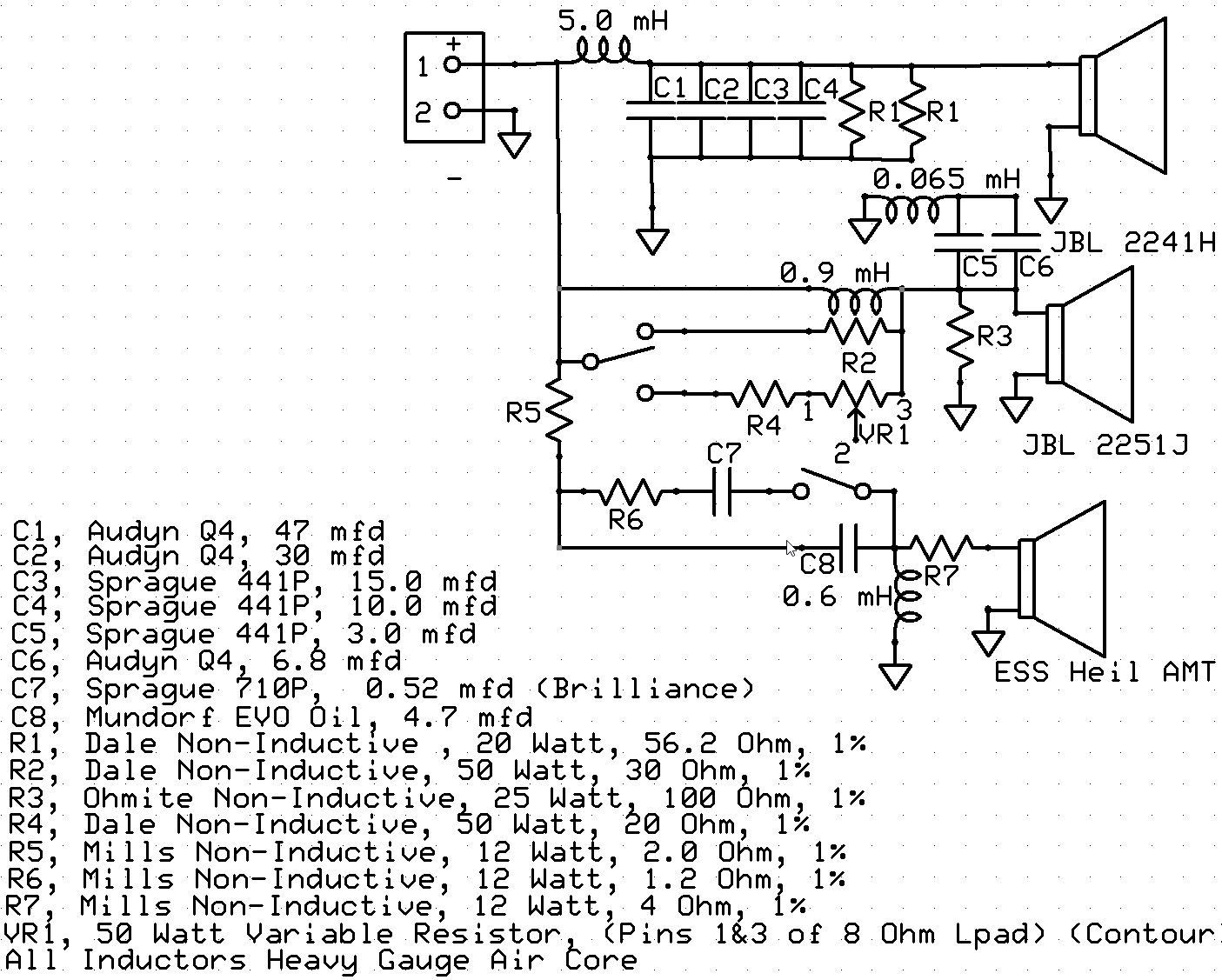
On my JBL 2241H 18" I needed a value of about 100 mfd in the conjugate position. This speaker crosses over at ~230 Hz in a 2.5 way system with a JBL 2251J and modified Heil AMT. I had been using the Audyns to get to the desired value but had a pair of vintage Sprague 10 mfd and decided to try those. The sound completely changed and I liked it! Female vocals were greatly enhanced. In fact, so much so that I found another pair of the same Spragues in 15 mfd and replaced more of the Audyn's composite value.

I like the Spragues so much that I team them with Audyns in the conjugate for the 2251 and found a 0.52 mfd (these things are HUGE) that I use in conjunction with a Mundorf Evo Oil (4.7 MFD) on the Heil, similar to a by-pass cap that is switchable (Brilliance).

Of course my crossovers are unlike anything else out there and were designed in the room for the room. This shows the prior version, but the current iteration omits the Lpad replacing it with three resistor values (26.8, 36.8, and 56.8 ohms) for "Flat", "Music" and "Vocals." The problem with using Lpads is that you will never get the values exactly the same nor are they made to the same specifications as a quality resistor (i.e., 1% tolerance) and I think this impacts imaging. Something else about Lpads that no one has ever told you..., the internal coil has some inductance and you can check this on an inductance meter. Not much, but it is there.

I also removed the hodge-podge of wiring and replaced it with oxygen free Monster cable that I had on hand. I've never heard speakers that can image like these, and I've been to the shows. Additionally, a "tube" simulation circuit has been added to the latest version, again using Sprague caps.

Last version:
80-crossover_cc6778daf4e451ff4809a658cfaff97e32b94607.jpg
 
Last edited:
Back
Top Bottom