• The move to the new server is done. There are some software and database maintenance updates in process. This has us passing the hat around to help out. We appreciate any donations. Seriously, even a dollar helps. The payment page may be found here - https://www.audiokarma.org/support.html

Why do Speakers Sound Brighter As Volume Gets Louder?

Your right It’s likely it could be that also , many people skip the acoustic treatments on their room then wonder why their system doesn’t sound good.


Audiofreak71

lively speakers in a lively rm with a digital source :dunno:

I don't know his room, setup, equipment just throwing ideas out there
 
lively speakers in a lively rm with a digital source :dunno:

I don't know his room, setup, equipment just throwing ideas out there
Oh no doubt same here. I have no idea what his room has or doesn’t as far as treatment. I was just stating that many overlook or skip the room treatment aspect then chase what’s wrong with their system without addressing the room treatments, I was one of those people before I was shown the light.


Audiofreak71
 
Quite a few reasons. Our ears are most sensitive in the midrange so the high s are by nature surpressed at lower volumes allowing us to concentrate on the mid frequencies to communicate at longer distances and to be warned before dangers come upon us. Levels have to approach 95 db before ears are linear from the lowest to the highest frequencies. Another issues the louder you play your speakers the more compression is revealed which normally causes the woofers to be compromised first. Klipsch speakers sypically compress sound around 5 db in the bass first as they approach their power ratings. JBL any where from 3 to 5 db also. So if you have small woofers they may react faster and handle more power but they are more subject to compression. THere is the issue of power, too. Like other have said when amps start becoming non-linear they emphasize frequencies from the midrange on up first. Odd harmonic distortion for some reason bothers the ear the most. Thats why I have 10 db more power reserve as do my speakers than I will ever use. Both will put out about 116 to 117 db with out compression which means at my seating positions about 108 db with The HT system and because the others are line arrays about 111db with the Stereo system with less than 1% distortion. Still 104 db peaks about all I want above 800 hz or so. Below that I can tolerate all my amps will put out with the power Guard preventing distortion.

If your speakers aren't voiced properly in your environment there can be 10 to 15 db peaks that at low levels won't bother your ears but as you crank up the volume the ear will focus on the peaks and there fore will cause you to become very dissatisfied with the sound. Hard surfaces causing annoying reflections off floor ceiling and side walls can also aggravate your hearing because the ear/brain can't weed out the annoying reflections it doesn't normally hear in real life causing irritation and confusion, too. Most of what I mentioned is assuming you have speakers that can play loudly with out cone break up and other non linearities, and that is seldom the case. The loud speaker room combination most of the time is the weak link. And just spending big monies on loudspeakers and electronics isn't going to make you happy if your environment isn't acoustically friendly either.

Then there is the choices you make bout the speakers you are listening to as whether you are listening mostly in the reverberant field or in the near field. Both have positives and negatives you have to choose between that will keep you happy. For casual listening the ambient feld is fine. For critical listening being closer to the direct field will be more accurate in presentation all thing being equal. But how you choose to betweeen preferring the more ambient sound can have a big influence as to what the sound will be portrayed as as your turn up the volume. Maybe you don't like paneled or line arrays though you get the lowest distortion and highest clarity. But either might sacrifice dynamics, where horn loaded systems are best for strong dynamics with lower power. But they have distortion issues. The least capable speakers as far as low DISTORTION are the point source speakers unless you have big monies and big power and then they perform very well using exotic materials that most folks can;t or are un willing to spend the monies for. So we have to listen at reduced levels.

Even speakers that are specifically designed for professional applications where high levels are the norm have to installed in such away and voiced properly to prevent irritating distortions. This customizing of the sound most hifi enthusiasts and audiophiles won't accept and why they find their hearing aggravated.
 
Last edited:
As I noted, if the speakers are "lacking" they can sound bright and distorted as the volume increases.

Lets say the tweeter can take 100 watts of "amplifier power" through the crossover. Obviously, it doesn't get 100 watts, but once the signal goes through the network, maybe the tweeter actually gets 5 watts and being rated at 20 watts of "handling power" can easily take it.

Now say the woofer can take 50 watts of "amplifier power" again losing some of this through the crossover.

So at less than the 50 watts, the woofer starts to compress because it is near the top of its power handing capacity..., and that's what they do. As you increase the power, the woofer does not get proportionally louder, it just compresses getting somewhat louder and goes into distortion.

But the tweeter that can actually handle 100 watts of "amplier power" is singing along and because it is not near its limits does not compress. So the woofer compresses and distorts while the sound gets brighter because the tweeter is totally happy.
 
Beyond a 'normal' listening level (maybe 75dB?) music start sto sound brighter and harsher with more volume.

Theories so far include:
  1. - The speakers need more power to balance frequency range at higher volumes
  2. - The human ear (or at least my ear) is more sensitive to high frequencies and perceives a lopsided high to low frequency balance even if it's technically still where it was at lower volumes
Any thoughts or ideas as to this?

For reference, I am listening to Triangle BR08's (8 ohms rated, but which can briefly dip to 2 Ohms with lower frequency sounds) powered by a Marantz 2235 receiver.

Thanks!

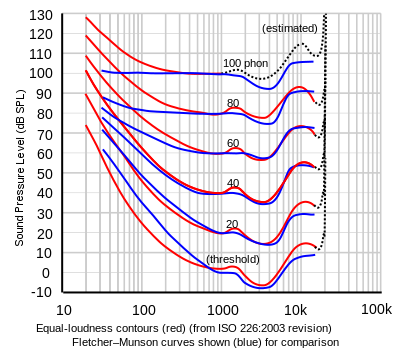
The Fletcher/Munson loudness curve we know and love in audio for many years. P.S. That Marantz is not rated for or wise to run any reactive load which dips to 2 ohms.
 
I think the answer is very simple. HF tend to "beam". As the power increases, this beaming effect becomes way more noticeable then the counterpart LF stuff. As with most things audio, the more power, the more distortion...or the more the distortion becomes obvious. This distortion could be in the recording, a little in the hardware, and of course, the speakers. If you were to listen to the speakers in your normal listing position, and the HF begins to bother you, move off axis from the speakers. You will notice that irritation at least is reduced. That is one reason some folks listen to their speakers with an aggressive toe-in.
 
FWIW, I suspect that as the system is cranked up, and is approaching it`s max output, assuming no other issues, that the THD is increasing with it`s higher frequency harmonics adding to the overall spectrum and making the sound brighter.

I confirmed this suspicion with my Class I IVIE IE 30A RTA back in the early eighties, by looking at the RTA`s display driving a few quality SS amplifiers with pink noise whose electrical response was flat, but the high frequency area above 1kHz of the display showed rise over flat as I increased the dynamic pink noise level drive bringing the amplifier closer to it`s max power rating.

I was curious why I would hear this effect on some sound systems as they were increased in SPL, both with properly run PA systems that had high quality components that were known to be in proper operating condition, and the same with some quality Hi-Fi systems.

After I was aware of this I could quickly tell whatever system was approaching it`s max clean power delivery capability, by the unnatural brightness in the sound that disappeared when the SPL was reduced a few DB, when there were no defects/issues elsewhere in the system.

Often an upgrade in the power output capability resolved this for the desired high SPL.


Carry on, just some unimportant technobabble noise from me !

Ciao
 
The one point that I haven't seen covered is crossover frequency shifting due to voice coil heating. When calculating crossover point frequencies the impedance of the driver at that frequency is critical in determining the start of each filter curve and the effective crossover point between 2 adjacent filters. The mid/high crossover frequency is the most pertinent here as that tends to be at around 2500Kz to 3500Hz in most systems. This is the upper treble area in most music and is also the frequency range where human hearing is most sensitive, as has been pointed out above.
The problem is as the power level to the loudspeaker drivers is increased the driver coils will start to heat up (as they are actually electric motors). The issue here is that as they heat up their impedance increases.
Why is this a problem? Unfortunately with passive crossovers as the driver impedance seen by a low pass filter increases the filter frequency starts to rise. Conversely, the opposite happens with a high pass filter.
This leaves us with a problem. As the power increases the upper midrange filter point moves upwards and the lower high range filter frequency moves down. This means that where the crossover region was flat it now starts to develop a hump right at the point where human hearing is most sensitive to screeching female voices and the top end of electric guitars. The effect of this on the overall sound balance is to generate a brash, sharp presentation.

The worst offenders in my experience seems to be small 2-way bookshelf size loudspeakers, but all passive systems will suffer from this effect to an extent.

If you try an on-line crosssover calculator and play about with the driver impedance you will actually see the resultant frequency values change as a result. It only takes a small deviation to create a noticeable effect.

My own system, being fully active with no loudspeaker crossovers installed doesn't suffer from this effect.
 
400px-Lindos4.svg.png

Fletcher-Munson has been superseded, basically because there were problems with the original experimental method, including high harmonic distortion levels in the speakers used. In the above curves anything that is lower than the c.3-4k level is "louder" anything higher is "less loud". This is because the human auditory system sensitivity peaks in this area. As you can see the "bright" frequency range which is 5k-up is effectively louder when you get to higher volume levels.
 
shut that off........turn that down.........(as you're reaching for the volume knob) :dunno:but I :dunno:

I guess that I`m very lucky in that respect, as the only other person that frequents my house is my 6 hr. a day, 5 day a wk. whose nearly my age female caregiver/housekeeper/comptroller and a very close friend, who thankfully and absolutely loves music of all types, less rap, so she`s exposed to at least 4 rooms in my house`s good sounding stereo systems playing all day long from my currently 12,367, & growing song WAV. ripped 6 genre music files played in the shuffle mode, and even had me turn up the workshop`s stereo loud enough for her to hear clearly in the adjacent to the workshop kitchen, where she spends a portion of the day taking care of various tasks, so we just leave that workshop door to the kitchen open. :thumbsup:, :bowdown:, :)

Never considered, nor wanted to install a hardwired, or otherwise signal fed stereo system in the kitchen. :no:
 
I guess that I`m very lucky in that respect, as the only other person that frequents my house is my 6 hr. a day, 5 day a wk. whose nearly my age female caregiver/housekeeper/comptroller and a very close friend, who thankfully and absolutely loves music of all types, less rap, so she`s exposed to at least 4 rooms in my house`s good sounding stereo systems playing all day long from my currently 12,367, & growing song WAV. ripped 6 genre music files played in the shuffle mode, and even had me turn up the workshop`s stereo loud enough for her to hear clearly in the adjacent to the workshop kitchen, where she spends a portion of the day taking care of various tasks, so we just leave that workshop door to the kitchen open. :thumbsup:, :bowdown:, :)

Never considered, nor wanted to install a hardwired, or otherwise signal fed stereo system in the kitchen. :no:

Renee is pretty understanding also, her brother's were in a band, the one surviving still is so she's been around music her whole life.

But unlike me she's smart enough to know when it's just too much, I kinda like it loud, most would say too loud.
Screenshot_20200414-224417.png
 
My wife and I were in the same history class in high school. She enjoyed music almost as much as I do, until she developed a mild case of tinnitus. Now, it depends. But I have a sound insulated room where I can crank it up as loud as I wish. However, if I ever hear any distortion, I will turn the volume down. Doesn't happen too often in my keeper systems anymore.

Personally, I think that Marantz is being pushed. Not a good thing for the Marantz or the Triangles. OP will see major improvement hooking up a decent power amp to the speakers. He could still use the preamp section of the Marantz too! Put the power amp under or behind something and no one will suspect.

Edit: I tend to like big woofers. I know there are exceptions, but in general, big woofers do better with high current amps. And I have seen a great deal of distortion and what causes it when experimenting with a test system on our dining room table. Been doing it for over 10 years now. And I tend to play around with different amp/speaker combinations until I have a system I think sounds the best. If I hear harsh highs, that is a warning sign that the tweeter is being pushed. If the bass seems uncontrolled or boomy, that is another sign. I have even heard harsh highs, boomy bass, and was able to correct it by just changing the preamp. Who would have thought...
 
Last edited:
it's your room, I have no such issues with any of the 5 systems set up here.

I was thinking this. I know that above a certain SPL. I get reflection & attendant audible distortion.
I've got some treatments, but just to knock down the most egregious primary reflections - could be better.
 
Reflections.

Time to think about taming some of the harder surfaces in the room. Norah Jones used to go nuclear shrill here until I added dampers at the ceiling's primary reflection points. Went with a hardcore audiophile grade solution. Memory foam carpets from a local big box, on clearance for $5 each. Hey, only the best here at Casa sKiZo ... <G>

ceiling-carpets-001.jpg
 
Back
Top Bottom