• The move to the new server is done. There are some software and database maintenance updates in process. This has us passing the hat around to help out. We appreciate any donations. Seriously, even a dollar helps. The payment page may be found here - https://www.audiokarma.org/support.html

Why doesnt *everyone* make 'high current' amps ?

estreeter

Super Member
http://www.youtube.com/watch?v=WjNfhsqu86s

Clearly, if HK and Marantz go for high current output in their amplifiers, there has to be a reason why many others don't. Can someone clue me in as to the downside of this approach please ? Apologies if its a dumb question, but it's been nagging me for a while.

Thanks,

estreeter
 
Register to hide this ad
:lurk:

I'll start:

1. First of all, it's expensive. High current requires lots of oomph in the power supply, and that means a hefty power transformer, and that means a hefty amount of iron, and that makes for a heavier amp. Which means more expensive shipping.

2. Second, it's a difficult benefit to quantify. Consumers don't buy "current", they buy "watts". That's why you find computer speakers for twenty dollars claming 100 watts. An engineer from Marantz told me many years ago, "Wattage is a threat; current is what backs up that threat."

3. Third, there are other methods to achieve the same result; Class D amplifiers are one of those.
 
First of all, it's expensive. High current requires lots of oomph in the power supply, and that means a hefty power transformer, and that means a hefty amount of iron, and that makes for a heavier amp. Which means more expensive shipping.
Yup. And then there's capacitors, heat sinks, and most importantly, output devices which can take such a wallop - which means either more expensive, or just more (although modern components do offer the best of both worlds).

Assuming that the biggest benefit of high current is the ability to drive low and/or varying impedance loads with ease, most Class D stuff shouldn't be mentioned here - from what I've seen the frequency response of most, if not all Class D amps decreases with load impedance.
 
Last edited:
Excellent feedback, guys - very much appreciated. :thmbsp:

HK - and various reviewers - make a point of how over-engineered their power supplies are, and I think that approach may have other pluses if this review of a Marantz amp is any guide :


Although Marantz rates the PM7001 KI’s power output at 70-watts per channel, you’d hardly guess that from the results returned by the test sample, where the lowest output measured was 85-watts per channel, and that was at 20kHz with both channels driven into 8Ω. At lower frequencies into exactly the same load, and still with both channels driven, the PM7001 KI delivered 96-watts continuous per channel. When only a single channel was driven, the Marantz broke through the 100-watt barrier at all frequencies, and for all loads, with a best result of 200-watts per channel into 2Ω. You need only to look at the tabulated figures, and/or the bar-graph results to see for yourself the performance of which the Marantz PM7001 KI is capable. I should bring to your attention that because this amplifier is capable of delivering more than 140-watts per channel, both channels driven, continuously into 2Ω loads, its current delivery is in the region of 8 amps! Important too, is something a set of test results cannot tell you, which is that the technician measuring the power output reported that unlike many amplifiers, which buzz, chatter and otherwise misbehave when pushed to their maximum output into low impedance loads, the Marantz PM7001 KI stayed quiet and remained cool at all times.

http://www.avhub.com.au/index.php/P...tz-pm7001-ki-integrated-amplifier/Page-3.html
 
If you choose competently design efficient (easy to drive) loudspeakers then you don't need high current amplifiers. Most SET amps are not high current and many including me find them to be the best sounding amplifiers on the market.

Take the classic Sugden A21a which is the longest selling integrated amplifier in the world - been selling since 1967. Cosmetic changes and better parts over the years. This is a 20 watt Pure Class A Single Ended Topology (SET) no feedback amplifier at 8ohms and drops to 11 watts at 4ohms and about 3 watts at 2 ohms. This amp gets trotted out by Hi-Fi Choice every so often in their blind level matched panel auditions where it beats modern Class A/B amplifiers from Bryston, Musical Fidelity, Roksan, Rega, Cyrus etc. In spite of the fact that the amp isn't high current and has the highest measured distortion it simply sounds better than your average SS amp (err the majority of SS amps - Err I can't think of a SS amp I'd rather own and certainly none for the same money - $3,500).

I started out in this hobby with stuff like Bryston/Arcam/Rote/Krell/Musical Fidelity etc. High Current? Great - looks good to tell your friends and you can look at the impressive graphs and spec sheets. No way I can go back.

Just get a speaker that is 90+dB sensitive and has a minimum impedance that doesn't drop below 3.5 ohms and a you'll play quite load with a 5 watt amplifier. My amp is 4 watts and I have a 93db sensitive speaker (doesn't drop below 5 ohms) and I can POUND the bass and get complaints at leave the room volume levels.

There is no advantage of buying Low efficiency loudspeakers - they don't do anything better except forcing you to buy more expensive amplifiers.

What is important is the amp have very good power supplies.
 
That is also correct, but "high current" really does matter in high-power, high-SPL applications where more compromised designs start showing their limitations - it takes less for a 20 watt amp to throw down a transient at 20 watt listening levels than it does for a 200 or 400 watt amp to do so at their respective levels.
 
Expensive to make and an overkill with most home applications.

If you don't need it, you don't want it.
 
I don't need Ongaku, but I want it. I don't need 30K worth of PMC speakers, but I want them. And that brings me to women and booze :D

Let's not get started on needs vs wants ;)
 
I don't need Ongaku, but I want it. I don't need 30K worth of PMC speakers, but I want them. And that brings me to women and booze :D

Let's not get started on needs vs wants ;)

I wants Threshold, Krell, Karan, Boulder, Classe.

An original Jean Hiraga would do if nothing else.
 
the technician measuring the power output reported that unlike many amplifiers, which buzz, chatter and otherwise misbehave when pushed to their maximum output into low impedance loads, the Marantz PM7001 KI stayed quiet and remained cool at all times.
The Lab Report is a dead link, unfortunately. But this tech must be futzing with some pretty lame gear, since rarely does a 1/2 way decent amp complain about high output. And I know how big the heatsink is on the 7001. His statement that the amp 'remained cool' means he ran it at high power for 10 seconds, or he's just making it up 'cause it'll please Marantz and get them more gear shipped to 'em. In any event, run most any amp to clipping with a 2 ohm load, and it's going to get bloody warm within 3 or 4 minutes, unless it's liquid cooled. The 7001 would likely go into thermal protect after 15 minutes of 'full-power, 2 ohm load'.

Eh, not slighting the amp...it's a fine piece. But the reviewers have more than a few mistakes in the article (1800µf 63V caps, eh?), and tech sounds like he needs some better gear on his bench...

Anyway, carry on...
 
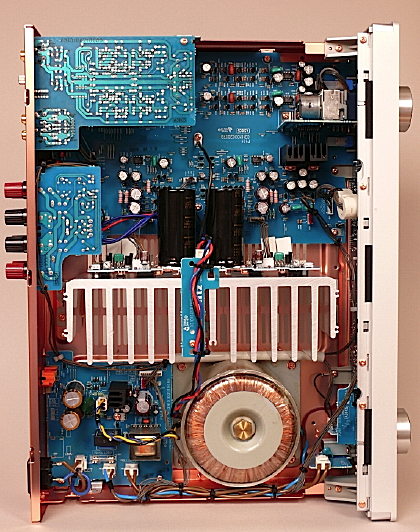
Where do you guys see the High Current in this one? :dunno: Looks plain integrated to me.

marampoffensch420.jpg
 
Where do you guys see the High Current in this one? :dunno: Looks plain integrated to me.
Actually looks like a damned nice design to me, for a 70WPC amp.

"High-current' is generally a marketing phrase, since there's no real definition (please don't trot out the 'doubled-power for 1/2 the load', since that's your definition, not mine or that of any official body).

Yep, some amps will drive damn near a direct short, but the closer you want to get to that, the more you will spend on current capability that you're probably never going to use or need. Still, I think most here might be surprised at how well their gear performs down to a bit under 3 ohms. No, I don't recommend putting it to the test, but don't underestimate the gear built in the glory days when mfgr's stuck real guts into these power supplies.
 
High Current as in anything that drives 2 ohm loads or less. Is it related to delivering more current? Why do we need more current?
 
Where do you guys see the High Current in this one? :dunno: Looks plain integrated to me.

marampoffensch420.jpg

What parts of an amp make it "high current"? I have little to no knowledge of electrical engineering. My Emotiva amps are called high current, what should I be looking for inside?

picture.php
 
Back
Top Bottom