• The move to the new server is done. There are some software and database maintenance updates in process. This has us passing the hat around to help out. We appreciate any donations. Seriously, even a dollar helps. The payment page may be found here - https://www.audiokarma.org/support.html

Why doesnt *everyone* make 'high current' amps ?

I wouldn't say bottom from looking at your signature. :thmbsp:

That's kind of you to say, but I do sometimes think that my amps are the thing that's holding my system back....of course that's probably just the audiophile neurosis talking. :scratch2:
 
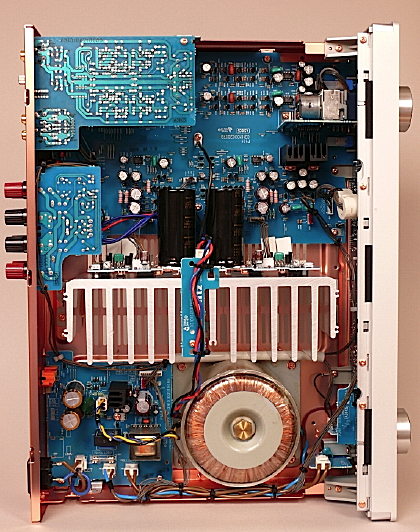
Where do you guys see the High Current in this one? :dunno: Looks plain integrated to me.

marampoffensch420.jpg

Um, that big copper colored thing in the lower right.:D

Although not guaranteed, a toroidal transformer is usually a good indicator of a highly capable power supply - i.e. high current.
 
Where you really start needing a lot of current and heat dissipation is when low impedance meets high electrical phase angle (a result of crossover design decisions).
 
What do you feel its missing, soundwise?

Overall, I would say that my system sounds sterile, it lacks the organic sound that should be present on good recordings. I'd love to hear what a low-powered SET would sound like in my system, but my speakers wouldn't play nice with that type of amp.
 
Overall, I would say that my system sounds sterile, it lacks the organic sound that should be present on good recordings. I'd love to hear what a low-powered SET would sound like in my system, but my speakers wouldn't play nice with that type of amp.

Borrow a tube preamp, see how it goes. :wave:
 
This is the inside view of the aforementioned HK990 - 24kgs and reportedly a real 'joy' to get out of the box :D

hk-990-part-2-fig-1-large.jpg


That's from, arguably, the most detailed 3-part dissection of an amplifier you will read anywhere - Secrets of Home Theater let Dr David Rich loose on the HK and he clearly relished the opportunity. Hopefully HK fixed the equalisation software - in every other respect it seems to be a well-engineered amp and is currently selling for well below the initial launch price.

http://www.hometheaterhifi.com/integrated-amplifiers/integrated-amplifiers-reviews.html
 
A major problem is that peak current is rarely a reported specification, which makes it difficult to compare amplifiers.

In that video, HK describes current as the amplifiers capability to start and stop the loudspeaker. Doesn't the damping factor do the same?
 
Ability to deliver current requires a very low output impedance. For a direct-coupled amp, damping factor = Load impedance / output impedance, so yeah, they are related.

As far as being able to drive a 2 ohm load, hard, all day, few amps can do this. If we define 'all day' as 12 hours, I'd bet that even the amp in Post #12 is going to have an issue or two. But few amps need to be capable of this. The amp can't force current into the load that isn't needed...the load is the determining factor. If you know that your speaker is going to provide an unfriendly environment for an amp, then you'll look for one with a hefty power supply, and multiple output devices for each channel to share the supplied current, as well as large heatsinks and/or forced cooling. And that should be enough, since we don't run our amps into 2 ohm loads, hard, all day. ;)
 
What I find most ridiculous are companies that produce literature that list current specs that may be possible under some very weird test conditions for a few milliseconds, but is impossible to achieve under any real world conditions.

H/K is probably the worst offender of that, but even my B&K amp listed +/-75 amps and there is no way possible for that to ever happen. Even if it could somehow, it won't ever in real world use so it's a stupid spec. It's marketing though, and apparently it helps sell products because the spec looks impressive.
Been like that ever since the FTC was de-regulated - see here.
 
I'm with Steve on this. Only spec you need to see is the ohms rating. If its 4 ohms rated it will survive dips even under 3 ohms. If its 2 ohms or 1 ohm rated, then you can weld your fence with it.
 
I'm with Steve on this. Only spec you need to see is the ohms rating. If its 4 ohms rated it will survive dips even under 3 ohms. If its 2 ohms or 1 ohm rated, then you can weld your fence with it.

Exactly. I don't even own any speakers rated below 6 ohms. Both of my DCM's are rated at 8 ohms, my JBL L80t's are 8 ohms, I'm actually not sure what my Philips driver "mystery towers" are now that I think about, but none of my amps had any issue with them, my Pioneer BS22's are 6 ohms.

I think every speaker I've had, and many are now gone, where 8 ohms. I did have a pair of Cerwin Vega VS-120's that were rated at 4 ohms, but even the Yamaha receiver I drove them with at the time didn't have any issue with them.

Short of some of the more exotic, high end speakers, most typical consumer speakers can be driven by most consumer amplifiers/receivers so even if an amp CAN deal with low impedance, most don't ever have to.

Even Magnepans that are 4 ohms are a fairly easy load to drive.

I guess having an amp that can drive loads below 4 ohms is better than not having one...just in case, but generally speaking, it isn't really needed.
 
Back
Top Bottom