• The move to the new server is done. There are some software and database maintenance updates in process. This has us passing the hat around to help out. We appreciate any donations. Seriously, even a dollar helps. The payment page may be found here - https://www.audiokarma.org/support.html

Why Recap Speakers and When?

To conclude my exercise here, I did end up putting the Solens back in and let them play for 5 hours or so, when I returned the high frequency was there that had been missing. I will admit I still don't undersatnd why a capacitor of this type would require burn in for any period of time. When I think of all the equipment manf. out there I rather doubt they burn it all in for hours and hours, but maybe I am wrong.

I concluded that the Solens in these speakers did not improve any aspect that I could tell and maybe still detracted a slight bit, consequently I put the originals back in the ADS L910's.
 
Is volume a consideration when "breaking in" new caps?

I have a pair of Advent 5002's that will be getting a re-cap pronto. There is a 3 ohm 10% 10w resistor in line with the tweeter. It tests fine. However, there is a bad cap (50v 7mfd) that needs to be replaced before the tweeter works again. Would you recommend replacing the resistor along with the caps or just leave the resistor alone?
 
Would you recommend replacing the resistor along with the caps or just leave the resistor alone?

I asked the same question recently and the consensus answer was to leave the resistors alone.

If I remember correctly, resistance is just resistance, and if an old resistor still tests within tolerance it ought to be okay. Caps are a different story. While old caps may test within tolerance for capacitance, with age they can increase in resistance and that isn't good.

Somebody straighten me out if I haven't got this right.
 
It depends on the material. Ceramic and metal can be left untouched. Carbon types are however noisy lots that can be improved upon by changing them for ceramic. I have had sound problems changing carbon to metal on some speakers for some reason, but ceramic solved the problem. I also found that uprating the wattage on the resistors if you play music loud regularly also made a difference.
Off course perhaps, but I even bolted my cross over on to a heatsink. It makes a difference once you have had the speakers playing for an hour or so.
 
I feel bad about this, I have not read through the whole thread, something I would not normally skip. I promise I will read through the other 10 pages as soon as I can. I am just a little pushed for time as my other half is due sometime in the next week and recapping needs to work around her schedule.

I have a pair of Mission 70MkII ('88 vintage) and I want to recap them, and hopefully pass on the information once I have used mine as guinea pigs. They only have the two caps per crossover, both are "Micro" brand, bi directional 3.3 uF 50v.

I understand (thanks to ESP) that bi directional caps are cheap and prone to fast degradation. Can I replace these with non bi directional (uni directional?) caps? If I can, which way around do I install them? And does anyone have any recommendations? I am not wanting to get the absolute best caps, but a reasonable priced upgrade would be good.
 
I have had time to read through the rest of the thread, and have answered some questions, but have a new question. I can use "polarised" (yay, I no longer sound like an idiot) caps in either direction.

My new question is that since there are two caps in each crossover, I am assuming (please correct me if I am wrong) that one is for the tweeter roll off and one is for the woofer roll off. Will it adversely affect the sound if I accidentally install a cap one direction for the tweeter and the other direction for the woofer? I know that noise cancellation techniques work on out of phase sound waves. I can clearly make out the direction of the earth for one of the caps, but not the other.

Since a reply has take a while, I am off today to get some Solens. The importer is nearby and they are not a horrendous price. That and I can't find anyone nearby who sells any of the other brands listed in this thread.
 
hey there notsure,

polarised caps block current in one direction. the music signal to your speakers is alternating current (AC), in two directions. so you can't use polarised caps in there. you need to get non-polarised or bipolar caps, that pass current both ways. since they are not polarised it doesn't matter which way you put them in.
 
NotSure,
Here's what I did on my Mission 70 MkII's. SOLEN's for the series tweeter cap and the woofer shunt cap. And a Mills MRA5 resistor for the tweeter circuit. Left the woofer cored-inductor alone, as I currently have no way of measuring inductance or DCR of the coil.
 
NotSure,
Here's what I did on my Mission 70 MkII's. SOLEN's for the series tweeter cap and the woofer shunt cap. And a Mills MRA5 resistor for the tweeter circuit. Left the woofer cored-inductor alone, as I currently have no way of measuring inductance or DCR of the coil.

Thanks for the information. It looks like I have the same Solens you got, I have not installed them as I have been busy seeing to my wife and new son... In fact we were in the car ab out to go buy the Caps when she went into labor... so the Caps had to come second... it DID require a five minute conversation about priorities. No SWMBO did not try to convince me to give up my dream of new Caps, she was the one wanting to go get them.


So why did you add the Mills MRA5 resistor?
 
hey there notsure,

polarised caps block current in one direction. the music signal to your speakers is alternating current (AC), in two directions. so you can't use polarised caps in there. you need to get non-polarised or bipolar caps, that pass current both ways. since they are not polarised it doesn't matter which way you put them in.

Thanks for the headsup. I read someone else in this thread who seemed to indicate it was OK to use polarised. The Solens I was looking at were bi-polar by accident anyway, but I double checked before paying for them thanks to your advice.
 
So why did you add the Mills MRA5 resistor?

I replaced the original sand-cast resistor that was in there (a 2.2 ohm I believe). Sonically, it's a better resistor. I get the feeling that our two Mission 70's have slightly different crossovers. I think yours might be a bit later variety than mine.
 
I have a pair of Mission 70MkII ('88 vintage) and I want to recap them, and hopefully pass on the information once I have used mine as guinea pigs. They only have the two caps per crossover, both are "Micro" brand, bi directional 3.3 uF 50v.

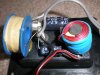
Yep, we definitely have 2 different variations of the "MK II" speaker. So Mission must have changed drivers somewhere in the line. Here's a picture of the original crossover for mine, located on the back of the binding post plate. I rebuilt them at the bottoms of the enclosures for ease of access into the box.
 

Attachments

  • M70 old crossover1.JPG
    M70 old crossover1.JPG
    59.7 KB · Views: 80
  • Back11.JPG
    Back11.JPG
    29.6 KB · Views: 57
Yep, we definitely have 2 different variations of the "MK II" speaker. So Mission must have changed drivers somewhere in the line. Here's a picture of the original crossover for mine, located on the back of the binding post plate. I rebuilt them at the bottoms of the enclosures for ease of access into the box.

Yes they did change tweeter in 88 or earlier. They went to a SEAS tweeter. It was supposed to tame the treble a little. I had only ever heard the SEAS version when I purchased my first pair. They made one last change that I know of later, but it was only adding a vinyl sheet to the inside of the front baffle. My crossovers do not have resistors, the caps are all 3.3 uF, but the rest of the crossover seems the same.
 
OK, question

I've read through ~one quarter of this thread and found some valuable information, but I think I should still ask, so here goes... *deep breath*

I have a pair of Yamaha NS-A100's that I'm considering recapping. They are about 22 years old (1986) and I DO notice some problems with the sound that are constants regardless of what I power them with:

1. Either the left midrange is quieter than it should be, or the right midrange is louder than it should be

2. The right tweeter definitely seems to lack some of its lower frequencies(lower than ~8,000 cycles). The right one seems fine. Again, this might be the opposite, with too much lower frequencies leaking into the left tweeter.

So, does this sound like I need a recap? They are simple crossovers, with an electrolytic in the positive line of each mid and tweet.

EDIT: Forgot to mention that all drivers are cones, if it matters.
 
Last edited:
I've read through ~one quarter of this thread and found some valuable information, but I think I should still ask, so here goes... *deep breath*

I have a pair of Yamaha NS-A100's that I'm considering recapping. They are about 22 years old (1986) and I DO notice some problems with the sound that are constants regardless of what I power them with:

1. Either the left midrange is quieter than it should be, or the right midrange is louder than it should be

2. The right tweeter definitely seems to lack some of its lower frequencies(lower than ~8,000 cycles). The right one seems fine. Again, this might be the opposite, with too much lower frequencies leaking into the left tweeter.

So, does this sound like I need a recap? They are simple crossovers, with an electrolytic in the positive line of each mid and tweet.

EDIT: Forgot to mention that all drivers are cones, if it matters.


Like you, I've read thru the recap threads, and finally decided to bite the bullet. I ordered Dayton 5% poly caps for my Smaller Advents and Wharfedale W-60E's. Both are over 30+ yrs old.

I wasn't too impressed with the 60E's when I first got them, but let them play softly for a few days, and sprayed Deoxit into the mid and tweeter pots, and things improved...still not like I remembered my old 60's (new in '63).

I recapped one of the 60E's today, and was astounded at the improvement..even to my tin ears!! :music: I had daughter's Polk 10A's next to the 60E and the 10A's were definitely better in the bass then the 60E...BUT NOT NOW!! Makes me wonder how much of an improvement the Solens or Jantzen caps would have been :scratch2:

Go for it...unless getting at the caps is a royal PITA :thmbsp:
 
Not too tough to get at, just first-order in-line. The hard part for me will be deciding how to attach the new ones to the wires. :headscrat
 
A quick question for the Re-capping gurus.

I have a new (to me) set of Cerwin Vega D9's. They sound great but to get the bottom end going I need the loudness button engaged and to crank up the bass knob.

With the treble and bass at 0 (flat) they are really anemic.

Crank up the bass and they rock. Is this an old crappy cap problem?

Thanks
 
Back
Top Bottom