Sansui SP-3000 Recap
Thanks to everyone who has contributed to this thread. It has been very helpful to me.
I just recapped my Sansui SP-3000 speakers and I am very pleased with the results.
I am hearing more high frequency response and the bass is more clearly defined. I am hearing more percussive sounds like the “slap” of bass strings in jazz music and more of the harmonics of classical guitar strings than I had noticed previously. With organ and choral music I am noticing more of the reverb and overtones in the performance space. With chamber music and classical guitar, it sounds more like the instruments are in the same room with me.
I used Dayton Precision 1% Metalized Polypropylene caps, which were $54 for the ten caps at Parts Express. I considered using the regular Dayton polypro’s ($30), Solens ($46), and ClarityCap PX Range ($52). The Precision caps have a 1% tolerance versus 10% for the regular Daytons and 5% for the Solens and ClarityCaps. I figured that the quality control that goes into making something with a 1% tolerance just might be worth the extra money.
SP-3000s haven't received very good reviews from some Akers because of weak bass response. I wondered whether investing $54 in caps was “trying to make a silk purse from a sow’s ear.” I’m sure there are better speakers out there, but for the moment with only $82 for the speakers and $54 for the caps invested I think I’m getting my money’s worth. I like the walnut veneer, the wood lattice grills, and the solid construction of the cabinets along with what seems to me to be good musical sound.
Before the recap, I had hooked a subwoofer and a pair of supertweeters to the "B" output of my SX-1050. I would click these on whenever I wanted to hear more top and bottom end. With the new caps, I find that the Sansuis are so much brighter that I don't need the supertweeters and so I've disconnected them from the system. I think I’ll keep the sub for those times when no one else is at home and I want to shake the house. :yes:
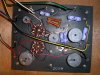
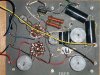
For anyone wanting to recap their SP-3000s, these have a five-way crossover. There are five caps per speaker: two 15μF and one each 3.3μF, 2.2μF, and 0.47μF. The Dayton caps are larger than the old electrolytics, but there is plenty of room for them on the board. The crossover is easy to follow and easy to work on. It's just a matter of desoldering the old caps, prying them up off the board, soldering in the new caps and hot-gluing them down so that they don't rattle around. I broke a couple of the mounting tabs while trying to desolder the old caps. Wrapping and soldering wires directly to the cap leads solved the problem. Following advice on this forum, I didn’t replace the two 3Ω resistors. I did give the L-pads a good cleaning with Deoxit.
I’ve attached a couple of pictures: first of the crossover with the original caps and second with the new caps.