• The move to the new server is done. There are some software and database maintenance updates in process. This has us passing the hat around to help out. We appreciate any donations. Seriously, even a dollar helps. The payment page may be found here - https://www.audiokarma.org/support.html

Wood body Grado cartridges ?

I think any real sonic changes resulting changed wood type indicators a poorly damped arm.
There is a real difference with thr woodies and the glue used itself appears to provide damping too. Changing woods I really doubt does much.
Chris
 
I think any real sonic changes resulting changed wood type indicators a poorly damped arm.
There is a real difference with thr woodies and the glue used itself appears to provide damping too. Changing woods I really doubt does much.
Chris
Van Alstine also used a thick silicone oil on the coils to “pot”. Effective? Who knows.
 
Van Alstine also used a thick silicone oil on the coils to “pot”. Effective? Who knows.
A while ago now I installed a silicone tube inside a Technics arm while rewiring it. Dropping the armtube on a table before it bounced and vibrated like a tuning fork. After it landed with a thunk. Putting a tube on the outside was not nearly as effective due to the effects of constrained damping. I noted that comparing a Technics with an undamped arm and this arm carts were sounding much better on the damped arm which is no real surprise. Two things I am thinking here, one with a well damped arm how much difference does damping the cart make?
Two the glue in the grado is kind of constrained damping so how much differences does changing the wood make and combine this with a well damped arm.
Chris
 
A while ago now I installed a silicone tube inside a Technics arm while rewiring it. Dropping the armtube on a table before it bounced and vibrated like a tuning fork. After it landed with a thunk. Putting a tube on the outside was not nearly as effective due to the effects of constrained damping. I noted that comparing a Technics with an undamped arm and this arm carts were sounding much better on the damped arm which is no real surprise. Two things I am thinking here, one with a well damped arm how much difference does damping the cart make?
Two the glue in the grado is kind of constrained damping so how much differences does changing the wood make and combine this with a well damped arm.
Chris
Right. If I had unlimited funds…and room to do it, I’d have 2 Technics one stock and one to try all these mods. Only thing I’ve done to mine is the KAB damper.
 
Also been speculation the higher mass in front of the cantilever accomplished the same thing Frank Van Alstines longhorn mod did.

I was thinking the same thing. The later, wider ones have more mass further out from center as well as more wood to help dampen resonance. That switch to jarrah though, made for a less attractive appearance but if it improves sound quality, I shouldn’t fuss..
With the maple Opus3, they just left it chunky all the way back..

Anyway, what prompted my questions about their wood selection was because I just picked up another “Reference Platinum” with the old body style - but in what appears to be jarrah, unlike my other one made from mahogany…

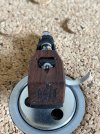
I think this one’s jarrah which looks much more porous than mahogany :

IMG_6026.jpeg


…and I think this one’s mahogany :

IMG_5848.jpeg

I haven’t compared them yet. When I bought ‘em, my intention was to have ‘em both re-tipped with a much nicer needle profile and possibly a boron cantilever too. I’ll have to put them under the microscope first; they’re both supposedly very low hours…


BTW - looking at the spec. sheets and Grado’s site, the old mahogany bodies weigh 6 grams, jarrah with that style body weighs 7 grams, Opus3 weighs 8 grams - and the current jarrah bodies weigh in at 9 to 10 grams, depending on model..!
SO… I think it may be unwise to assume that all Grado woodies require the same tonearm mass (?).

 
Last edited:
I was thinking the same thing. The later, wider ones have more mass further out from center as well as more wood to help dampen resonance. That switch to jarrah though, made for a less attractive appearance but if it improves sound quality, I shouldn’t fuss..
With the maple Opus3, they just left it chunky all the way back..

Anyway, what prompted my questions about their wood selection was because I just picked up another “Reference Platinum” with the old body style - but in what appears to be jarrah, unlike my other one made from mahogany…

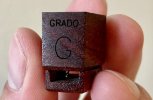
I think this one’s jarrah which looks much more porous than mahogany :

View attachment 3001232


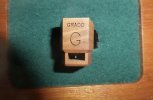
…and I think this one’s mahogany :

View attachment 3001239

I haven’t compared them yet. When I bought ‘em, my intention was to have ‘em both re-tipped with a much nicer needle profile and possibly a boron cantilever too. I’ll have to put them under the microscope first; they’re both supposedly very low hours…


BTW - looking at the spec. sheets and Grado’s site, the old mahogany bodies weigh 6 grams, jarrah with that style body weighs 7 grams, Opus3 weighs 8 grams - and the current jarrah bodies weigh in at 9 grams!
SO… I think it may be unwise to assume that all Grado woodies require the same tonearm mass (?).
I’d not worry about tonearm mass too much. I just did a years worth of swapping between light and heavy headshells. If there was a difference, my brain forgot between swaps. I don’t discount it, but I wonder if you have a damped tonearm..it doesn’t matter so much. I used an old Grado G1 from ‘79 that was still 30+ compliance and a Shure V15Vxmr with a Korf headshell and I heard no ill effects.
 
I was thinking the same thing. The later, wider ones have more mass further out from center as well as more wood to help dampen resonance. That switch to jarrah though, made for a less attractive appearance but if it improves sound quality, I shouldn’t fuss..
With the maple Opus3, they just left it chunky all the way back..

Anyway, what prompted my questions about their wood selection was because I just picked up another “Reference Platinum” with the old body style - but in what appears to be jarrah, unlike my other one made from mahogany…

I think this one’s jarrah which looks much more porous than mahogany :

View attachment 3001232


…and I think this one’s mahogany :

View attachment 3001239

I haven’t compared them yet. When I bought ‘em, my intention was to have ‘em both re-tipped with a much nicer needle profile and possibly a boron cantilever too. I’ll have to put them under the microscope first; they’re both supposedly very low hours…


BTW - looking at the spec. sheets and Grado’s site, the old mahogany bodies weigh 6 grams, jarrah with that style body weighs 7 grams, Opus3 weighs 8 grams - and the current jarrah bodies weigh in at 9 to 10 grams, depending on model..!
SO… I think it may be unwise to assume that all Grado woodies require the same tonearm mass (?).
If you do retip, go the boron too as it makes a very worthwhile difference and the cost is similar for a bigger upgrade.
Chris
 
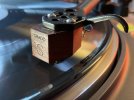
Just got this cartridge today - the jarrah body Reference Platinum. Sounds quite nice to me! Recommended tracking force is 1.5 grams, but I set it at 1.6. I know that some like these woodies a little “tail down” but I started with it level. No Grado dance or hum, just a nice, full-bodied sound. Not as “clinical” as the Audio-Technica I had on here to test the arm.

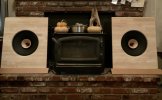
BTW - listening through my new Lii F-15’s, too. I cut the baffles from a table someone put at the curb for trash..
Amazing clarity and detail from these speakers - I should have bought a pair a couple years ago!

IMG_6052.jpegIMG_6029.jpeg
 
I am a total rookie when it comes to cartridges. I joined this forum and a member kindly pointed me towards a really good deal on my current Kenwood KD-770D. In a random act of GREAT luck, it came with this Grado Sonata 1 cart. I can only compare it to my previous cart of decades, as Shure m91, and it's leaps and bounds better. The separation and detail I hear in the midrange and treble is noteworthy and brilliant. I wish I had more adjectives and the lexicon of the other TT audiophiles, but that's my $0.02.

x8J3lDn.jpg

8xlDwIx.jpg
 
I am a total rookie when it comes to cartridges. I joined this forum and a member kindly pointed me towards a really good deal on my current Kenwood KD-770D. In a random act of GREAT luck, it came with this Grado Sonata 1 cart. I can only compare it to my previous cart of decades, as Shure m91, and it's leaps and bounds better. The separation and detail I hear in the midrange and treble is noteworthy and brilliant. I wish I had more adjectives and the lexicon of the other TT audiophiles, but that's my $0.02.

x8J3lDn.jpg

8xlDwIx.jpg

Excellent table, looks in great shape.

Haven't tried any Grado cartridges on mine, have used a Denon DL-301, the MKII also. Thought it happier with carts a bit less compliant so now running a Frankenstein Clearaudio Concept V2 with an ATVMN95ML stylus with good results.

IMG_20230710_224746851.jpg

Screenshot_20230710-214850.png

My wood body Grado is with Joseph Long waiting for surgery when it returns I'll have to give it a listen. These carts just seem to sing, it would be nice if it's an optimum pairing, my other option would be replacing the Grace on the Grace G707 arm..........
 
Last edited:
I have never understood why Sapphire and ruby cantilevers continued when boron was available again. Sapphire and ruby are heavier and less stiff than boron, actually they are even heavier than simple aluminium cantilevers so they are not great at all as a cantilever material which needs to be stiff and light.
Chris
My experience is that sapphire or ruby is more delicate, than boron. After the last snapped cantilever, no more for me.
 
I am a total rookie when it comes to cartridges. I joined this forum and a member kindly pointed me towards a really good deal on my current Kenwood KD-770D. In a random act of GREAT luck, it came with this Grado Sonata 1 cart. I can only compare it to my previous cart of decades, as Shure m91, and it's leaps and bounds better. The separation and detail I hear in the midrange and treble is noteworthy and brilliant. I wish I had more adjectives and the lexicon of the other TT audiophiles, but that's my $0.02.

x8J3lDn.jpg

8xlDwIx.jpg
Great cartridge. Although that looks to be Mahogany wood,…which would make it a Sonata. Sonata 1’s went to Jarrah wood which is much darker. You can confirm by looking at the bottom. Black plastic stylus grip will be inscribed with an S, or S1.
 
I wonder what changes to the “1” were made besides the switch to jarrah wood (?).

The Reference Platinum I received yesterday has the jarrah body and “P1” inscribed. My mahogany body RP has only “P” inscribed. While I like the look of the older mahogany best, it seems that the newest Series 3 Grados may really be the most improved..

@Sgt Shultz - I’d really like to know what you think of your re-tipped Platinum when it returns from Joseph!
 
My experience is that sapphire or ruby is more delicate, than boron. After the last snapped cantilever, no more for me.
No they are much heavier and not as stiff as boron ( cantilever indeed to be stiff and light). Density of boron is just over 2 and ruby and Sapphire are over 4 so they are twice as heavy not good.
Chris
 
Last edited:
No they are much heavier and not as stiff as boron (cantilever indeed to be stiff and light). Density of boron is just over 2 and runs and Sapphire are over 4 so they are twice as heavy not good.
Chris
I mean "delicate" as in handle with care.
 
Back
Top Bottom