• The move to the new server is done. There are some software and database maintenance updates in process. This has us passing the hat around to help out. We appreciate any donations. Seriously, even a dollar helps. The payment page may be found here - https://www.audiokarma.org/support.html

Yamaha CR-1020 LED Upgrade: Paradise by the Dashboard Lights

reydelaplaya

Super Member
Done, done, and done.

Just finished reconnecting everything after pulling my CR-1020 out again, this time for a LED upgrade.

The last of my lamps gave out the other day so I ended up ordering a set of 20 3mm, 12V pre-wired, pre-resistored, soft white LED bulbs from a seller on Amazon.

They came in today, and have now been installed.

At first, I just replaced the 5 standard bulbs.
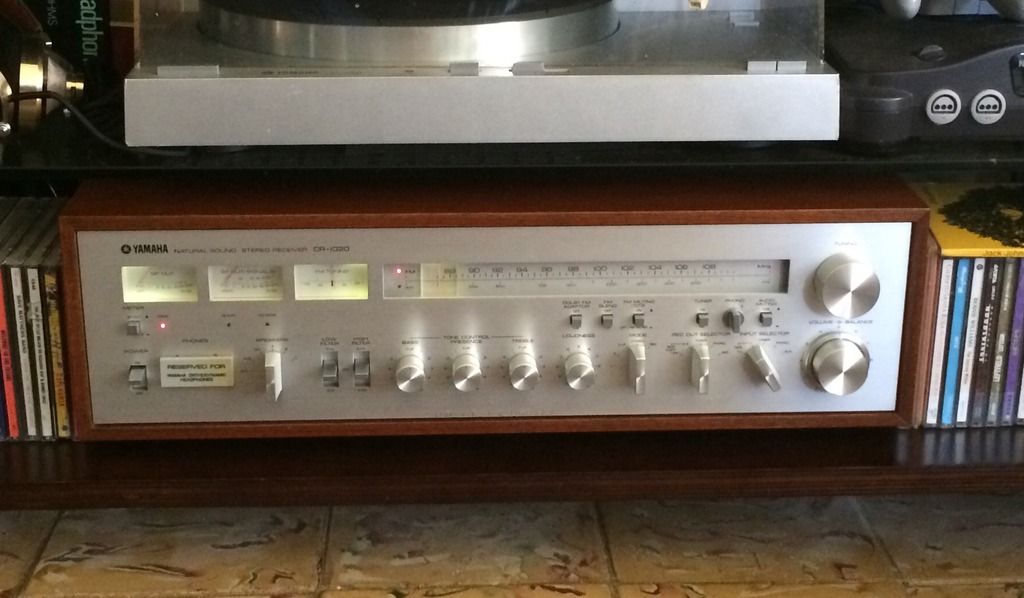
761E2EB9-B483-46D9-9280-E234763A6FFB_zpssyo1qf1u.jpg


But once I saw how it looked, I decided it needed just one more thing.

Since I don't have Yamaha's bean-counters peeping over my shoulder, I decided to do what I'm certain the techs wanted to do but got told no.

I lit that dial...

E27A10AA-2A62-4C61-A703-6E36A47BB3AF_zpsmhxhalxx.jpg


It looks much better in person than it does in that photo, but you get the idea.

Using the concept behind fiber optics, I put two more LEDs on opposite sides of the dial panel glass aimed at the edges so it would softly carry through.

The pics do not do it justice.

8A55650F-B5E9-40EF-8AB5-CCB132410961_zpsjkong7wk.jpg


While the pointer is still that same soft green hue as the meters, the brushed aluminum lights up a really nice tan.

99F138D6-FB9F-42CD-A346-63A81AB5E7D8_zpsec4hfenf.jpg


Totally worth pulling it out yet another time to finish that off.
 
Last edited:
Register to hide this ad
I have also experimented with Yamaha's and used Green LED's I used them primarily in the Yamaha 40 series, but they sort of transform the 20 series to green light like to 40 series.
I have also put Green LED's into some Pioneer Silver face units and it makes them look super.But then again I am Irish, so maybe I "Just
Like Green"

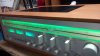
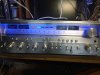
Yamaha 2040 done.jpg pioneer sx-980 blue led.jpg SX-780 Front.jpg
 
While adding 12 v LED's to a unit that used 8V ac lamps will work, many times you can wind up with a little flashing as well as less than desired LED intensity, especially when working with the Blue type. I have found nice inexpensive DC-DC step up power supply boards on the "bay" that work great. I use these boards and connect a 2 amp bridge rectifier (+ and -) directly to this new power supply board, and connect the original 8v ac wires to the ac legs of the bridge rectifier. I then connect a set of wires from the output of this board to the lighting panel board connections where the original 8v ac wires went to. There is a small trimpot on the board that allows you to adjust the DC output to the optimal 12vdc for the LED's, or just dial it back to 8v if you decide to put bulbs back in it.
Here is a listing for an upgraded up converting PS with an on board voltmeter, that even has mounting hardware for $8 shipped. DC-DC 100W 3-35V 12V to 3.5-35V Boost Step-up Power Supply LED Voltmeter N144
 
While adding 12 v LED's to a unit that used 8V ac lamps will work, many times you can wind up with a little flashing as well as less than desired LED intensity, especially when working with the Blue type. I have found nice inexpensive DC-DC step up power supply boards on the "bay" that work great. I use these boards and connect a 2 amp bridge rectifier (+ and -) directly to this new power supply board, and connect the original 8v ac wires to the ac legs of the bridge rectifier. I then connect a set of wires from the output of this board to the lighting panel board connections where the original 8v ac wires went to. There is a small trimpot on the board that allows you to adjust the DC output to the optimal 12vdc for the LED's, or just dial it back to 8v if you decide to put bulbs back in it.
Here is a listing for an upgraded up converting PS with an on board voltmeter, that even has mounting hardware for $8 shipped. DC-DC 100W 3-35V 12V to 3.5-35V Boost Step-up Power Supply LED Voltmeter N144


Thanks for the info on the step-up, but at least I got a little lucky there.

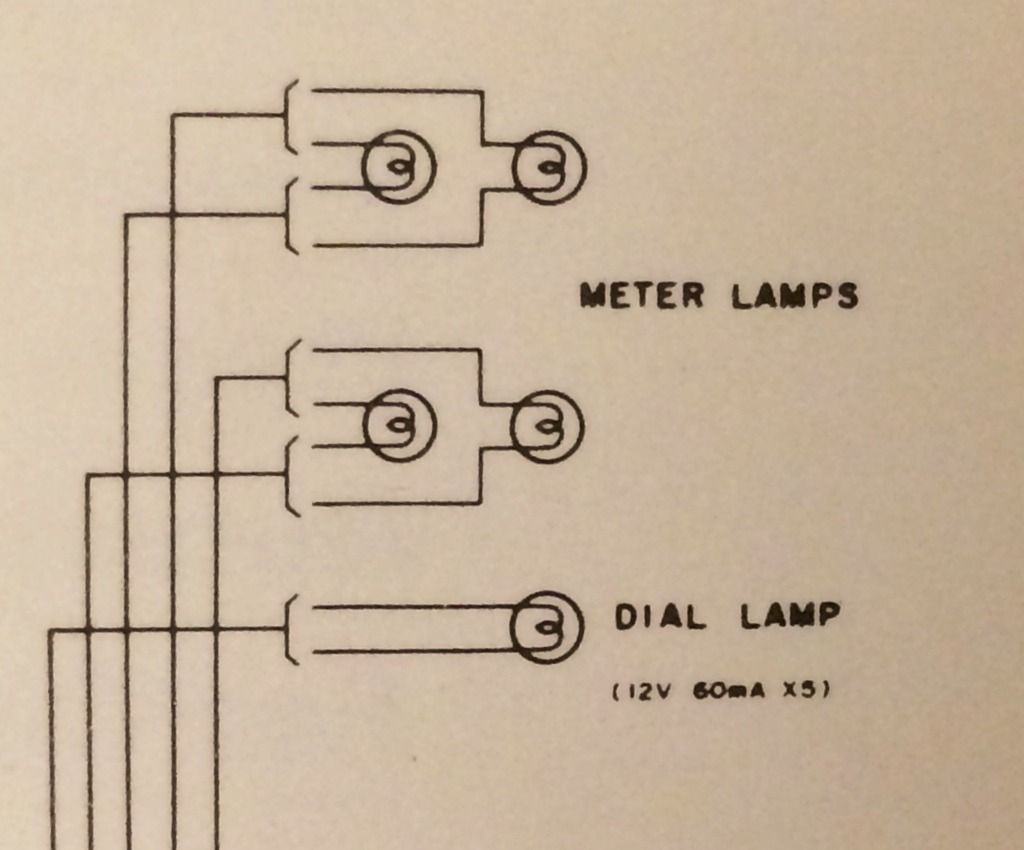
According to my owner's manual schematic, all five of my lamps are 12V and I'm pretty sure DC, though not 100%.

8E06A820-4250-4BD1-8DF7-B71E91A8D94D_zpsqggcv9f6.jpg


The lamps I used are these:

Lighthouse LEDs 20 x 3mm 12v Pre-Wired Warm / Soft White LED - Ultra Bright (10v, 11v, 12v, 13v, 14v, 15v) https://www.amazon.com/dp/B00TA4IZCM/ref=cm_sw_r_cp_awd_z6H9wbGR4G9XR

As per your prior post, look how good the CR-1040 looks with its dial factory lit - even in different colors. I still don't understand why Yamaha didn't do the same with the '20' series. Just taping two LEDs on the inside of the faceplate to light it looks fantastic, I'm sure they could have done an even better permanent installation from the factory. At 60mA each lamp, I'm sure it wasn't to cut back on energy usage - had to be the accounting dept. :dunno:

But regardless, I love how it looks now, but I may need to get back in there and take some sandpaper to those two LEDs as well. I lightly sanded the outer shell of the other five to get better light dispersion from them, making them less directional. I'll probably do the same to these because now that I've seen it in the dark, there is a little unevenness and a light/shadow cast on my floor in front of the receiver.

No harm in tinkering I suppose - I did buy a 20-pack to have extras to play with.
 
On the LED upgrades to various xx40 series receivers I tried a variety of LEDs including various green LEDs. What I ended up with were warm white LEDs covered with the original green rubber bulb covers. I used wide angle LEDs that I sandpapered. This looks closest to the original as you might expect.
 
Thanks for the info on the step-up, but at least I got a little lucky there.

According to my owner's manual schematic, all five of my lamps are 12V and I'm pretty sure DC, though not 100%.

8E06A820-4250-4BD1-8DF7-B71E91A8D94D_zpsqggcv9f6.jpg


The lamps I used are these:

Lighthouse LEDs 20 x 3mm 12v Pre-Wired Warm / Soft White LED - Ultra Bright (10v, 11v, 12v, 13v, 14v, 15v) https://www.amazon.com/dp/B00TA4IZCM/ref=cm_sw_r_cp_awd_z6H9wbGR4G9XR

As per your prior post, look how good the CR-1040 looks with its dial factory lit - even in different colors. I still don't understand why Yamaha didn't do the same with the '20' series. Just taping two LEDs on the inside of the faceplate to light it looks fantastic, I'm sure they could have done an even better permanent installation from the factory. At 60mA each lamp, I'm sure it wasn't to cut back on energy usage - had to be the accounting dept. :dunno:

But regardless, I love how it looks now, but I may need to get back in there and take some sandpaper to those two LEDs as well. I lightly sanded the outer shell of the other five to get better light dispersion from them, making them less directional. I'll probably do the same to these because now that I've seen it in the dark, there is a little unevenness and a light/shadow cast on my floor in front of the receiver.

No harm in tinkering I suppose - I did buy a 20-pack to have extras to play with.

You are correct, The pioneers are the ones I typically put the power supply in. The Yamaha's don't need the PS, but you may want to put a small value resistor in series with the lamps if needed. I know that when I LED Converted the 40 series, which used bulbs paired in series, the voltage across each LED was up at like 14.5v. So I put a resistor in series to drop the voltage to ~ 11.5v (The rating on the 40 series bulbs is 14.5v
 
Well, I've pulled the dial lamps for now.:(

After another afternoon trying to get the light more balanced, even going as far as removing the faceplate (including the dial string - which was not exactly fun re-stringing), I've determined that it'll almost work, but it's too off for my OCD to accept.

So it's back to the original five for now.

We'll see if I end up pulling it again tomorrow and putting them back in.

Probably...

Especially now that I've seen it lit, and now it's dark again...
 
Back
Top Bottom