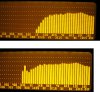
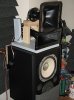
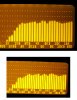
Find the frequency where the wavelength of the sound wave is equal to the smallest dimension (usually the width) of the baffle. That will be the point where the center of the woofer (if centered on the baffle) will be 1/2 wave away from the outside edge of the cabinet. At any frequency lower than this, the wavelength will be BIGGER than the baffle dimension, and the sound waves will no longer be "supported" by the baffle... they will 'wrap around' the cabinet, which will reduce the effective output to the front of the speaker.
In scientific terms, we call this the "2-pi to 4-pi radiation transition frequency". In layman's terms, it the frequency where the bass drops in level because of the loss of baffle support. In short, it's known as the "baffle step frequency"... because, if you graph it, it looks like a "step" in the response curve at that frequency.
Fortunately, it's about a 6 dB step, in theory... pretty much equivalent to the output of a second woofer added in parallel to the first. So, if you pick a crossover frequency for the second woofer EQUIVALENT to the frequency where the baffle is 1 wavelength wide... you will be in the ballpark.
IME, I've had good luck with a sort of modified approach. Tune both woofers to an EBS vented (long-tail rolloff vented box) or low-Q (near Qtc of .5 or so) sealed alignment, and use a lower frequency lowpass crossover on the .5 woofer (about 1 octave below baffle-step). This makes for a more subtle baffle-step compensation... more like 2-3 dB rather than the full 6 dB. I find this works better for speakers in real rooms... where the speaker is still somewhat "supported" below the baffle step by proximity to a wall behind the speaker cabinet (which "restores" to an extent, the 2-pi baffling effect below the nominal baffle step frequency of the cabinet)...
In short... there's no hard-and-fast rules on what will sound best in your particular ".5 woofer" setup... but these will give some good guidelines on where to start...
Regards,
Gordon.