• The move to the new server is done. There are some software and database maintenance updates in process. This has us passing the hat around to help out. We appreciate any donations. Seriously, even a dollar helps. The payment page may be found here - https://www.audiokarma.org/support.html

Zilch's AK Design Collaborative - Econowave Speaker

I think many of you guys are starting to really get this stuff, but I think it's worth maybe reiterating some points just to be clear. Some people are new to the concepts, so maybe it wouldn't hurt to touch on the basic principles and go through the bases.

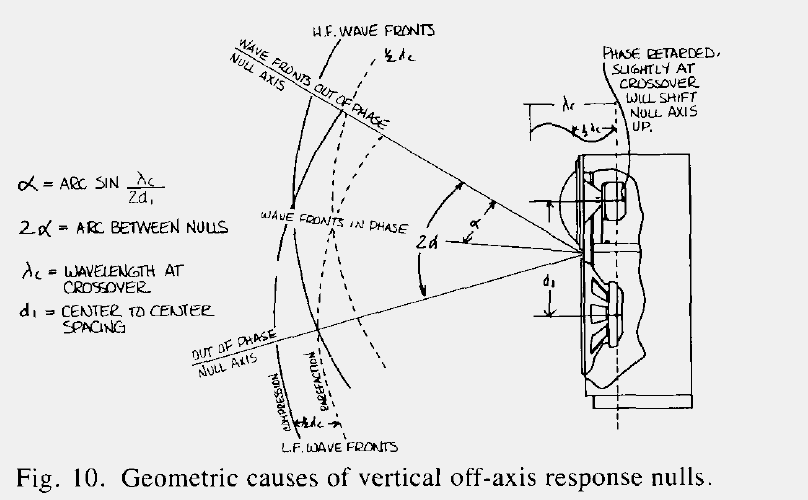
The center of the forward lobe is (or should be) where woofer and tweeter are in phase. Their phase relationship is determined by the electrical phase of the crossover, the electro-mechanico-acoustic phase of the drivers and horn and the physical relationships to one another. The physical relationship is set not only by the vertical position on the baffle but also the depth, which sets the distance to the listener, creating a fixed delay.

Each driver is some distance from the listener, which introduces a fixed delay. The electrical crossover and the electro-mechanico-acoustic features set the phase, which represents a delay that changes with frequency. The two things are not the same, but if frequency is fixed, then the phase is also fixed, meaning the delay is too. So at a specific frequency, phase has a fixed delay that can be compared to the fixed delay of path length. Similarly, over a narrow frequency band, phase changes are small and so delay changes are also small. The long and the short of it is crossover phase can be used to sort of offset path length differences over a small audio band, where phase shift is within range. This fact is used when designing crossovers in speakers like ours, it is how you set the position of the forward lobe.

The thing is, if the crossover phase and path length differences combine to bring the sound sources in phase straight in front of the speaker, then you can expect the vertical nulls to line up pretty much where you expect them to be. But if the phase shift is a complete cycle (or multiple cycles), then what is straight in front of the speaker is actually a minor lobe, which is generally smaller than the major lobe. You can sort of get the response to be OK, but the nulls will appear to be abnormally close. So be careful of that when designing and measuring your speakers.

You can use the Altec procedure of reverse connecting the speakers and looking for a null straight out in front, but be aware that you'll see a null at odd multiples of 180°. Every odd half-cycle shift will create a null. So if the woofer and tweeter are in phase and youy reverse connect them, you'll see a notch. But this will also happen if the woofer and tweeter are 360° out of phase - a full cycle shift. Reverse the connections and you'll see a notch. This can sometimes make you think you are in phase when you are really a full cycle out.

Say you set everything up, do the Altec reverse-connection thing to put the notch straight out front, then connect properly and measure polars. If you find nulls aren't where you expect them to be from the CTC spacing and frequency, then there's a good chance there is a full cycle or maybe even a multi-cycle shift between sound sources. Again, if that's what you're seeing, then what's straight in front of the speaker is actually a secondary minor lobe, which is much smaller than the major lobe. The major lobe is probably way off somewhere above or below the speaker.

A long time ago, I used to calculate the crossover phase and estimate the electro-mechanico-acoustic phase of the drivers. As some of you have rightly stated, the wavelength of 1.6kHz is 8.5". The wavelength of 1.2kHz is 11.3". So a physical offset of half those amounts will introduce a half-cycle shift, as will a 180° phase shift, be it from electrical crossover or electro-mechanico-acoustic phase from a horn or direct radiator in a box.

Hornresp will show the phase of the horn and box modeling tools will show the phase of direct radiators, so you can simulate the system and include the predicted phase in your calculations. That's what I have done, and then combine the physical offset to estimate the phase of the sound sources. When I begin a new system, I do this initially, and even with measurement equipment, it still is nice to know the phase, at least approximately, to know where to start. Measurements can be used to fine tune the system, changing component values a little bit to slightly adjust the phase to get the position of the forward axis and vertical nulls just right.

 
Tonight I opened the B-Waves back up, added bracing, and made them (hopefully) airtight. Oh, and I straightened the binding posts. Listening to them, I heard a definite improvement in the bass, as the previous peakiness was gone. However, I think I detect a peakiness in the midrange--I'll have to run a sweep to tell for sure. Anyway, percussion sounds more, well, percussive. I listened to a little Bela Fleck and the Flecktones, and Vic Wooten's bass sure sounded good. So did Marcus Miller in the next song.

I think this calls for a period of serious listening...:music:
 
...

Say you set everything up, do the Altec reverse-connection thing to put the notch straight out front, then connect properly and measure polars. If you find nulls aren't where you expect them to be from the CTC spacing and frequency, then there's a good chance there is a full cycle or maybe even a multi-cycle shift between sound sources. Again, if that's what you're seeing, then what's straight in front of the speaker is actually a secondary minor lobe, which is much smaller than the major lobe. The major lobe is probably way off somewhere above or below the speaker....

Wayne,
I understand the angle of the forward lobe is set at a specific frequency by electro-mechanico variables. But the nulls are fixed by crossover frequency and CTC spacing. So if the arc is pointing up, the nulls might chop it into two lobes, one might be minor and forward whereas the other could be facing the ceiling and major. Do I have a grab on this?
 
Nulls always mark the edges of lobes. If crossover phase or horn depth moves the forward (major) lobe up a bit, then the nulls move with it. The major lobe will be pretty much the same size, it's just that it can be moved around a bit with slight adjustments in crossover phase or fore-aft movement of the horn.

If you go too far with this, it stops working though. Once you've shifted the forward lobe up or down enough, what's really in front of the speaker is either a null or a secondary lobe, which isn't very wide at all. Once you've gone that far, speaker performance is poor because the sound field in front of the speaker is a mess, almost any movement at all changes the response radiacally.

This is why some horns are so problematic to work with. You can talk all day long about the virtues of the horn (by itself), good pattern control, nice time and amplitude response, etc. But if it can't be combined in a loudspeaker system without running into these kinds of problems, it's a white elephant.
 
Thanks for pulling together the lobe/nulls issue

We've been picking at these issues from the edges trying to answer questions as best we can as they come up but it's great to have a comprehensive explanation, with references no less. Thanks again Wayne for your patience and invaluable contributions. Nothing beats a clear explanation of a complex concept to give people confidence.

I'd like to point out that in the diagram posted by Skywave the vertical dashed line through the drivers is supposed to represent alignment of the drivers. This is somewhat deceptive, as what is really significant is the acoustic center of the driver. Zilch pointed out that the acoustic center is not easy to determine and may actually change with frequency.
 
I don't want to do your math. And you wouldn't want me to. :D
For those following who weren't here for the baffle spacing/nulls discussion, remember that the forward lobe is the arc between nulls as you see in this pic.
Vertical_Null_Angles.gif

That lobe can be pointed straight ahead, up or down. So "taller" is confusing, to me at least. Wider or narrower characterizing the arc is better I think.

My tree cents.
http://www.pispeakers.com/AES_v31_n6_p408.pdf

Thanks Skywave, I've never seen that particular illustration, or have forgotten it. It appears to be the JBL 4430 ( or maybe 4425 ) in the illustration there!

P.S. Once I read the PDF, i do remember seeing this document before.

Russellc
 
Last edited:
Cheap cabinet option?

I'm always looking for off the shelf cabinets for things and I ran across this while looking for parts for another project.

It's an Ikea cabinet that's about 12" X 12" X 30", or about 2.4 cu ft inside. There's no front and the back is flimsy cardboard. It seems like you could make a single speaker cabinet from 2 of these cabinets pretty easily:

1) build the basic cabinet with no back.
2) use a 'side' from another cabinet as a new back.
3) use a 'side' to make a front baffle.
4) use a 'top', cut out, as a shelf brace
5) use a 'bottom' to cut up to make full-depth angled legs with a brace between them.
6) put the terminal cup on the bottom hidden behind the legs brace.

The cabinets are $22 each, so a pair of speaker cabinets could be made for $88 + tax. The material is .75" particle board, which is not as strong as MDF but a shelf brace should stiffen it up considerably.

The P.E. DC 12" works well in this size enclosure sealed and should go down to the 40s at the bottom end.

The width is 11.875", which should match well with a 12" driver and the PH612 WG. The woofer needs an 11" cutout, which would be close.

The P.E. DC 8" will work in this box ported and tuned to around 30 hz.
 
I used to move two cars out of the garage, and set up my listening and testing area in the space vacated, leaving the garage doors open. But lately, it is easier to just test in a smaller area near my office door. Maybe that accounts for a lot of the problems I have been having making meaningful measurements. Five feet away on one side is a shop sink, behind that a base which has the heater and air compressor sitting on it. On the other side about four feet away is my office door, and a work area sitting in a corner. Five feet in front of the speakers is my car, a refrigerator, and Myrna's SUV. A very hard environment, and extremely lumpy. Most of it is very difficult to move.

I have found when testing speakers laying on their backs (measuring the vertical nulls), the measurements are much more consistent, and moving the microphone a few inches is not nearly as significant as when they are standing on the floor. The garage has a ten foot ceiling, putting it around nine feet from the baffle. A large null at about 100-200 Hz is probably caused by the reflections from the ceiling, but everything else seems much more stable.

Is there any reason not to test with the speakers laying on their backs? I cannot see why this would not be a better way to utilize my space than fighting them standing on the floor broadcasting into all of the obstacles around them.
 
That's 2-Pi alignment with boundary reinforcement augmenting the bass response, and probably not significantly affecting the high frequencies, but whatever is off to the four sides is still generating reflections. Try it outside to see the difference, like standing normally in front of the garage door. Door up is 2-Pi, door down is 1-Pi, ground and door comprising two boundaries.

If it's relatively quiet out there, you also have the potential to do ground-plane measurements in the driveway, as well.... :yes:
 
Last edited:
The HD-77 is a good box but I don't really consider them restoration material. Others may disagree. I think I paid $150/pair 30 years ago.
There are advantages to having the waveguide as close to the woofer as possible, having to do with interference nulls in the crossover region and center-to-center distance.
Google 'econowave' and 'arcsin' to find the discussion and the math on that.

Should I keep the ports in the new boxes?

Should I try and find a mate to the one 77 driver that I have? I have one right now.

Thanks again!:music:
 
Didn't mean to slight the new stuff, I am just in a VERY cost consciencious mode now. The original is SUCH a GREAT DEAL. And of course the performance is amazing.

I'm in the same boat. I've wanted to build a set of speakers for my music room but my wife stays home with our 3 year old and we have another on the way in January. I really like what I'm reading in terms of musical clarity. I've heard soooo much about horns so this will be my first venture in that direction. Looking forward to it. I'll post pics when the build begins.

Thanks for the encouragement everyone!
 
heh. Imagine my surprise, sittin' on a plane en route to Charlotte, NC this morning, reading my latest copy of Make magazine... what should I espy but an article by Bauhausler on the titular heroes of this thread! Pretty durn cool.

Welcome to my neck of the woods! Charlotte is a great place!
 
I'm in the same boat. I've wanted to build a set of speakers for my music room but my wife stays home with our 3 year old and we have another on the way in January. I really like what I'm reading in terms of musical clarity. I've heard soooo much about horns so this will be my first venture in that direction. Looking forward to it. I'll post pics when the build begins.

Thanks for the encouragement everyone!

You will not be disappointed, and the price is very reasonable. The entire Selenium driver costs less than most diaphragms, except its own of course.

russellc
 
Well, I finally had a chance to really turn up the B-Waves. (As in, the wife was out shopping, and the kids were out playing.) I also hooked up my Kenwood KA-8100 amp, a combination which I had been wanting to try. My first impression is that these speakers can move a lot of air. And, an estimated 20 to 30 watts of output is sufficient to vibrate furniture, even couch cushions! The bass is rich and full, especially the all-important low bass. These speakers have absolutely no trouble with anything I've tried to play. However, the low-mid peak is still there, but not as noticeable as before. I'm perfectly willing to believe, though, that the room could be interfering.

Another thing I noticed is that at high volumes there's considerable breakup in the HF driver. Or so it seems. I tried several different sources, and it seemed to be present with each. If I was really scientific, I'd hook up a different amp to test, but I have neither the time nor inclination to do so. The hash was only present at high volumes, well above what I would normally listen at. Is this a normal phenomenon in new Ti drivers, or something I should be concerned about?

I'm trying to find the "perfect" amp to pair with these speakers. It's the Kenwood's turn to see what they can do!
 
Nube question here.

As far as measuring goes would it be possible to make panels with duct board or fiberglass on the inside to absorb first reflections? they could be positioned to allow the width and height of the measurement field?:dunno:

I also have hard areas but the walls of my shop have sound board on them instead of drywall. Just thinking :scratch2:

Edit: My ceiling is open as well so I wonder what the effect is with this as well. here are some pics
 
Last edited:
...However, the low-mid peak is still there, but not as noticeable as before. I'm perfectly willing to believe, though, that the room could be interfering....

I tried to find your original B-Wave post in this thread but failed. Do you have stuffing in the box? Maybe a cabinet resonance?

Too low in frequency for upper-end woofer response problem that a Zobel would fix....
 
Should I keep the ports in the new boxes?

Should I try and find a mate to the one 77 driver that I have? I have one right now.

Thanks again!:music:

The original speakers were sold with plugs for the ports so they could be used sealed or ported. If you keep the original woofers try it both ways before deciding what works best.

First you have to find out if the original woofer will work for ewave. It will have to have decent output up to 1600 hz. Since the original speaker had a cone midrange and a complex 4-way crossover it's unlikely that the woofer was used that high by Marantz. Probably the only way to find out is to test it.
Or decide to change to a woofer that will work in that cabinet and is known to perform well with the ewave top end.
 
Another thing I noticed is that at high volumes there's considerable breakup in the HF driver. Or so it seems. I tried several different sources, and it seemed to be present with each. If I was really scientific, I'd hook up a different amp to test, but I have neither the time nor inclination to do so. The hash was only present at high volumes, well above what I would normally listen at. Is this a normal phenomenon in new Ti drivers, or something I should be concerned about?
Several builders have noted this, in the same context, well beyond the levels where they would normally listen. The Selenium drivers provide more extended VHF response than many others, and if we take advantage of that with HF compensation as in eWave, there are limits to how hard they can be pushed without protest.

As far as measuring goes would it be possible to make panels with duct board or fiberglass on the inside to absorb first reflections? they could be positioned to allow the width and height of the measurement field? :dunno:
Yes, but like typical room treatments, they are frequency selective; fiberglass panels must be quite thick (like 4" - 6") to provide broadband absorption, and in any practical thickness, they will still not damp the low frequencies.

The best answer when measuring with RTA in my experience has been to accept that you are measuring "in-room" response with the known consequences "reflected" in the results. With time-windowed methods like MLS and gated sinusoidal, you can cover 200 Hz and above quasi-anechoically without such treatments, though it doesn't hurt to use them. Read up in Dickason Loudspeaker Design Cookbook and D'Appolito's Measuring Loudspeakers. Your vaulted ceiling is an advantage, actually, as its reflection will arrive later than those coming from the sidewalls and floor.
 
Last edited:
Back
Top Bottom